Welcome to the Stillroom cocktail glossary. From the classic techniques every bartender must master to the laboratory processes that define contemporary mixology, here you’ll find every term, ingredient and method explained with technical precision.
This glossary is born from the Stillroom philosophy: recovering the ancestral knowledge of the seventeenth-century British stillrooms —where spirits were distilled, tinctures prepared and botanicals experimented with— and fusing it with the most advanced techniques of modern cocktail making.
Each definition is a doorway. The linked terms will take you to full guides where we go deeper into history, practical applications and specific recipes.
Glossary Index
- 1. Classic Cocktail Techniques
- 2. Advanced and Laboratory Techniques
- 3. Cocktail Families
- 4. Base Spirits
- 5. Liqueurs and Modifiers
- 6. Technical Ingredients
- 7. Bar Tools
- 8. Glassware
- 9. Service Terminology
1. Classic Cocktail Techniques
Mastering these techniques is the foundation of all professional cocktail making. Every method exists for a specific reason: the type of ingredients, the desired texture, the optimal temperature and the correct dilution determine which technique to apply. An expert bartender instinctively chooses the right method for each recipe.
Build
A direct-preparation technique where ingredients are poured sequentially into the serving glass, with no need for a shaker or mixing glass. It’s used for cocktails that don’t require vigorous integration: typically long drinks with soft drinks or tonic. The build order matters: ice first, then the base spirit, then the modifiers, and finally the mixer or top. Classic examples: Gin and Tonic, Cuba Libre, Whisky Highball.
Stir
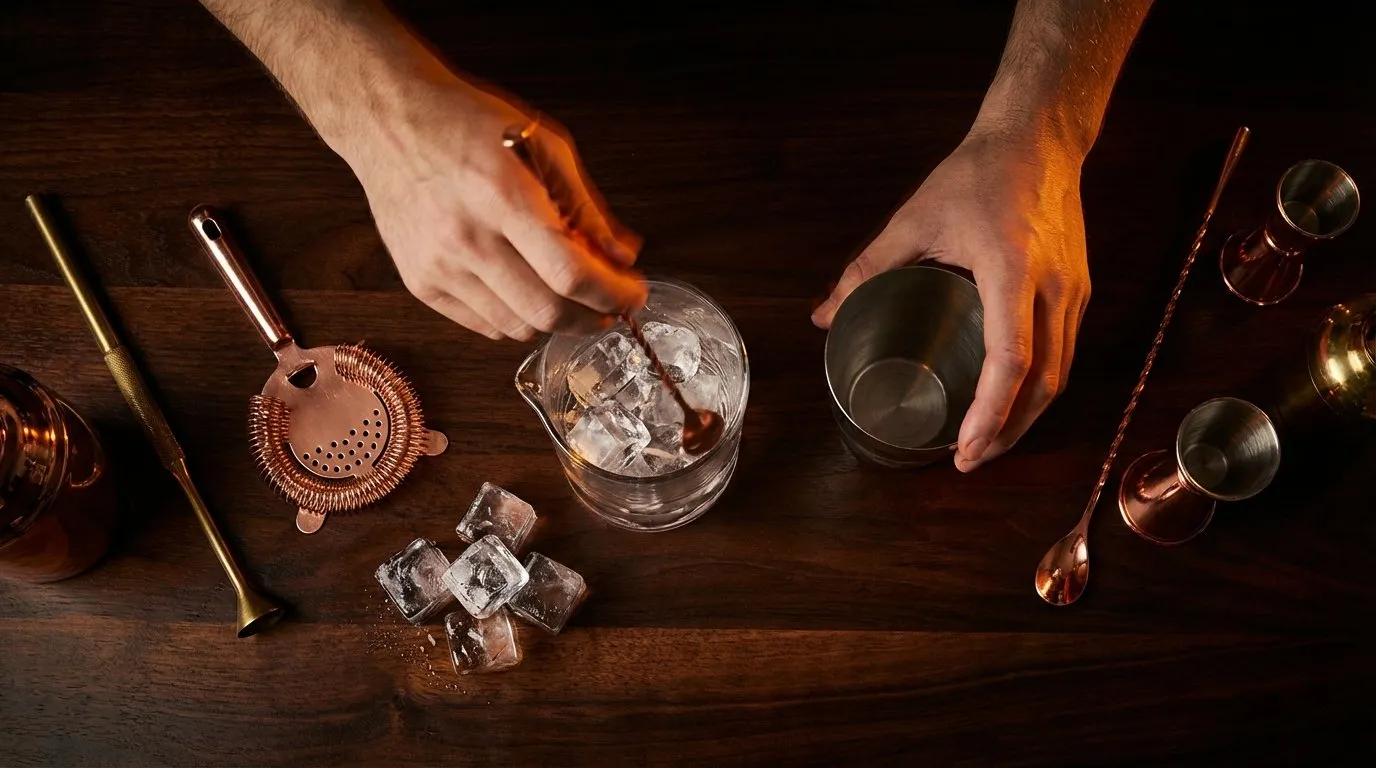
A gentle mixing method carried out with a bar spoon inside a mixing glass with ice. It’s applied to cocktails made up solely of spirits and liqueurs, where the goal is elegant integration, controlled dilution and chilling without aeration. The movement should be circular, hugging the walls of the glass, for 30-45 seconds. It preserves the silky, crystalline texture of the liquid. Classic examples: Martini, Manhattan, Negroni, Old Fashioned.
📖 Full guide: Stir — how to stir a cocktail — find out more here →
Shake
A technique of vigorous shaking in a shaker with ice. It’s used when the cocktail contains citrus juices, syrups, creams, egg or other ingredients of differing density that require vigorous integration. The shake chills quickly, dilutes in a controlled way, aerates the mix and emulsifies the components. It’s carried out forcefully for 10-15 seconds until the shaker frosts over on the outside. Examples: Daiquiri, Margarita, Whisky Sour.
📖 Full guide: Shake — how to shake a cocktail — find out more here →
Muddle
A pressing-and-twisting technique with a wooden or plastic muddler to extract essential oils, juices and aromas from fresh ingredients directly in the glass or shaker. The pressure should be firm but controlled: with herbs such as mint, you press gently to release oils without turning them bitter; with fruit, you muddle more intensely to extract juice. It’s never crushed to the point of disintegration. Examples: Mojito, Caipirinha, Smash.
📖 Full guide: Muddle — find out more here →
Dry Shake
Vigorous shaking without ice, used specifically for cocktails with egg white or aquafaba. The aim is to emulsify the proteins and create a dense, stable foam before adding ice. After the initial 15-20 second dry shake, ice is added and a second shake is carried out to chill and dilute. This technique guarantees the creamy texture characteristic of foamy sours. Examples: Whisky Sour, Pisco Sour, Clover Club.
📖 Full guide: Dry shake — find out more here →
Reverse Dry Shake
A variation on the dry shake where the order is reversed: it’s shaken with ice first to chill and dilute, the liquid is strained, and it’s then shaken without ice to foam up. Some bartenders prefer this method because it produces a denser, more consistent foam by working the proteins once the liquid is already cold. The result is a more defined, visually superior foam layer on the surface of the cocktail.
Whip Shake
A brief, intense shake using only a few small ice cubes or crushed ice that dissolves almost completely during the process. The aim is to chill and dilute quickly without over-shaking. A technique common in tiki cocktail making for drinks that will be served over crushed ice and need controlled initial dilution. The shake lasts only 5-8 seconds, until the ice audibly disappears.
Hard Shake
A shaking technique developed by legendary Japanese bartender Kazuo Uyeda. It combines vertical, horizontal and rotational movements in a precise three-dimensional pattern that maximises the liquid’s contact with the ice. The result is superior chilling, optimal dilution and an exceptionally smooth, silky texture. It takes years of practice to master, and embodies the Japanese philosophy of perfection in every detail.
Throw
A traditional mixing technique where the liquid is poured repeatedly from a height between two vessels, typically a mixing glass and a strainer. It originates in classic Spanish and Cuban cocktail making. Throwing subtly aerates the cocktail, chills it without excessive dilution and creates a uniquely velvety texture. Especially suited to vermouths, sherry and cocktails where aeration is wanted without the aggressiveness of a shake. Classic example: Bloody Mary.
📖 Full guide: Throwing — find out more here →
Roll
A gentle mixing method where the cocktail is transferred from one vessel to another several times, letting the liquid roll and integrate without harsh agitation. Similar to throwing but with less height and more control. Ideal for cocktails with delicate ingredients such as tomato juice, or preparations that shouldn’t be aerated excessively but need integration. It produces minimal dilution and foam. Main use: Bloody Mary and variants.
Strain
The action of separating the liquid from ice and solids when pouring the finished cocktail into the serving glass. It’s carried out with a Hawthorne strainer (for a shaker) or a Julep strainer (for a mixing glass). A good strain guarantees that no ice fragment, seed or ingredient residue makes it into the final cocktail. The technique requires holding the strainer firmly against the shaker while pouring with a controlled, steady motion.
Double Strain
A filtering technique that uses the shaker’s strainer and a fine mesh strainer simultaneously. It removes absolutely every particle: ice fragments, pulp, seeds, muddled herb residue and air bubbles. Essential for cocktails served without ice (up/straight up) where a crystal-clear presentation is the priority. The fine strainer is held over the glass while pouring through the Hawthorne.
📖 Full guide: Double strain — find out more here →
Layer
A visual construction technique where ingredients are arranged in separate layers according to their density, creating a gradient effect. It’s carried out by pouring each liquid slowly over the back of a bar spoon touching the surface of the previous liquid. The denser ingredients (syrups, creamy liqueurs) go at the bottom; the lighter ones (spirits, sparkling wines) on top. It requires knowing the specific gravity of each component. Examples: B-52, Pousse Café.
📖 Full guide: Layered cocktails — find out more here →
Float
A variant of layering where a single ingredient is deposited as the top layer of the finished cocktail. Typically a high-proof spirit, a fortified wine or an aromatic liqueur is floated to create visual and olfactory contrast. It’s poured with extreme delicacy over the bar spoon so it rests without mixing in. The float means the first sip carries greater aromatic intensity. Examples: dark rum in a Dark ’n’ Stormy, absinthe in a Sazerac.
Express
The action of pressing and folding a piece of citrus peel over the surface of the cocktail to release its essential oils as an aromatic spray. The twist is held between thumb and forefinger with the outer (coloured) side facing the cocktail, and folded sharply so the oils burst over the drink. It can optionally be flamed to caramelise the oils. It transforms the cocktail’s aromatic profile. It’s the finishing touch on Martinis, Old Fashioneds and Negronis.
Flame
A controlled-ignition technique applied to cocktails or ingredients. Two main uses: flaming citrus peel to caramelise its essential oils and add toasted notes; or setting light to the cocktail directly (with high-proof spirits) to create spectacle and alter flavours. It requires strict safety precautions: hair tied back, distance from flammable materials and controlled extinguishing. Never drink while a flame is active.
Rim
Decorating the rim of the glass with salt, sugar, spices or other dry elements. The rim is moistened with citrus, syrup or liqueur, then pressed onto a plate with the rimming element. It can be full (the whole rim) or partial (a half-moon) to give the drinker a choice. The rim adds flavour to every sip and visually defines the cocktail. Iconic examples: salt on a Margarita, sugar on a Sidecar, chilli-lime on a Michelada, smoked salt on a Bloody Mary.
📖 Full guide: Rimming the glass — find out more here →
Smoke
An aromatisation technique where wood, herb or spice smoke is introduced into the cocktail or the glass. Main methods: a cocktail smoker with wood chips, a smoking dome, a smoking gun, or the direct burning of ingredients (cinnamon, rosemary, palo santo). The smoke can be infused into the liquid or applied only to the glass for an initial aroma. It adds complexity, depth and spectacle. Use at Stillroom: the smoked Campari in the Easy Way.
📖 Full guide: Smoked cocktails — find out more here →
Swizzle
A Caribbean mixing technique using a swizzle stick branch (originally from the Quararibea turbinata tree) spun rapidly between the palms. It’s inserted into the glass with crushed ice and spun briskly to chill, dilute and mix simultaneously. The movement creates frost on the outside of the glass, a sign the cocktail has reached optimal temperature. The defining technique of Caribbean Swizzles: the Queen’s Park Swizzle, the Chartreuse Swizzle.
📖 Full guide: Swizzle — find out more here →
Churn
Vigorous mixing with a bar spoon directly in the serving glass, typically with crushed ice. Unlike the elegant stir, churning is energetic and aims to integrate ingredients while chilling quickly. It’s used in tiki and frozen cocktails where the ingredients are already in the final glass. The spoon moves up and down while turning, working the ice into the mix. Common in Mint Juleps and cocktails served in pilsner glasses with crushed ice.
Top
The action of adding the final ingredient —usually something fizzy— on top of the cocktail already built in the glass. Sodas, tonics, sparkling wines and beers are poured gently to preserve carbonation and create gradual integration. Never shaken after the top; at most, one gentle turn with a spoon. The top completes the cocktail’s volume and adds freshness, texture and effervescence. Examples: Aperol Spritz, Tom Collins, French 75.
Dash
An informal unit of measure equivalent to a sharp shake of the bitters dasher: roughly 0.6-1ml depending on the dasher. It’s done by inverting the bottle with a quick, firm movement so a controlled amount comes out. Bitters are always dosed in dashes because their intensity demands precision: one dash too many can throw a cocktail off balance. In classic recipes, “2-3 dashes” indicates the standard amount. A dash of Angostura defines the Old Fashioned.
📖 Full guide: Cocktail measures — jigger, dash and parts — find out more here →
Rinse
A subtle aromatisation technique where a small amount of an intense liqueur or spirit is poured into the glass, swirled to coat the inner walls, and the excess discarded. The aim is to leave only an aromatic film that will perfume every sip without dominating the cocktail. Classically used with absinthe (Sazerac), mezcal (Margarita variants) or potent herbal liqueurs. It adds depth without adding liquid volume.
Garnish
A visual and aromatic element that completes the cocktail. Beyond decoration, a good garnish adds complementary aromas, invites interaction from the drinker and communicates the cocktail’s identity. Main categories: citrus (twist, wheel, half-moon), fresh herbs (mint, rosemary, basil), fruit (cherries, olives, berries), dry elements (spices, flowers, peels) and elaborate garnishes (dehydrated pieces, foams, airs). It must be edible, fresh and consistent with the cocktail’s profile.
📖 Full guide: Garnish and twist — find out more here →
Chill
Preparing the glass before service to ensure the cocktail keeps its optimal temperature. Methods: filling it with ice and cold water while the cocktail is prepared, pre-chilling the glassware in the freezer, or using dry ice for instant chilling. A warm glass can raise the cocktail’s temperature by 4-6°C on serving. Especially critical for cocktails served without ice (Martini, Manhattan) where there’s no further chilling afterwards.

Clear Ice
Dense ice with no trapped air, obtained by directional freezing: the water freezes in a single direction (top to bottom, in a container insulated on the sides and base) and pushes the air and minerals towards the bottom portion, which is discarded. With no microbubbles or internal fractures, it chills just as well but melts more slowly and predictably, controls dilution and withstands thermal shock without cracking. It is the service standard of contemporary cocktail making: large cubes for a rocks glass, spears for highballs and spheres for spirits served over ice.
📖 Full guide: Clear ice — technique and formats — find out more here →
2. Advanced and Laboratory Techniques
This is where cocktail making transcends the traditional bar and enters the territory of applied science. These techniques, heirs to the seventeenth-century British stillrooms and refined with contemporary technology, allow us to extract impossible flavours, create unprecedented textures and transform everyday ingredients into extraordinary components. At Stillroom, these aren’t technical showmanship: they’re tools in the service of flavour.
Lactofermentation
An anaerobic fermentation process where lactic acid bacteria (Lactobacillus) transform the sugars in fruit and vegetables into lactic acid, CO2 and complex aromatic compounds. The result is ingredients with deep acidity, characteristic funk notes and layers of flavour impossible to replicate with added acids. The process requires temperature control (18-22°C), precise salinity (2-3%) and time (3-14 days). At Stillroom, lactofermentation defines our Garibaldi Fermentado —fermented orange and grapefruit that bring a lively, complex acidity— and the Pinkie, with lactofermented raspberries that balance natural sweetness with acidic depth.
📖 Full guide: Lactofermentation in cocktail making — find out more here →
Fat Washing
An infusion technique where a spirit is mixed with a fat (butter, oil, animal fat, nuts) to extract its aromatic fat-soluble compounds. The mixture rests at room temperature, then is frozen: the fat solidifies on the surface and is removed, leaving a crystal-clear spirit with the flavour and velvety texture of the original fat. Alcohol extracts flavours that water can’t capture. At Stillroom we apply fat washing in the Green Margarita —tequila washed with coriander seed oil that brings deep herbal notes— and in the Super Fashion, where the brandy is washed with salted caramel for a toasted, unctuous profile.
📖 Full guide: Fat washing — find out more here →
Clarification
A set of techniques for obtaining crystal-clear liquids from cloudy mixtures, removing suspended particles while preserving flavour. Main methods: milk clarification (milk punch), where milk proteins coagulate on contact with acids and trap particles as they precipitate out; agar-agar clarification, which gels and releases a transparent liquid; and high-speed centrifugation. A clarified orange juice keeps all its flavour but with the appearance of crystal-clear water. It allows for silky mouthfeels and visual presentations impossible with traditional methods.
📖 Full guide: Milk clarification (milk washing) — find out more here →
📖 Full guide: Agar clarification (crystal-clear juices) — find out more here →
Sous-vide
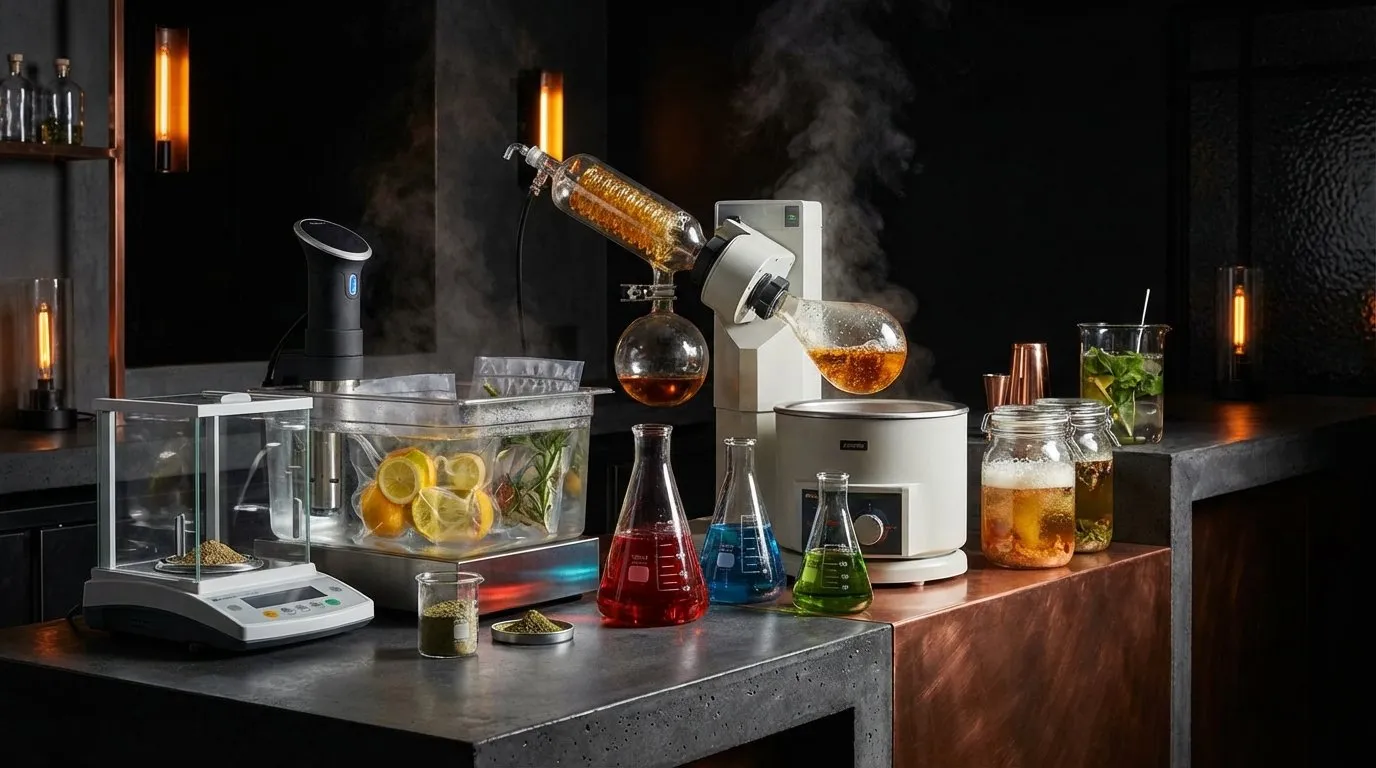
A temperature-controlled cooking technique where ingredients are vacuum-sealed in bags and submerged in a water bath with an immersion circulator. In cocktail making, it enables precise, repeatable infusions: the constant temperature extracts specific aromatic compounds without the bitter tannins or scorched flavours of traditional heat infusion. A spirit can be infused with fruit at exactly 52°C for 2 hours, achieving identical results every time. It also speeds up macerations from weeks to hours. Total control over the ingredient’s final profile.
📖 Full guide: Sous-vide in cocktail making — find out more here →
Infusion
An extraction process where a liquid (spirit, water, oil) absorbs the aromatic and flavouring compounds of a solid ingredient through prolonged contact. Unlike maceration, infusion typically involves heat or accelerated techniques (sous-vide, ultrasound) and shorter times. The critical variables are: ingredient-to-liquid ratio, temperature, time and agitation. On the Stillroom menu, several cocktails employ technical infusions: the Blue Tonic with gin infused with lavender, blue pea flower, jasmine, cardamom and lemongrass; the Satori Floral with sake infused with sakura blossom; the Mediterráneo with gin infused to capture lemon oregano.
📖 Full guide: Infusion in cocktail making — find out more here →
Maceration
Cold extraction where ingredients sit in the base liquid without the application of heat, over extended periods (days to weeks). The process is slower but preserves volatile compounds that heat would destroy, resulting in aromatic profiles more faithful to the original ingredient. Alcoholic maceration extracts different compounds from aqueous maceration: essential oils, resins and fat-soluble compounds are released better in alcohol. In Stillroom’s Garibaldi Fermentado, the vodka is macerated with the leftover citrus peels from the fermentation, capturing essential oils that complement the ferment’s lactic acidity.
📖 Full guide: Maceration in cocktail making — find out more here →
Reduction
A concentration technique where a liquid is simmered to evaporate water and concentrate flavours, sugars and aromatic compounds. Volume decreases while intensity increases exponentially. In cocktail making, it’s applied to fortified wines, vermouths, juices and liqueurs to create hyper-concentrated versions that deliver impact in small doses without adding excessive volume. Reduction also caramelises natural sugars, adding toasted complexity. At Stillroom, the Campari reduction in the Garibaldi Fermentado intensifies the characteristic bitterness and develops bitter caramel notes that balance the ferment’s acidity.
Vacuum Distillation (Rotovap)
Distillation under reduced pressure that allows liquids to be boiled at very low temperatures (30-40°C instead of 100°C). The rotary evaporator —a laboratory instrument adapted for cocktail making— captures extremely delicate volatile aromas that traditional distillation would destroy. Fresh flowers, herbs, fruit and complex preparations can be distilled to obtain essences of crystalline purity. The resulting hydrosol carries the ingredient’s aromatic signature with no colour or sugar. A high-end cocktail-making technique used to create ingredient “waters”: tomato water, rose distillate, cucumber essence.
📖 Full guide: Vacuum distillation (rotovap) — find out more here →
Liquid Nitrogen
A gas liquefied at -196°C used for instant freezing and cryogenic effects. Applications in cocktail making: creating instant sorbets and ice creams incorporated into the cocktail; flash-freezing garnishes for impossible textures; chilling glasses to extreme temperatures; generating dramatic vapour fog; pulverising frozen ingredients into aromatic powders. It requires specific training and strict safety protocols: direct contact causes severe cryogenic burns. Never consume while liquid nitrogen is still active in the glass. Spectacle in the service of sensory experience.
📖 Full guide: Liquid nitrogen in cocktail making — find out more here →
Spherification
A molecular gastronomy technique where a liquid is transformed into spheres with a gelled membrane and a liquid centre, simulating caviar or pearls. Two main methods: basic spherification (the alginate liquid drops into a calcium bath) and reverse spherification (a calcium liquid into an alginate bath), the latter preferred for liquids with alcohol or high acidity. The spheres burst in the mouth, releasing concentrated flavour. They’re used as sophisticated garnishes or to dose intense ingredients. Campari caviar, vermouth pearls, passion fruit juice spheres: textures that surprise and deliver flavour in a unique way.
📖 Full guide: Spherification in cocktail making — find out more here →
Cordial
A concentrated non-alcoholic syrup made by extracting flavour from fruit, herbs or spices, acidified and balanced with sugar. Unlike a simple flavoured syrup, a properly formulated cordial incorporates acidity (citric, malic, tartaric) to create a self-balanced component that delivers sweetness, flavour and acidity simultaneously. It reduces the number of ingredients a recipe needs and guarantees consistency. At Stillroom, cordials are fundamental: caramelised banana in the Japanese Style, lemongrass and orange in the Zest & Roots, passion fruit in the Tropical Tiki, tamarind and marsala in the Super Fashion, apple in the Apple Ron, honey in the Tequila Honey.
📖 Full guide: Homemade cordial in cocktail making — find out more here →
Super Juice
A revolutionary citrus-maximisation technique developed by Nickle Morris. The essential oils are extracted from the peels using powdered citric and/or malic acid (an acid oleo saccharum process), then the pressed juice and water are added to reconstitute. The result: 8 times the yield of traditional juice, a more complex flavour with integrated peel notes, greater stability (it keeps refrigerated for 2 weeks versus 4 hours for fresh juice) and a dramatic reduction in waste. Practically indistinguishable from fresh juice in a cocktail. At Stillroom, lemon super juice appears in the Easy Way, Mediterráneo and Tequila Honey, optimising costs without sacrificing quality.
📖 Full guide: Super juice in cocktail making — find out more here →
Shrub
A fruit syrup preserved in vinegar, a seventeenth-century American colonial technique revived for contemporary cocktail making. The fruit is macerated with sugar (drawing out juices by osmosis), then quality vinegar is added (cider, champagne, balsamic). The result is a complex sweet-and-sour concentrate with acetic notes that adds a dimension impossible to replicate with citrus. It keeps for months refrigerated. The shrub brings acidity with depth —vinegar as a flavour enhancer— and allows seasonal fruit to be incorporated while preserving its essence. Ideal for cocktails wanting non-citrus acidity.
📖 Full guide: Shrub in cocktail making — find out more here →
Oleo Saccharum
Literally “sugar oil” in Latin. A historic technique where citrus peels are macerated with sugar to extract their essential oils by osmosis. The sugar breaks down the peel’s cells and captures the oils, creating a cloudy, intensely aromatic syrup that is the traditional base of classic punches. It requires no heat or special equipment: just peels, sugar, time (2-12 hours) and occasional pressing. Oleo saccharum delivers a citrus concentration impossible to achieve with juice: the essence of lemon or orange in liquid form. The foundation of the historic English Punch.
📖 Full guide: Oleo saccharum in cocktail making — find out more here →
Foam
A semi-solid aerated structure arranged as the top layer of the cocktail. It’s generated using an ISI siphon charged with N2O (nitrous oxide), intense whipping of egg whites, or foaming agents (lecithin, Versawhip). Foams add an ethereal texture, gradual aromatic release and visual contrast. They can be flavoured with any liquid: the coconut foam in the Tropical Tiki adds tropical creaminess; the cola foam in the Cubata Volumen 2 subverts expectations with unexpected texture. Density and stability depend on the foaming agent and the dispensing technique.
📖 Full guide: Foams in cocktail making — find out more here →
Air
An extremely light, almost ethereal foam, made up mainly of bubbles with a minimal amount of liquid. It’s created by adding soy lecithin (0.5-1% of the liquid’s weight) and aerating vigorously with a hand whisk or stick blender. Unlike a dense foam, an air is fleeting and nearly transparent: it delivers aroma without weight, sensation without substance. It disappears gradually, releasing perfume with every sip. On Stillroom’s Green Margarita, a black pear tomato air crowns the cocktail with a subtle umami aroma that complements the coriander-oil-washed tequila. A technique of extreme refinement.
📖 Full guide: Airs in cocktail making (lecithin) — find out more here →
Tepache
A traditional Mexican fermented drink made with pineapple skins, piloncillo (or brown sugar) and spices. Natural fermentation lasts 2-5 days and produces a slightly alcoholic (1-3%), acidic, effervescent drink with the characteristic funk complexity of ferments. Unlike controlled fermentation with specific cultures, tepache relies on the wild yeasts present on the pineapple skin. At Stillroom, the Roasted Pineapple Tepache elevates the tradition: the pineapple is roasted before fermenting, adding caramelised, smoky notes that complement the ferment’s acidity. A direct connection to ancestral Mexican tradition.
📖 Full guide: Tepache in cocktail making — find out more here →
Kombucha
Sweetened tea fermented by a SCOBY (a symbiotic culture of bacteria and yeast) that yields an acidic, slightly effervescent drink. In cocktail making it brings lively acidity, natural fizz and complexity, ideal for low-alcohol cocktails and mocktails.
📖 Full guide: Kombucha in cocktail making — find out more here →
3. Cocktail Families
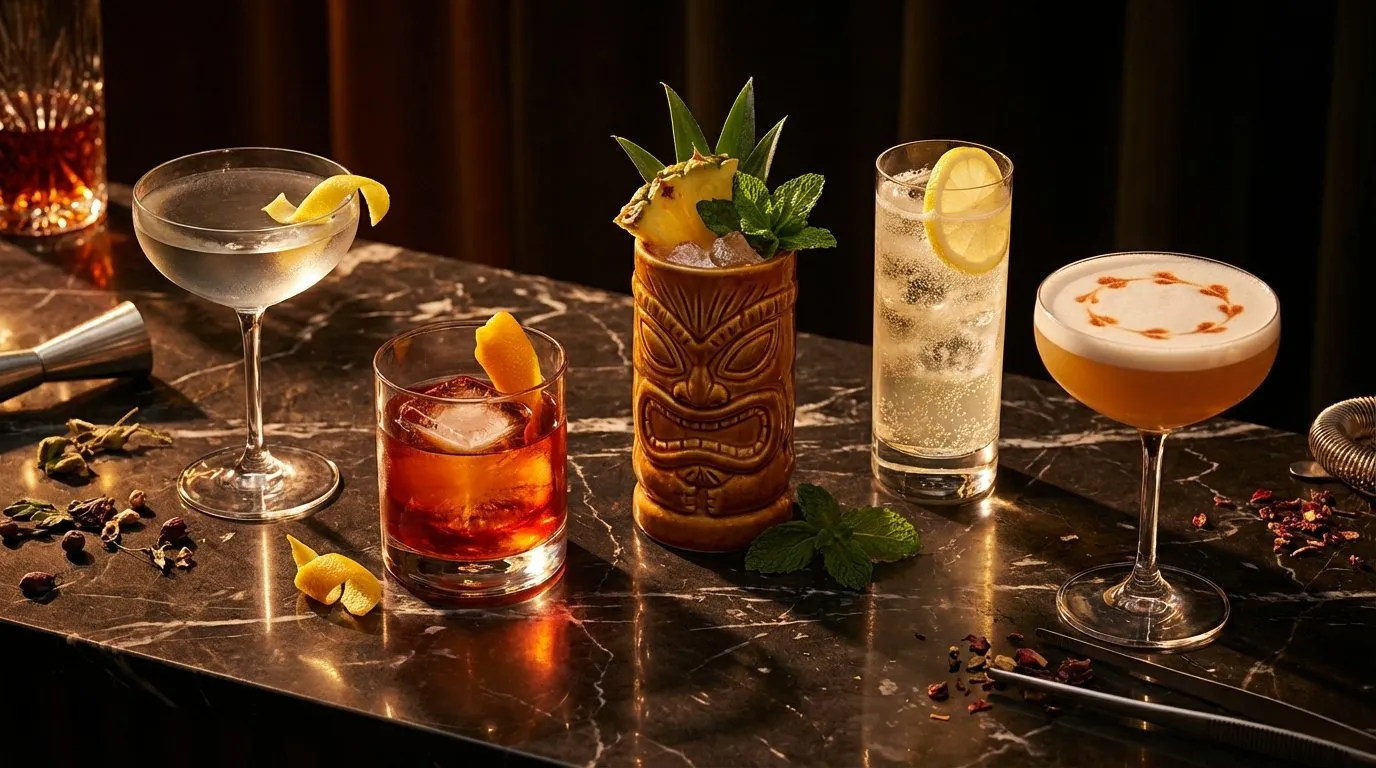
Understanding cocktail families means mastering the DNA of mixology. Each family defines a base structure —proportions, techniques, key ingredients— that has generated hundreds of variations over two centuries. Knowing these templates lets the bartender improvise with a solid foundation, create coherent variations and understand why the classics work. A Margarita is a Sour; a Negroni follows the Americano formula; a Moscow Mule belongs to the Buck family. Everything connects.
Sour
The most influential family in Western cocktail making. Fundamental formula: base spirit + citrus (lemon or lime) + sweet (syrup, liqueur). The classic ratio is 2:1:1 or 2:¾:¾, though every bartender adjusts it to taste and ingredients. The balance between sour and sweet defines a Sour’s success. The egg-white version adds a silky texture and characteristic foam. Technique: vigorous shake (dry shake if it contains egg). Iconic cocktails: Whisky Sour, Daiquiri, Margarita, Pisco Sour, Sidecar. At Stillroom, the Easy Way and the Green Margarita are contemporary interpretations of this universal structure.
📖 Full guide: The sour family — find out more here →
Fizz
An evolution of the Sour with the addition of carbonated water, creating a longer, lighter, more refreshing cocktail. Structure: spirit + citrus + sweet + soda. The Sour is shaken, strained over fresh ice and topped with soda. The original Fizz contained egg white (Silver Fizz) or yolk (Golden Fizz); the Royal Fizz includes whole egg. The protein’s foam interacts with the carbonation to create a unique texture. The Ramos Gin Fizz —with cream, orange blossom water and egg white— is the most complex of the family. The Fizz is served in a highball glass, smaller than the Collins.
Collins
A direct cousin of the Fizz but served longer and built directly in the glass. Structure: spirit + lemon + sugar + plenty of soda + ice. Unlike the Fizz (shaken first), the Collins is built in a tall glass with ice, combining the build method with a soda top. The name comes from John Collins, a waiter at Limmer’s Hotel in nineteenth-century London. The Tom Collins (with gin) and the Whisky Collins are the best known. The Collins family prioritises refreshment over complexity: long, cold drinks, perfect for warm weather.
Highball
A family of long drinks defined by simplicity: base spirit + carbonated mixer, served in a tall glass (which lends the family its name). The typical ratio runs from 1:2 to 1:4 depending on the spirit; the contemporary highball leans towards 1:3-1:4. The quality of a Highball depends on the quality of the ice (large, dense, crystal-clear) and the carbonation (freshly opened mixer, gentle pour). The Japanese Whisky Highball elevated this simple formula to an art form through impeccable technique. Gin and Tonic, Cuba Libre, Paloma, Whisky Soda: all Highballs. At Stillroom, the Blue Tonic and the Japanese Style belong to this family, elevated with technical infusions and artisan cordials.
📖 Full guide: Highball — ratios and technique — find out more here →
Old Fashioned
The oldest and purest family: spirit + sugar + bitters + water (ice dilution). It represents the original definition of “cocktail” documented in 1806. There are no juices or modifiers to mask anything: the spirit is the absolute protagonist, subtly enhanced by sweetness and bitters. It’s built in the glass using the stir technique, expressing citrus peel at the end. The bourbon Old Fashioned is the archetype; the Sazerac (with rye and absinthe) is its New Orleans cousin. At Stillroom, the Punch and the Super Fashion are contemporary explorations of this essential structure where the spirit rules.
Martini
A family of elegant cocktails made up of base spirit + vermouth, served cold without ice (up) in a cocktail glass or Nick & Nora. The vermouth-to-spirit ratio defines the style: wet (more vermouth), dry (less), extra dry (just a rinse). Technique: stirred in a mixing glass with impeccable ice, double strained. The garnish is ritual: an olive, a lemon twist or a cocktail onion (Gibson). The Dry Martini with gin is the archetype of sophistication; the Vodka Martini its contemporary version. Stillroom’s Highball Martini subverts the family: it deconstructs the classic into a long format with tomato soda.
Manhattan
A foundational structure: whisky (rye or bourbon) + red vermouth + bitters, in a 2:1 ratio with 2-3 dashes of Angostura. Born at the Manhattan Club in New York circa 1870, it established the model for stirred cocktails with vermouth. The family includes variants: the Rob Roy (with scotch), the Boulevardier (bourbon + Campari + vermouth), the Brooklyn (with Amer Picon and maraschino). The Perfect Manhattan uses half red vermouth, half white. It’s served up in a cocktail glass, garnished with a quality cherry. The stir must be precise: enough dilution to integrate, without watering down the whisky.
Negroni
A perfect trinity of equal parts: gin + Campari + red vermouth, with a mathematical balance that creates a whole greater than its parts. Born in Florence when Count Negroni asked for his Americano with gin instead of soda. The family has exploded into variations: the Boulevardier (bourbon), the Mezcal Negroni, the White Negroni (Suze + Lillet Blanc), the Negroni Sbagliato (sparkling wine instead of gin). It’s built in an Old Fashioned glass over a large ice cube, with a brief stir and an orange twist. At Stillroom, the Green Negroni reinterprets the classic with Midori and Chartreuse, creating a herbaceous version where green dominates.
Tiki
More than a family, an aesthetic and technical universe born in the bars of Don the Beachcomber and Trader Vic in the 1930s-40s. Defining features: multiple rums blended together, tropical juices (lime, pineapple, passion fruit), spiced syrups (orgeat, falernum, passion fruit), exotic bitters and theatrical presentation in ceramic mugs. Tikis are complex cocktails —often 6+ ingredients— that require precise balance between sweet, sour, spiced and spirituous. Mai Tai, Zombie, Painkiller, Navy Grog: tropical escapism in a glass. Stillroom’s Tropical Tiki honours the tradition with passion fruit cordial, lime and coconut foam.
Flip
A historic family defined by the inclusion of whole egg (yolk and white), creating an extremely creamy, rich texture. Classic structure: spirit or fortified wine + sugar + whole egg, shaken vigorously and served without ice. The dry shake is essential to emulsify it properly. American colonial origins, where it was heated with a red-hot poker. Today they’re served cold. Porto Flip, Brandy Flip, Sherry Flip: rich, comforting digestif cocktails. Grated nutmeg as a garnish is traditional. Technically challenging but texturally unique in the cocktail canon.
Punch
The mother of all cocktails: a communal preparation born in seventeenth-century India, brought to England by sailors of the East India Company. The original rule of five elements (panch means five in Hindi): sour (citrus), sweet (sugar), strong (spirit), weak (water/tea) and spice (spices/bitters). It’s prepared in a large punch bowl for sharing. Oleo saccharum (peels + sugar) is the traditional base. Fish House Punch, Planter’s Punch, Chatham Artillery Punch: historic recipes of legendary potency. Stillroom’s Punch, with infused mezcal and homemade corn liqueur, connects with this primordial tradition.
Smash
An evolution of the Julep where aromatic herbs are muddled (smashed) with sugar and citrus before the spirit is added. Structure: spirit + sugar + fresh herbs (mint, basil) + seasonal fruit (optional) + plenty of crushed ice. Muddling releases the herbs’ essential oils. It’s served in a short glass with crushed ice, garnished with more fresh herbs. The Whiskey Smash is the best known; the Gin Basil Smash its most influential contemporary version. Seasonal cocktails, perfect for using market fruit and herbs.
Julep
An aristocratic American family, immortalised by the Kentucky Derby’s Mint Julep. Simple structure: spirit (traditionally bourbon) + sugar syrup + fresh mint + plenty of crushed ice. The mint is pressed gently —not muddled— to release aroma without bitterness. It’s served in a metal or pewter cup that frosts spectacularly. The short straw forces the nose close to the mint. It’s not stirred: the natural stratification creates a journey of flavours from initial sweetness to pure bourbon at the bottom. Ritual, Southern elegance and tradition.
Spritz
A Venetian family of light, aperitif cocktails: sparkling wine + bitter/aperitif liqueur + soda (optional). Classic ratio: 3 parts prosecco, 2 parts bitter, 1 part soda. It’s built directly in a large wine glass over ice, garnished with orange. The Aperol Spritz dominates globally, but the family includes versions with Campari (Campari Spritz), Select, Cynar or any Italian amaro. Stillroom’s Satori Floral evokes this family with its prosecco top over sake infused with sakura blossom, creating a spritz with Japanese inspiration.
📖 Full guide: The spritz — find out more here →
Mule / Buck
A family of spiced highballs with ginger beer or ginger ale as the main mixer. Structure: spirit + lime + ginger beer, served in a tall glass or copper mug. The Moscow Mule (vodka) popularised the format in the 1940s, but the family includes the Kentucky Mule (bourbon), the Mexican Mule (tequila), the London Mule (gin) and the Dark ’n’ Stormy (dark rum, considered a Buck). Ginger brings a spicy kick and depth that complements almost any spirit. The copper mug isn’t just aesthetic: it conducts cold, keeping the drink chilled longer.
Daisy
A family of Sours enriched with orange liqueur (curaçao, Cointreau, Grand Marnier) in addition to the primary sweetener. Structure: spirit + orange liqueur + citrus + syrup (optional). The Margarita is technically a Tequila Daisy; the Sidecar a Brandy Daisy. The liqueur adds complex sweetness with orange notes that elevate the sour’s basic structure. They’re served shaken, up or over ice depending on the recipe. The name “daisy” —margarita in Spanish— connects directly to the world’s most famous Mexican cocktail.
Fix
A historic family virtually identical to the Sour but served, without exception, over crushed ice in a small glass. Structure: spirit + citrus + sugar/syrup + seasonal fruit (traditional). Crushed ice and the “on crushed” format define the experience: fast dilution, an ice-cold drink that evolves. Popular in nineteenth-century cocktail making, the Fix fell out of use but is resurfacing in contemporary bars. Brandy Fix, Gin Fix, Santa Cruz Fix (rum): classic recipes ideal for reviving. A rustic presentation with fresh fruit is characteristic.
Sling
A historic family of long drinks with water (cold or hot, depending on the era) and sugar. The structure evolved: the original Sling was spirit + water + sugar + nutmeg; the contemporary Singapore Sling is a complex construction with gin, Heering, Bénédictine, citrus and soda. The common thread is length and refreshment. Hot Slings were precursors to the toddy. The Singapore Sling (Raffles Hotel, 1915) redefined the family towards tropical complexity, moving away from its original simplicity. A family in constant evolution since the eighteenth century.
Rickey
A minimalist, refreshing family: spirit + lime + soda, with no added sugar. The absence of sweetness defines the Rickey: it depends solely on the spirit, the lime’s acidity and the fizz. Born in Washington D.C. in the 1880s, named after Colonel Joe Rickey. The Gin Rickey is the best known; the Bourbon Rickey the American version. It’s built in a tall glass with half a lime squeezed and left in the glass. A cocktail for those who find most drinks too sweet: clean, direct, no compromises.
Cobbler
A nineteenth-century family built over crushed ice with a base of fortified wine (originally sherry) or spirit, citrus and sugar, generously garnished with fresh seasonal fruit. The Sherry Cobbler was the cocktail that popularised the use of ice and the straw in America. Structure: wine/spirit + orange/lemon + sugar + crushed ice + abundant fruit. It’s “built” in layers and served with a straw among the fruit. Visual, refreshing, perfect for summer. The overflowing-fruit aesthetic is a non-negotiable characteristic.
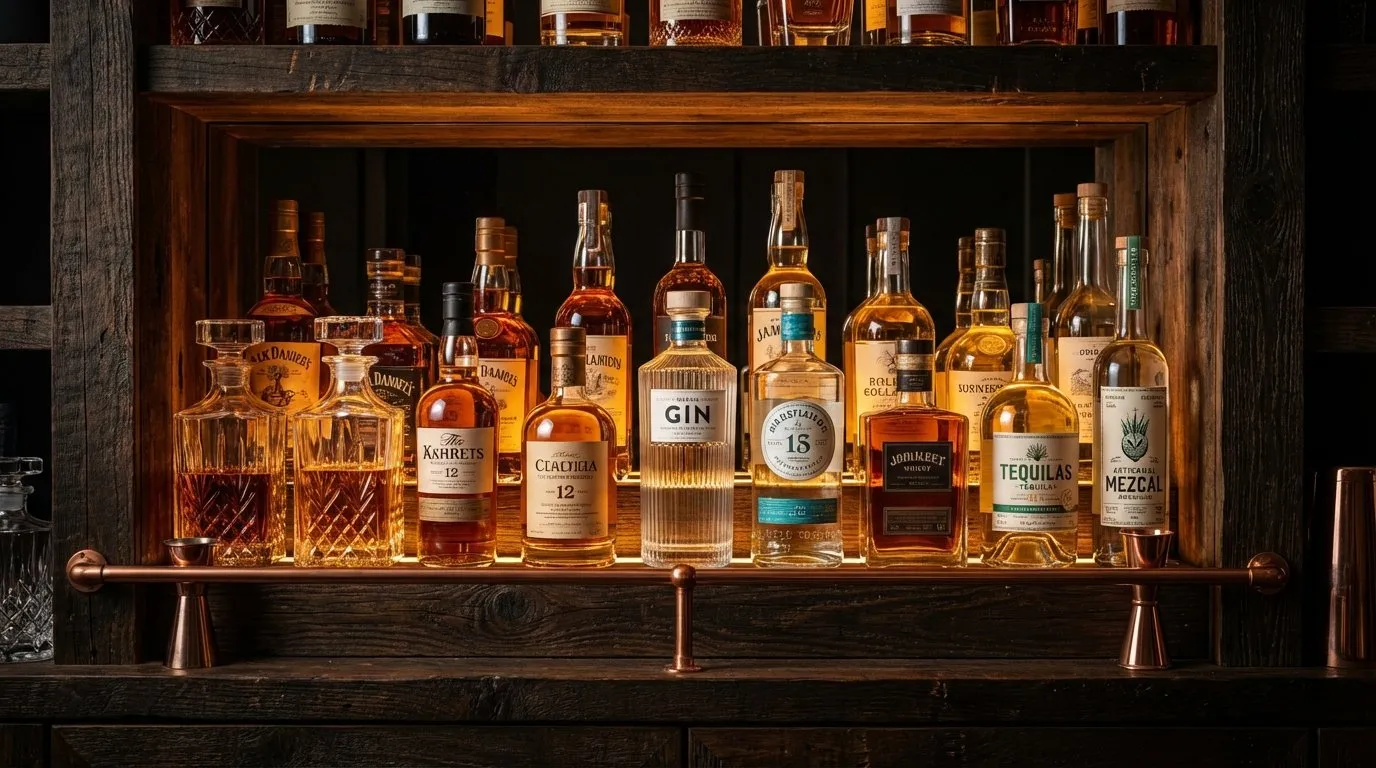
4. Base Spirits
The base spirit is the soul of the cocktail: it determines the dominant aromatic profile, the flavour structure and the pairing possibilities. Understanding each category —its production process, varieties, flavour profiles and applications in cocktail making— is fundamental to creating coherent combinations. Here we break down the great spirits that underpin the classic and contemporary repertoire, including those that define the Stillroom menu.
Gin
A neutral-grain spirit flavoured with botanicals, where juniper must be the dominant flavour by legal definition. Main styles: London Dry (dry, pronounced juniper, no added sugar), Plymouth (earthier and softer), Old Tom (slightly sweet, historic), New Western/Contemporary (creative botanicals that can eclipse the juniper). The secondary botanicals vary infinitely: citrus, spices, flowers, roots. Gin is versatile in cocktail making: it works in Martinis, Negronis, Collinses, Fizzes and as a base for technical infusions. At Stillroom, multiple infused gins define cocktails: the Blue Tonic (lavender, jasmine, cardamom), the Mediterráneo (lemon oregano), the Zest & Roots (turmeric, ginger).
Vodka
A highly pure neutral spirit traditionally made from grain (wheat, rye) or potato, though it can be produced from any fermentable raw material. Defined by its neutrality: multiple distillations and filtrations remove congeners and distinctive flavours, leaving pure ethanol with a subtle character from the original raw material. Its “lack of flavour” is paradoxically its strength in cocktail making: it lets other ingredients shine while contributing alcoholic body. Essential in the Moscow Mule, Bloody Mary, Cosmopolitan, Espresso Martini. In Stillroom’s Garibaldi Fermentado, the vodka is macerated with citrus peels to extract essential oils that complement the ferment without competing with its acidity.
Rum
A sugarcane spirit, made either from molasses (a byproduct of refined sugar) or fresh cane juice (rhum agricole). Categories by colour/ageing: white (unaged or filtered, clean and versatile), gold (medium ageing, notes of vanilla and caramel), dark/aged (extended ageing, wood complexity, spices, dried fruit). Regional styles vary enormously: light Cuban/Puerto Rican, heavy Jamaican (funky esters), dry Spanish, aromatic French (agricole). Rum is the backbone of Tiki and essential in the Mojito, Daiquiri, Cuba Libre, Mai Tai. At Stillroom, the Cubata Volumen 2 reinvents the Cuba Libre with coffee-and-rosemary-infused rum; the Apple Ron explores gin with green tea and mint.
Tequila
A Mexican spirit made from blue agave (Agave tequilana Weber, blue variety), produced exclusively within its denomination of origin (mainly Jalisco). Categories: Blanco/Plata (unaged, pure agave expression), Reposado (2-12 months in barrel, a balance between agave and wood), Añejo (1-3 years, wood-dominant), Extra Añejo (3+ years). 100% agave tequila differs radically from “mixto” (minimum 51% agave). The flavour varies between highlands (fruity, floral) and lowlands (earthy, mineral, peppery). The base of the Margarita, Paloma, Tequila Sunrise. At Stillroom, the Easy Way uses reposado tequila with smoked Campari; the Green Margarita employs fat washing with coriander oil.
Mezcal
A Mexican agave spirit with a denomination of origin, distinguished from tequila by the variety of agaves permitted (more than 30 species), an artisan process and a distinctive smoky profile. The heart of the agave (the piña) is cooked in underground pits with hot stones and wood, imparting the characteristic smokiness. Categories: Joven (unaged), Reposado, Añejo. Wild-agave mezcals (Tobalá, Tepeztate, Madrecuixe) offer unique profiles limited by the scarcity of the agave. Mezcal’s smokiness transforms any classic cocktail: Mezcal Negroni, Mezcal Margarita. At Stillroom, the Punch uses mezcal infused with liqueur smoke, intensifying its smoky nature.
Bourbon
An American whiskey defined by law: a minimum of 51% corn in the grain mash, distilled to a maximum of 80% ABV, aged in new charred American oak barrels, with no colour or flavour additives. The corn brings characteristic sweetness; the new charred barrel imparts vanilla, caramel, spice and pronounced tannins. Kentucky produces 95% of the world’s bourbon, though it can be made in any state. Typical notes: vanilla, caramel, sweet corn, oak, spice. The foundation of the Old Fashioned, Whiskey Sour, Mint Julep, Manhattan. At Stillroom, the Japanese Style uses bourbon with caramelised banana cordial and toasted rice syrup.
Rye Whiskey
An American whiskey with a minimum of 51% rye in the grain mash, aged in a new charred oak barrel like bourbon. The rye brings a spicy, peppery, dry character that contrasts with bourbon’s sweetness. Historically dominant before Prohibition, rye is resurging as the preferred choice in classic cocktails originally created with it: Manhattan, Sazerac, Old Fashioned (the original recipe). Canadian rye follows different rules and can contain other grains. For cocktails that need structure and spice without excessive sweetness, rye is the superior choice. Notes: pepper, spice, dark fruit, rye grain.
Scotch Whisky
Scottish whisky with a denomination of origin, aged a minimum of 3 years in oak barrels in Scotland. Categories: Single Malt (100% malted barley, one distillery), Blended Malt (a mix of single malts), Blended Scotch (malt + grain), Single Grain. The regions define profiles: Speyside (fruity, elegant), Islay (smoky, iodine-like, peaty), Highlands (variable, complex), Lowlands (light, soft), Campbeltown (saline, oily). The smoky/peaty character of some scotches adds a unique dimension in cocktail making: Penicillin, Blood and Sand, Rob Roy. For cocktails, blends work well; complex single malts deserve to be tasted neat.
Japanese Whisky
A tradition begun in the early twentieth century, inspired by scotch, that evolved its own identity characterised by precision, elegance and balance. Japanese distilleries (Yamazaki, Hakushu, Nikka, Chichibu) produce varied styles: from Islay-style smoky malts to delicate, floral expressions. The Japanese Highball —whisky with soda in a precise ratio, impeccable ice, perfectionist technique— elevated this simple format to a cultural ritual. Japanese whisky shines where subtlety matters: Highballs, Mizuwari (with water), cocktails where the spirit must integrate, not dominate.
Brandy / Cognac
A wine spirit (grape brandy), where Cognac is the most prestigious French denomination (the Cognac region, Ugni Blanc grape, double distillation in a Charentais pot still, ageing in French oak). Ageing categories: VS (2+ years), VSOP (4+ years), XO (10+ years). Other notable brandies: Armagnac (France, continuous distillation), Brandy de Jerez (Spanish solera system), Pisco (Peru/Chile, unaged). Brandy brings fruity richness, grape notes, barrel complexity. The base of the Sidecar, Brandy Alexander, Vieux Carré. At Stillroom, the Super Fashion reinvents the Old Fashioned with salted-caramel-washed brandy, adding toasted unctuousness.
Pisco
An unaged grape spirit produced in Peru and Chile with separate denominations of origin and a historic rivalry. Peruvian pisco is distilled to its final proof (with no subsequent dilution), using specific grape varieties: aromatic (Italia, Moscatel, Torontel, Albilla) or non-aromatic (Quebranta, Negra Criolla, Mollar, Uvina). Categories: Puro (one grape), Acholado (a blend), Mosto Verde (distilled from partially fermented must, more aromatic). The Pisco Sour is Peru’s national cocktail: pisco + lime + syrup + egg white + Angostura bitters. Aromatic pisco excels in cocktails that need fruity/floral character with no barrel influence.
Cachaça
A Brazilian spirit made from fresh sugarcane juice (not molasses, as with most rums), with a denomination of origin. Fermenting the fresh juice preserves a unique vegetal, grassy, funky character. Categories: Cachaça Branca/Prata (unaged, pure cane expression), Cachaça Ouro/Envelhecida (aged in native Brazilian woods such as amendoim, freijó or oak). Its grassy, vegetal profile sets it radically apart from rum. It’s the exclusive base of the Caipirinha —muddled cachaça + lime + sugar— Brazil’s most important cocktail. Artisan pot-still cachaça differs substantially from industrial column-still cachaça.
Absinthe
A high-proof spirit (45-75% ABV) flavoured with anise, fennel and wormwood (Artemisia absinthium), among other botanicals. Wormwood contains thujone, the psychoactive compound responsible for its historic mystique and prohibition (now debunked at normal quantities). The traditional ritual involves an absinthe fountain with ice-cold water dripping over a sugar cube, diluting it and triggering the louche (opalescence). In classic cocktail making, absinthe is used in small amounts as a rinse or dash: it defines the Sazerac, appears in the Corpse Reviver No. 2, adds aniseed complexity to Martinis. A powerful modifier where drops are enough.
Sake
A Japanese alcoholic drink made by multiple parallel fermentation of polished rice (the starch converts to sugar as it ferments). It’s neither wine, beer nor spirit: a category of its own. The degree of rice polishing determines the category: Junmai (no added alcohol), Honjozo, Ginjo (40%+ polished), Daiginjo (50%+ polished). The more polished, the more delicate and aromatic. Sake works surprisingly well in cocktail making thanks to its subtle umami and versatility. At Stillroom, the Satori Floral uses sake infused with sakura blossom, yuzu and red shiso, topped with prosecco: a fusion of Japanese technique with a Mediterranean spritz format.
Vermouth
A fortified wine (15-22% ABV) flavoured with botanicals, where wormwood (wermut in German, the origin of the name) is historically definitive. Main categories: Rosso/Red (sweet, spiced, traditionally Italian), Dry/White (dry, traditionally French), Bianco/Sweet White (sweet but pale), Rosé. Quality vermouths contain dozens of botanicals: roots, bark, flowers, herbs, spices. Italy (Turin) and France (Chambéry) are the historic homes, but Spain produces exceptional vermouths. Essential in the Martini, Manhattan, Negroni, Americano. At Stillroom, the Cool Sangría incorporates Tío Pepe fino macerated with Carpano Bianco and gin; the Highball Martini deconstructs the classic with tomato-infused vermouth.
Fino / Sherry
A Spanish fortified wine from the Jerez-Xérès-Sherry denomination, with unique versatility in contemporary cocktail making. Main categories: Fino (aged under a layer of flor yeast, dry, saline, almondy), Manzanilla (fino from Sanlúcar, lighter and more iodine-like), Amontillado (oxidised fino, darker and more complex), Oloroso (no flor, oxidative from the start, rich and dry), Pedro Ximénez (sweet, dense, raisiny). Fino brings salinity and complexity without adding sweetness; PX works as a sweet modifier. The Sherry Cobbler is a historic classic. At Stillroom, the Cool Sangría uses Tío Pepe fino macerated with peach, orange and mint as the base of a technical, sophisticated sangria.
Homemade Corn Liqueur
An artisan preparation where corn —toasted, nixtamalised or infused— lends its earthy sweetness and characteristic notes to an alcoholic base. The process may involve macerating toasted corn in neutral spirit, infusing fresh corn on the cob, or incorporating nixtamalised corn masa. The result is a liqueur with natural sweetness, toasted notes and a character evoking fresh tortilla and earth. It connects to ancestral Mesoamerican traditions where corn is sacred. At Stillroom, the homemade corn liqueur appears in the Punch alongside the infused mezcal, creating synergy between two pillars of Mexican culture.
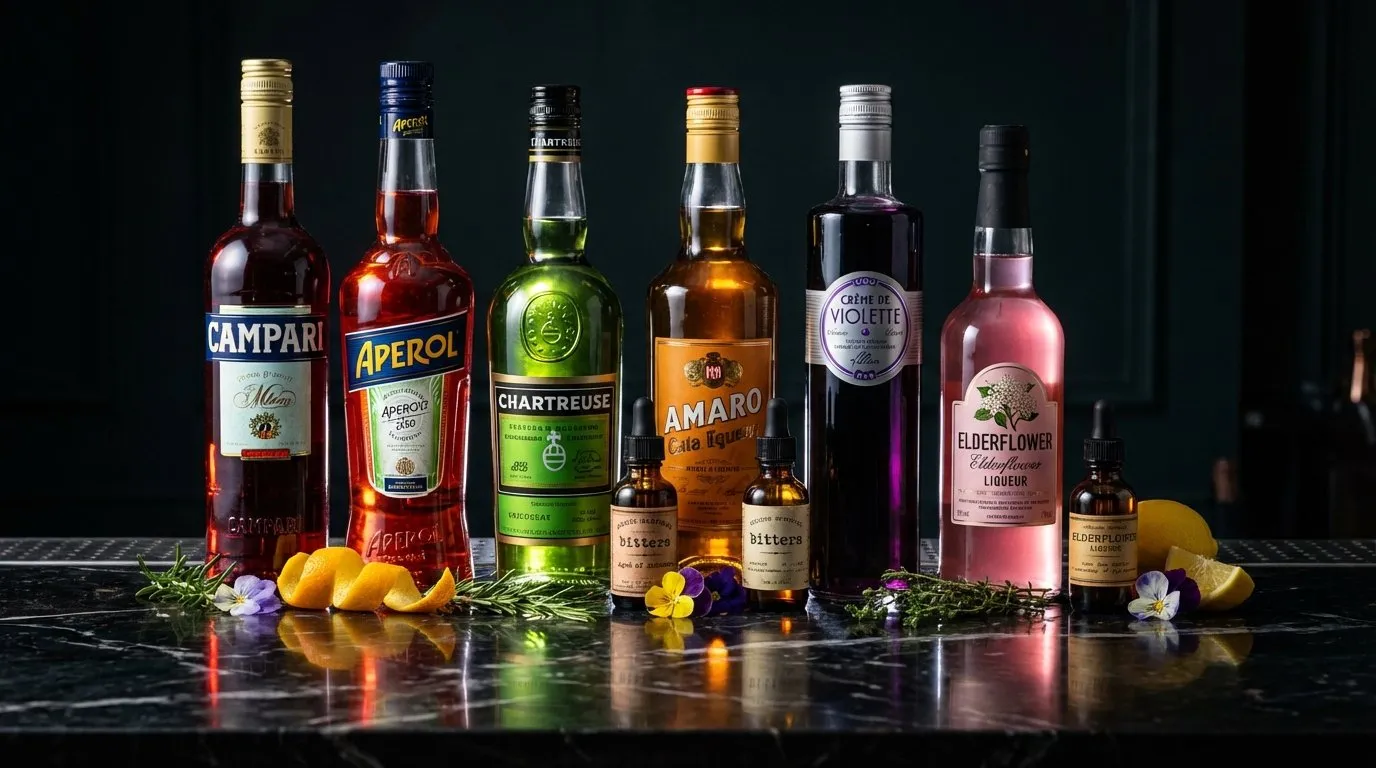
5. Liqueurs and Modifiers
Modifiers are the architects of balance: they transform a simple spirit into a complex cocktail. This category spans sweet liqueurs, Italian amari, concentrated bitters, vermouths and aromatic preparations that —in small doses— add layers of flavour impossible to replicate. Knowing their profiles lets you substitute, experiment and create. A dash of bitters, a rinse of Chartreuse, a splash of Campari: small additions that define great cocktails.
Campari
An iconic Italian bitter of intense red colour (originally from cochineal, today artificial colourings), with a bittersweet profile dominated by herbs, citrus and quinine. Created in 1860 by Gaspare Campari in Milan, it’s the defining bitterness of the Italian aperitivo. Its polarising flavour —loved or hated— is unmistakable: bitter grapefruit, medicinal herbs, orange, spice. Essential in the Negroni (equal parts with gin and red vermouth), Americano, Boulevardier, Garibaldi. At Stillroom, the Easy Way uses smoked Campari that adds toasted depth to its classic bitterness, while the Campari reduction in the Garibaldi Fermentado concentrates its essence into a bitter syrup.
Aperol
A low-proof Italian bitter (11% ABV) with a more accessible profile than its cousin Campari: sweet orange, rhubarb, gentian and herbs, with gentle bitterness and a slightly sweet finish. Its characteristic vibrant orange colour. Created in 1919 in Padua, it achieved worldwide fame with the Aperol Spritz (Aperol + prosecco + soda), which defined summer aperitivo culture. Its lower intensity means it can be used in greater proportion than other bitters. It works in the Paper Plane, Naked and Famous, Division Bell. An ideal introduction to the world of amari for uninitiated palates.
Green Chartreuse
A French herbal liqueur made by Carthusian monks since 1737 to a secret recipe of 130 plants. The green version (55% ABV) is more potent and complex than the yellow: intensely herbaceous, minty, spiced, with balanced sweetness and a long, warm finish. It’s the only liqueur naturally green (from plant chlorophyll). Its flavour defies classification: every sip reveals new layers. Essential in the Last Word, Bijou, Champs-Élysées. A single spoonful transforms any cocktail. At Stillroom, the Green Negroni and the Apple Ron incorporate green Chartreuse to add a herbal complexity no other ingredient can provide.
Yellow Chartreuse
A softer, sweeter version of Chartreuse (40% ABV), with the same 130 plants but a profile dominated by honey, saffron and floral notes. Less aggressive than the green, it’s more versatile in cocktail making where herbal complexity is wanted without dominating. A natural golden amber colour. Created in 1838 as an accessible alternative. It works in the Alaska (with gin), Golden Last Word, Widow’s Kiss. While the green brings vegetal intensity, the yellow adds honeyed sweetness with depth. Both are unique, irreplaceable products in the repertoire of any serious bar.
Bénédictine
A French herbal liqueur made with 27 plants and spices on a brandy base, with a sweet, spiced, complex profile: honey, saffron, myrrh, cinnamon, vanilla. Supposedly created by Benedictine monks in 1510 (a disputed history; commercialised since 1863). The letters D.O.M. (Deo Optimo Maximo) adorn every bottle. Sweeter than Chartreuse, less bitter. Essential in the Vieux Carré, Singapore Sling, Bobby Burns. B&B (Bénédictine + brandy) is a popular bottled blend. It brings spiced richness and rounded sweetness that softens cocktails with potent spirits.
Cointreau
A premium French triple sec, a crystal-clear orange liqueur made with sweet and bitter orange peels. Drier and more balanced than other curaçaos, with 40% ABV that contributes significant alcoholic structure. Cointreau is transparent (unlike amber Grand Marnier), allowing cocktails with no colour alteration. Essential in the Margarita, Cosmopolitan, Sidecar, White Lady, Corpse Reviver No. 2. Its balance between sweet and bitter citrus makes it irreplaceable: other triple secs don’t achieve the same finesse. It’s the standard against which every orange liqueur is measured.
Grand Marnier
A French liqueur combining VSOP cognac with bitter orange essence (Citrus bigaradia), creating a more complex, richer profile than standard triple sec. The amber colour of the cognac, an unctuous body, notes of candied orange, vanilla, oak. Created in 1880 by Louis-Alexandre Marnier-Lapostolle. While Cointreau is clean and versatile, Grand Marnier brings depth and richness that works especially well in cocktails with whisky or brandy. Excellent in the Cadillac Margarita (replacing triple sec), the B-52, a luxury Mai Tai. Also exceptional on its own, as a digestif.
Maraschino
A colourless Italian liqueur distilled from marasca cherries, pits included, producing a unique profile: subtle cherry, bitter almond (from the pits), floral notes and delicate sweetness. Luxardo has been the reference producer since 1821. Not to be confused with cherry syrup or maraschino cherries: the liqueur is dry, elegant, never cloying. Small amounts transform cocktails: it adds a fruity-almond dimension without dominating. Essential in the Aviation, Last Word, Hemingway Daiquiri, Martinez. A professional bartender’s ingredient that elevates any sour.
Luxardo
An Italian house founded in 1821, synonymous with quality maraschino but also a producer of other essential liqueurs. Luxardo Maraschino is the industry standard; Luxardo cherries (preserved in a dense syrup, undyed) are the only ones acceptable in serious cocktail making. Other notable products: Bitter Bianco (a white bitter), Sangue Morlacco (a sweet cherry liqueur), Triplum (triple sec), Amaretto di Saschira. At Stillroom, Luxardo cherry liqueur appears in the Cubata Volumen 2, bringing dark cherry sweetness that complements the coffee-infused rum.
Midori
A Japanese melon liqueur with a characteristic bright green colour, launched by Suntory in 1978 at Studio 54 in New York. Made with Yubari and musk melons, it has a sweet, fruity, distinctly artificial-tropical profile. Low proof (20% ABV), pronounced sweetness. It defined the Japanese Slipper and popularised green cocktails in the 1980s-90s. Today it’s used sparingly to add colour and melon sweetness. At Stillroom, the Green Negroni incorporates Midori alongside Chartreuse, creating an intense green palette with contrast between the melon’s sweetness and the French liqueur’s herbal character.
Curaçao
A family of orange liqueurs originating on the Caribbean island of Curaçao, made with laraha peels (a local bitter orange). Blue curaçao is the most visually recognisable, though its colour is artificial; the original is amber/orange. Pierre Ferrand Dry Curaçao and Senior Curaçao are quality references. The profile is bitter orange with subtle spice, less refined than Cointreau but with a character of its own. Essential in the Mai Tai (where it lends its amber colour), the Blue Lagoon, tiki cocktails. Blue curaçao is used mainly for looks in party cocktails.
Falernum
A Caribbean syrup or liqueur (mainly from Barbados) with a profile of lime, ginger, almond and spice (clove, nutmeg). It can be alcoholic (a liqueur, roughly 11-18% ABV) or non-alcoholic (a syrup). John D. Taylor’s Velvet Falernum is the best known; homemade versions are common in serious tiki bars. Falernum brings a tropical spiced complexity impossible to replicate with individual ingredients: it’s sweet, sour, spiced and slightly bitter all at once. Essential in tiki cocktails: the Royal Bermuda Yacht Club, Corn ’n’ Oil, Saturn, Zombie. The secret ingredient that defines Caribbean flavour.
Orgeat
A French almond syrup with orange blossom water, silky, milky, with elegant sweetness and subtle floral notes. Pronounced “or-ZHAH”. Traditionally made by macerating almonds in water, extracting their milk and adding sugar and orange blossom water. Homemade orgeat far outstrips the commercial kind. Essential in the Mai Tai (where its creaminess balances the rums), the Japanese Cocktail, the Trinidad Sour. It brings a velvety texture, rounded sweetness and floral aroma no other syrup replicates. An ingredient that separates the professional bar from the amateur.
Amari
An Italian family of bitter digestif liqueurs, made from infusions of herbs, roots, flowers, bark and spices. The spectrum runs from light and accessible to intensely bitter. Main categories: light (Aperol, Montenegro), medium (Averna, Nonino, Ramazzotti), intense (Fernet, Braulio, China-China), unique (artichoke Cynar, rhubarb Zucca). Amari work in cocktail making as bitter modifiers, vermouth substitutes, or as the star of the Black Manhattan, Paper Plane, Toronto. The right amaro can elevate or destroy a cocktail: choose according to the profile you want.
Fernet Branca
An extremely intense Italian amaro with a medicinal, minty, extremely bitter profile. Made with 27 ingredients including myrrh, rhubarb, chamomile, cardamom, saffron and aloe. Fernet is polarising: rejected or adored, no middle ground. Argentina drinks more Fernet than Italy (with Coca-Cola as ritual). In cocktail making, small amounts add unmatched bitter complexity: the Toronto (rye + Fernet), the Hanky Panky (gin + sweet vermouth + Fernet), the Industry Sour. It also works as a post-meal digestif shot. A dash can save an overly sweet cocktail.
Amaro Montenegro
An Italian amaro from Bologna, considered the most balanced and accessible of the family. A gentle profile with notes of orange, vanilla, flowers and spice, with mild bitterness and a slightly sweet finish. Made with 40 botanicals since 1885. Its versatility makes it a bartender favourite: it works where other amari would be excessive. The star of the Black Manhattan (replacing vermouth), the Montenegro Sour, the Paper Plane (Montenegro + bourbon + Aperol + lemon in equal parts). The entry-level amaro for beginners and the trusted one for professionals.
Angostura Bitters
The most iconic bitters in the world, created in 1824 in Venezuela by Dr Johann Siegert as a medicinal tonic. Today produced in Trinidad. A secret formula with gentian and spices that produces a profile of clove, cinnamon, cardamom and herbal bitterness. Dark brown in colour, extremely concentrated: used in dashes. A distinctively oversized label (a design mistake turned into a brand feature). Essential in the Old Fashioned, Manhattan, Whisky Sour, Pink Gin. Without Angostura, classic cocktail making wouldn’t exist. At Stillroom, the Japanese Style incorporates Angostura bitters that anchor the bourbon with banana cordial.
Peychaud’s Bitters
New Orleans bitters created circa 1830 by apothecary Antoine Peychaud, essential in Louisiana cocktail making. A more floral, anise-forward profile than Angostura, with notes of cherry, mint and sweet spice. A reddish colour that tints cocktails. They’re irreplaceable in the Sazerac —New Orleans’s official cocktail— and appear in the Vieux Carré, the De La Louisiane. While Angostura is spiced-earthy, Peychaud’s is floral-fruity. Swapping one for the other completely changes the profile. For pre-Prohibition American classic cocktail making, Peychaud’s is as essential as Angostura.
Orange Bitters
A category of bitters dominated by bitter orange, with variations including spices and other citrus. Regner’s, Fee Brothers, Angostura Orange are the most common. The profile combines bitter orange peel with cinnamon, clove, cardamom depending on the brand. Historically essential in the original Martini (largely forgotten today), rediscovered in the craft era. They add a bitter citrus dimension with no acidity or sweetness. Excellent in a dry Martini, a bourbon Old Fashioned, whisky highballs. At Stillroom, the Super Fashion uses Angostura orange bitters to complement the caramel-washed brandy.
Elderflower Liqueur (St-Germain)
A French liqueur made from wild elderflowers, with an intense floral profile, notes of pear, lychee, grapefruit and honey. St-Germain (launched in 2007) defined the category and became a phenomenon: its versatility and elegance won over bartenders worldwide. The profile is delicate but distinctive: it adds floral softness to cocktails without dominating. It works with gin, vodka, champagne, tequila. The Hugo Spritz (St-Germain + prosecco + soda + mint), the Elderflower Margarita, the French Blonde. Common criticism: overused in the 2010s. Today it’s used more sparingly, but remains a valuable tool.
Crème de Violette
A floral violet liqueur with a characteristic purple colour and an intensely perfumed profile. “Crème” indicates a silky texture and sweetness, not dairy content. The flavour is floral-soapy (polarising), with pronounced sweetness and notes of lavender and orris root. Rothman & Winter is the reference brand. Essential in the Aviation (where it lends its bluish colour and floral balance to the gin and maraschino), the Blue Moon, the Attention. Use sparingly: a few drops are enough. Too much creates a grandmother’s-soap profile. A niche ingredient that defines specific cocktails.
Crème de Cassis
A French blackcurrant (cassis) liqueur, with an intense, sweet fruity profile, balanced by the fruit’s natural acidity. Burgundy (Dijon especially) is the traditional producing region. A dark purple colour, almost black. The Kir (cassis + white wine) and Kir Royale (cassis + champagne) are classic French aperitifs. In cocktail making, it brings dramatic colour, fruity sweetness and mild acidity. It works with gin, vodka, sparkling wines. The Bramble (gin + lemon + cassis) is the most famous contemporary cassis cocktail. Buy quality: cheap versions are artificial syrup.
Amaretto
An Italian almond-flavoured liqueur, though ironically it can be made with apricot kernels (which contain benzaldehyde, the same aromatic compound). A sweet, almondy profile, with notes of marzipan, vanilla and subtle spice. Disaronno is the dominant brand (it doesn’t use real almonds). Other producers use genuine almonds for more complex results. Star of the Amaretto Sour, the Godfather (with whisky), the French Connection (with cognac). Cheap amaretto is cloying; quality amaretto has a subtle bitterness that balances it. Useful for adding almond sweetness without syrup.
Kahlúa
A Mexican coffee liqueur with a sweet profile, notes of vanilla, caramel and roasted coffee. Made with arabica coffee beans from Veracruz, rum, vanilla and sugar. Low proof (20% ABV), pronounced sweetness. The foundation of the Espresso Martini (with vodka and espresso), the White Russian, the Black Russian, the B-52. Kahlúa dominated the market for decades; today Mr Black, Patrón XO Café and artisan coffee liqueurs offer less sweet, more coffee-forward alternatives. For classic cocktails, Kahlúa remains the reference; for modern profiles, explore alternatives.
Baileys Irish Cream
An Irish liqueur of dairy cream and Irish whiskey, created in 1974. A sweet, creamy profile, with notes of chocolate, vanilla, caramel and subtle whiskey. A distinctive dairy texture that doesn’t curdle thanks to a patented emulsification process. The foundation of the B-52, a luxury Irish Coffee, the Mudslide. Limitations: it doesn’t mix well with acidic citrus (it curdles), it expires once opened, and it’s sensitive to temperature. In modern cocktail making it’s used less because of these restrictions, but remains essential for creamy dessert cocktails. Serve very cold.
Pandan Liqueur/Syrup
An aromatic preparation from pandan leaves (Pandanus amaryllifolius), a South-East Asian plant with a unique profile: vanilla, coconut, green herbaceous notes, jasmine rice. A natural intense green colour. It’s prepared as a syrup (leaves blended with sugar and water) or a liqueur (alcoholic infusion). Pandan is “Asia’s vanilla”: ubiquitous in Thai, Malaysian and Indonesian desserts. In contemporary cocktail making, it adds a tropical-creamy dimension impossible to replicate. At Stillroom, the Easy Way incorporates pandan syrup alongside agave, creating an exotic sweetness that complements the tequila and smoked Campari.
Hibiscus
The hibiscus flower (Hibiscus sabdariffa), known as jamaica in Mexico, used for syrups, infusions and liqueurs with a fruity-tart profile, notes of cranberry, raspberry and plum, and an intense red colour. Mexican agua de jamaica is a cold infusion of dried flowers. In cocktail making, hibiscus syrup brings fruity acidity, dramatic colour and a flavour reminiscent of red berries without being one. It works with tequila, mezcal, gin, vodka. At Stillroom, the Satori Floral incorporates hibiscus alongside sakura blossom and red shiso, creating a complex floral palette of pink and red tones.
Yuzu
A Japanese-Korean citrus fruit (Citrus junos) with a unique aromatic profile: grapefruit, mandarin, lime, with a floral intensity impossible to replicate with other citrus. The juice is scarce and very expensive; mainly the peel and concentrated preparations (yuzu kosho, yuzu ponzu) are used. In cocktail making, yuzu appears as juice, syrup, bitters or liqueur. It brings elegant acidity and an unmistakable aroma that elevates cocktails into premium territory. At Stillroom, the Satori Floral and the Green Negroni incorporate yuzu, adding an Asian citrus complexity that complements the floral and herbal profiles.
Shiso
A Japanese herb in the mint family (Perilla frutescens) with a unique profile: basil, mint, coriander, anise, with subtle citrus notes. Two main varieties: green (milder, used in sashimi) and red/purple (more intense, used in umeboshi). In cocktail making, shiso brings an Asian herbal freshness that complements sake, gin, vodka and floral spirits. It’s used in muddling, as a garnish or in syrups. At Stillroom, the Satori Floral incorporates red shiso alongside the infused sake, creating an authentic Japanese herbal profile that defines the cocktail’s identity.
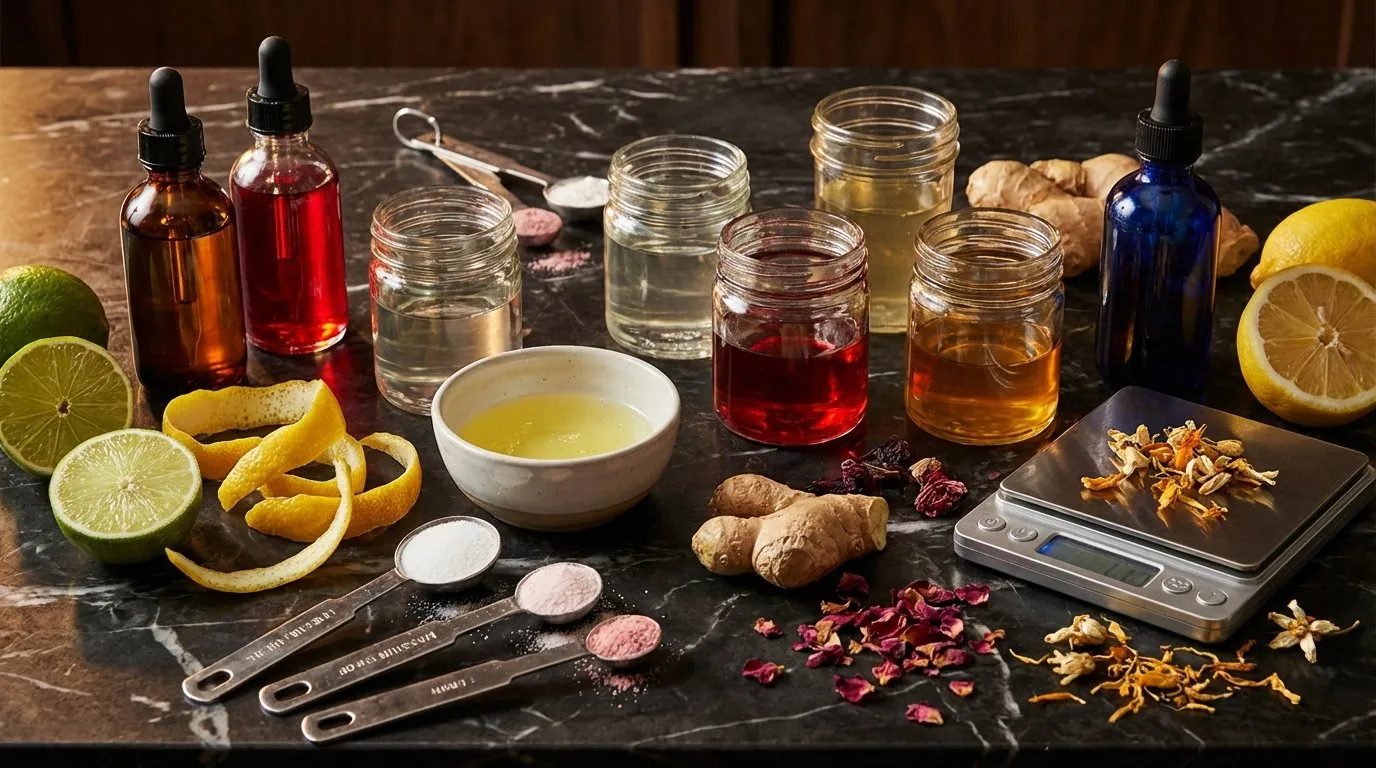
6. Technical Ingredients
Behind every great cocktail are ingredients that never appear in its name but define its character. Precisely calibrated syrups, balancing acids, texturising agents, aromatic waters and technical solutions that let bartenders sculpt flavour and texture with scientific precision. These ingredients are the secret vocabulary of professional cocktail making: mastering them separates the competent bartender from the exceptional one.
Egg White
An animal protein used to create silky foam and a velvety texture in sour cocktails. The albumen coagulates when shaken vigorously, trapping air in a stable foamy structure that crowns the cocktail. A dry shake (shaking without ice) is required to emulsify it properly before adding ice. One egg white per cocktail is standard. It adds body, softens citrus acidity and creates a distinctive presentation. Considerations: absolute freshness (commercial pasteurised eggs are available), protein allergies, vegan preferences. The Whisky Sour, Pisco Sour and Clover Club require it by definition. At Stillroom, the Easy Way and the Pinkie incorporate egg white for their characteristic texture.
Aquafaba
The cooking liquid from chickpeas (or the liquid from a tin), a vegan alternative to egg white. Discovered by accident, aquafaba contains proteins and starches that replicate the foaming properties of egg white. Ratio: 30ml of aquafaba is roughly equivalent to one egg white. It’s processed the same way: a dry shake to emulsify. The resulting foam is slightly less stable but functionally identical for most applications. It allows vegan versions of every foamy sour. Homemade chickpea aquafaba (boiling dried chickpeas) outperforms the tinned kind. A quiet revolution in inclusive cocktail making.
Saline Solution
A precise mixture of salt and water (typically 20% salt by weight: 20g salt in 80g water) used to add controlled salinity drop by drop. Salt enhances flavours, suppresses bitterness, boosts perceived sweetness and adds roundness to a cocktail. Using salt directly is imprecise; the solution allows exact dosing with a dropper. 2-4 drops transform a cocktail without it tasting “salty”. Dave Arnold popularised its use at Booker and Dax in New York. Essential for balancing cocktails where something’s missing but you don’t know what. At Stillroom, saline solution appears in the Tequila Honey to enhance its honey-ginger profile.
Citric Acid
An organic acid naturally present in citrus, available as a crystalline powder for technical use. It brings a clean, bright acidity characteristic of lemon and lime. In cocktail making it’s used to: adjust the acidity of super juices, create acid-adjusted drinks (drinks with precise acidity but no juice), formulate balanced cordials, and compensate for low-acid fruit. It’s measured in grams with precision. Lemon super juice combines citric acid with malic acid (roughly 2:1) to replicate the full profile of fresh juice. A calibration tool that allows a consistency impossible with variable fruit.
Malic Acid
An organic acid present in apples and other fruit, with a softer, more lingering profile than citric acid. On the palate, malic acid has a less aggressive attack but persists longer, creating a rounded acidity. It’s used combined with citric acid to replicate complex citrus profiles: real lemon contains both acids. Typical ratio in lemon super juice: 66% citric, 34% malic. Also useful for creating an “apple” acidity in cordials and fruit preparations. Malic acid alone produces the sensation of tart green apple. A tool for sculpting specific acidity profiles.
Lactic Acid
An acid produced by lactic fermentation, present in fermented dairy, sauerkraut and kombucha. In cocktail making it brings a soft, creamy acidity, with slightly dairy notes that round out the profile without citric acid’s sharpness. It’s produced naturally in lactofermentations and can be added in purified form to adjust. Cordials acid-adjusted with lactic acid have a more complex, less sharp mouthfeel. Stillroom’s Garibaldi Fermentado gets its distinctive acidity from the lactic acid produced during the lactofermentation of orange and grapefruit, creating a profile impossible to replicate with fresh citrus.
Gum Arabic
A natural resin from the Acacia senegal tree, used as an emulsifier, stabiliser and texturiser. In cocktail making, gum arabic is the secret ingredient in gomme syrup: it adds a silky texture, improves mouthfeel and stabilises foams. It also emulsifies ingredients that would normally separate (oils and water). It’s dissolved in warm water and incorporated into syrups. Syrups with gum arabic have superior body and integrate better into shaken cocktails. Historically present in classic nineteenth-century syrups. It’s seen a revival in the craft era for its unique textural contribution.
Lecithin
A natural emulsifier derived from soy, sunflower or egg yolk, essential for creating light airs and foams. Lecithin allows water and air to mix stably, creating tiny, persistent bubbles. Typical ratio: 0.5-1% of the liquid’s weight. It’s added to the cold liquid and aerated with a stick blender or hand whisk until an ethereal foam forms. Lecithin airs are lighter than siphon foams: nearly transparent, fleeting, purely aromatic. At Stillroom, the black pear tomato air crowning the Green Margarita is created with lecithin, bringing umami aroma with no weight.
Orange Blossom Water
A hydrosol from bitter orange blossom, a byproduct of neroli distillation. An intensely floral profile, with notes of honey, orange and jasmine. Originally from the Mediterranean and the Middle East, where it’s used in traditional pastries and drinks. In cocktail making, small amounts (drops, not millilitres) add an elegant floral dimension. Essential in the Ramos Gin Fizz (alongside cream and egg white), present in traditional orgeat. Potent orange blossom water demands a delicate hand: too much produces a soapy profile. Buy food-grade quality, not cosmetic. Store refrigerated once opened.
Rose Water
A hydrosol from rose petals, an aromatic distillate with an intense floral profile, slightly bitter and deeply perfumed. A Persian and Middle Eastern tradition. In Western cocktail making, rose water adds floral sophistication to cocktails with gin, vodka or neutral spirits. Use with extreme restraint: a few drops are enough; too much dominates any cocktail and produces the sensation of drinkable perfume. It works in Aviation variations, floral Gimlets, combinations with raspberry or lychee. Quality varies enormously: look for double-distilled, food-grade rose water. Store away from light and heat.
Beeswax
A natural wax from honeycomb, used in fat washing to bring an unctuous texture and subtle notes of honey and propolis to a spirit. Unlike liquid fats, the wax melts at around 65°C and solidifies completely on cooling, making for a clean separation. The beeswax tequila in Stillroom’s Tequila Honey exemplifies this technique: the beeswax adds roundness, an oily mouthfeel, and complements the cocktail’s honey profile without adding extra sweetness. It’s also used to seal artisan bottles and create decorative garnishes. Use food-grade wax, not cosmetic.
Gomme Syrup
A simple syrup enriched with gum arabic, producing a silky texture and superior body. A traditional nineteenth-century formula that fell out of use, revived in the craft era. Gum arabic acts as an emulsifier that softens the mouthfeel and improves the integration of sweetness. Typical ratio: 1:1 or 2:1 syrup with 1-2% dissolved gum arabic. Gomme syrup transforms shaken cocktails: the foam is finer, the body rounder, the texture more luxurious. Especially notable in sours where it plays against the acidity. It requires homemade preparation; commercial versions are rare.
Rich Simple Syrup (2:1)
A sugar syrup with a 2:1 ratio (two parts sugar to one of water by weight), denser and sweeter than standard simple syrup (1:1). Advantages: less dilution of the cocktail (less added water), longer shelf life (a high sugar concentration inhibits micro-organisms), a more viscous texture. It’s used in smaller quantities than 1:1 to achieve the same sweetness. The modern standard in professional cocktail making. Preparation: heat water, add sugar 2:1, stir until fully dissolved. Do not boil. Store refrigerated in a sterile bottle. The base for flavoured syrups.
Honey Syrup
Honey diluted with water to make it easier to dose and mix into cold cocktails. Pure honey is too viscous: it doesn’t disperse well in cold liquids and sinks. Standard ratio: 3:1 or 2:1 (honey:hot water). The resulting syrup flows easily and integrates when shaken. Honey’s profile (floral, earthy, depending on variety) adds complexity superior to simple sugar. Different honeys (acacia, forest, manuka, lavender) create different profiles. The Gold Rush (bourbon + lemon + honey syrup) is the contemporary classic. At Stillroom, the Zest & Roots uses acacia honey that complements the gin with turmeric and ginger.
Demerara Syrup
A syrup made with Demerara sugar, a partially refined cane variety with large crystals and a golden colour. The profile includes notes of molasses, toasted caramel and an earthy complexity absent from white sugar. Preparation is identical to simple syrup, just with Demerara. Particularly suited to cocktails with dark spirits: Demerara enhances bourbon, aged rum, brandy. An Old Fashioned made with Demerara syrup is significantly more complex than one made with simple syrup. It also works in dark Daiquiris and tiki cocktails. A minimal investment with maximum impact on the final result.
Grenadine
An authentic pomegranate syrup, dark red, with a fruity-tart profile and elegant sweetness. Cheap commercial grenadine is often dyed corn syrup with no real pomegranate: avoid it absolutely. Homemade grenadine (pomegranate juice + sugar 1:1, reduced) or quality brands (Jack Rudy, Small Hand Foods, Liber & Co) are essential. Essential in the Tequila Sunrise, El Presidente, Jack Rose, Shirley Temple. The red colour brings visual drama; the flavour should be fruity, not artificial. Pomegranate contributes subtle tannins that add structure. Making it at home is simple and transformative.
Lime Juice
A fundamental citrus in cocktail making, with a more acidic, less sweet and more floral profile than lemon. Persian lime (Citrus latifolia) is the Western cocktail-making standard; key lime (Citrus aurantifolia) is more aromatic and acidic, preferred in tiki and Caribbean cocktails. Always use fresh juice: bottled juice lacks essential oils and complexity. Lime juice oxidises quickly: prepare it fresh or at most 4 hours ahead. Squeeze by hand or with a press; avoid a blender, which extracts bitterness from the pith. The foundation of the Daiquiri, Margarita, Mojito, tiki cocktails. The difference between fresh and bottled lime is vast.
Lemon Juice
The most versatile acid in cocktail making, with a bright, clean, universally complementary profile. The eureka/lisbon lemon is standard; the Meyer lemon (a hybrid with mandarin) is sweeter and more floral. Like lime, always use it fresh: degradation begins immediately after squeezing. Lemon juice balances sweetness, enhances other flavours and provides the structural acidity of sours. The super juice technique (peel + acids + juice + water) multiplies yield while preserving quality. The foundation of the Whisky Sour, Sidecar, Tom Collins, French 75. The most-consumed ingredient after water and ice in any bar.
Tonic Water
Carbonated water with quinine (a bitter alkaloid from cinchona bark) and sugar, developed as an anti-malarial prophylactic in colonial British India. Quinine’s characteristic bitterness complements gin’s botanicals, creating the Gin and Tonic. Premium tonics (Fever-Tree, East Imperial, 1724) contain natural quinine and less sugar than commercial ones, allowing for drier, more complex profiles. The choice of tonic dramatically impacts the final cocktail: experiment with different brands and sweetness levels. Serve very cold, freshly opened, to preserve carbonation.
Soda Water
Carbonated water with no flavour or sugar, the neutral diluent par excellence. Soda adds fizz and volume without altering flavours. Quality varies: strong carbonation (siphon sodas, premium brands) produces a livelier texture than weakly carbonated commercial ones. A traditional soda siphon allows carbonation on the spot, ideal for professionals. In cocktails, soda is always added last (as a top) to preserve the bubbles; it’s never shaken. Essential in the Collins, Fizzes, Americano, Spritz, Mojito. The difference between excellent and mediocre soda significantly affects the experience of a long drink.
Carbonation
A technique for dissolving carbon dioxide (CO2) into a cocktail —with a siphon, a bottle carbonator or soda— to give it its own fizz and sparkle. It shouldn’t be confused with foam or air, which incorporate air rather than CO2. It works best with a liquid that’s very cold and free of particles: a clean, ice-cold liquid holds the gas for longer.
📖 Full guide: Cocktail carbonation (CO2) — find out more here →
Ginger Beer
A carbonated ginger drink with a spicy, sweet, peppery profile, significantly more intense than ginger ale. Traditional ginger beer is fermented (slightly alcoholic); modern versions are typically artificially carbonated but keep the intense spiciness. Brands vary enormously in intensity: Fever-Tree and Fentimans are balanced; Bundaberg and Reed’s spicier; Q Ginger Beer extremely intense. The foundation of the Moscow Mule (vodka + ginger beer + lime) and the Dark ’n’ Stormy (dark rum + ginger beer). Homemade ginger beer (fermented ginger) outdoes anything commercial.
Ginger Ale
A carbonated soft drink with a mild ginger flavour, significantly less intense than ginger beer. Two main styles: golden/pale (American, very mild, almost purely sweet with a hint of ginger) and dry (Canadian, drier and with more ginger). Ginger ale works where subtlety is wanted: the Whisky Ginger, the Presbyterian, the Horse’s Neck. Canada Dry is the commercial standard; Fever-Tree Ginger Ale offers a premium version with real ginger. For cocktails that need ginger’s spicy kick, use ginger beer; for a mild accompaniment that won’t compete, use ginger ale. They’re distinct products, not interchangeable.
Tincture
A concentrated extract where an aromatic ingredient (spice, herb, root, peel) is macerated in high-proof alcohol to extract soluble compounds. Tinctures are extremely concentrated: used in drops, not millilitres. High-proof alcohol (vodka, minimum 40%, preferably overproof at 60%+) efficiently extracts essential oils and aromatic compounds. Common tinctures: jalapeño (spicy), lavender (floral), coffee (roasted), cacao (chocolate). Unlike bitters, tinctures are typically single-ingredient, with no sweet/bitter balancing. A tool for adding specific notes with surgical precision.
Tomato Soda
A carbonated preparation of clarified tomato water or tomato juice with added CO2. Tomato water is obtained by filtering crushed tomatoes or through clarification (agar, centrifugation). The result is a crystal-clear liquid with the umami-vegetal flavour of tomato, with no pulp or colour. Carbonated, it produces a refreshing soda with unique savoury notes. At Stillroom, the Highball Martini incorporates tomato soda alongside olive brine, deconstructing the Dirty Martini twist into a long, fizzy format. A high-end cocktail-making technique that transforms an everyday ingredient into a sophisticated component.
Olive Brine
The preserving brine from olives, a salty liquid with pronounced umami and olive notes. An ingredient in the Dirty Martini, where it adds salinity and savoury complexity. The quality of the brine depends on the olives: quality olives in natural brine produce a liquid superior to commercial ones in artificial solution. Spanish casapueblo, manzanilla and gordal olives offer excellent brines. Beyond the Martini, olive brine works in Bloody Marys, dry-vermouth cocktails and savoury preparations. At Stillroom, the Highball Martini incorporates olive brine as a component of the saline-umami profile that defines this deconstruction of the classic.
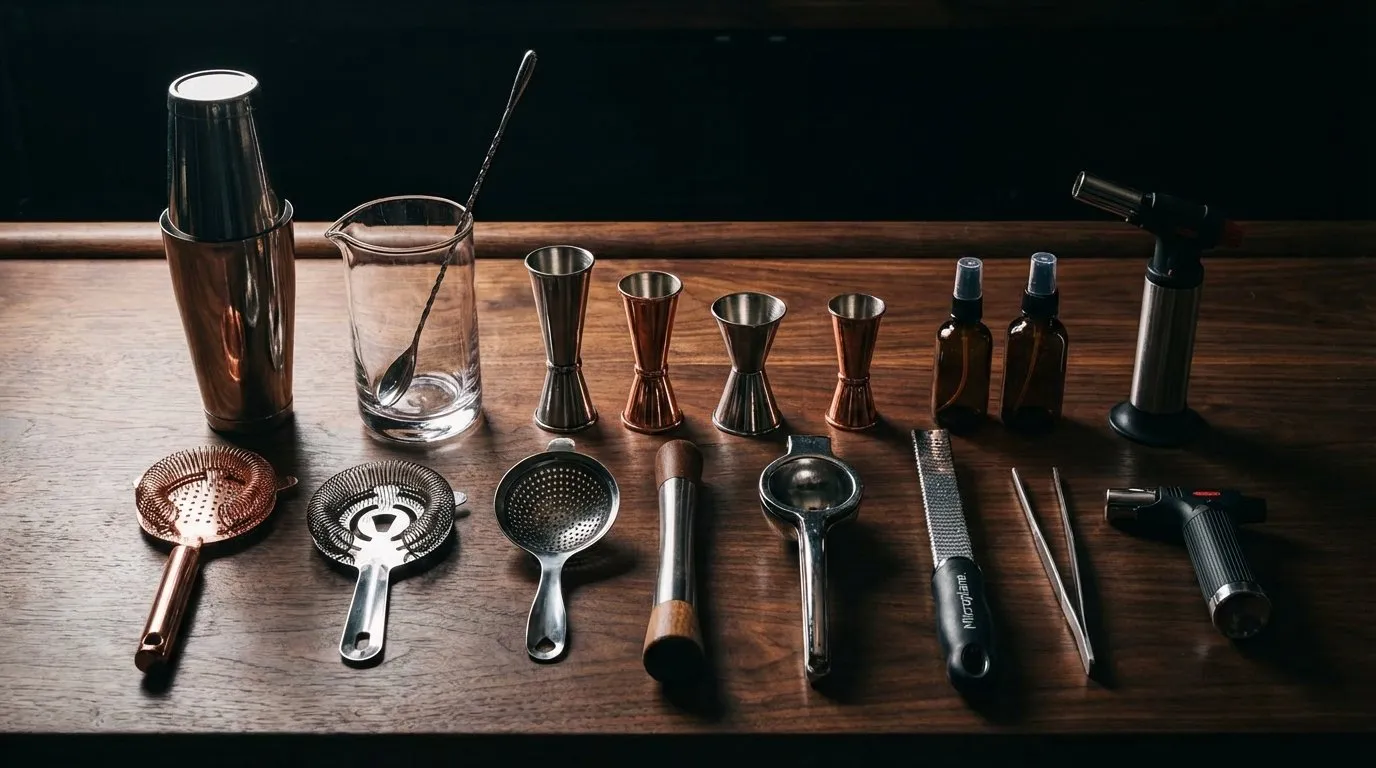
7. Bar Tools
Tools are an extension of the bartender: each one designed for a specific function, perfected over decades of evolution. Knowing not just what each tool does but how to use it correctly separates the enthusiast from the professional. A badly shaken shaker, a misread jigger, a badly positioned strainer ruin cocktails that are technically perfect on paper. Mastering the equipment is mastering the craft.
Boston Shaker
A professional shaker system made up of two pieces: a large metal tin (28oz/800ml) and a smaller glass or metal mixing tin (18oz/500ml). The pieces are fitted together by striking the palm against the metal tin, creating an airtight seal through thermal vacuum as it chills. Advantages over the cobbler: greater capacity, more efficient chilling, no risk of a built-in strainer clogging, faster in professional service. It requires a separate Hawthorne strainer. Opening technique: a sharp strike with the palm at the join. The global standard in professional cocktail making for speed and control.
Cobbler Shaker
A three-piece shaker: a base tin, a lid with a built-in strainer, and a small cap that doubles as an improvised measure. A classic, elegant design, accessible for home use. Advantages: a built-in strainer (no Hawthorne needed), visually appealing, easy for beginners to use. Disadvantages in professional use: limited capacity, the built-in strainer clogs with herbs/pulp, the lid tends to seal shut from vacuum (hard to open), slower in service. High-end Japanese cobblers (Yukiwa, Birdy) minimise these limitations with superior engineering and metals that don’t clog.
Mixing Glass
A thick glass vessel designed specifically for the stir technique: cocktails made up solely of spirits and liqueurs that require elegant integration without aeration. The glass allows you to observe the dilution and the movement of the liquid. Typical capacity: 500-700ml. Japanese glasses (Yarai, with a carved pattern) are design icons; seamless versions allow a smoother stir. Always used with a long bar spoon and a Julep strainer. The glass is pre-chilled with ice, which is discarded before building the cocktail. Essential for the Martini, Manhattan, Negroni and all stirred cocktail making.
Bar Spoon
A long-handled spoon (25-40cm) with a helical twist and a small bowl, designed for stirring cocktails in a mixing glass and carrying out precision techniques. The twist makes for a smooth rotary motion and allows liquids to be poured slowly for layering. The opposite end can have a weight (for balance), a flat disc (for muddling) or a trident (for garnishes). Correct stirring technique: the spoon is held between index, middle and ring finger, turning at the wrist while the bowl stays in contact with the glass. Length according to preference and the depth of the glass. A precision tool, not a simple utensil.
Jigger
A double-cone measure for dosing liquids with precision, the foundation of consistency in cocktail making. Standard capacities: 30/60ml (1oz/2oz), 25/50ml, 15/30ml. Japanese jiggers (Yukiwa, Leopold style) include interior lines for intermediate measures. Correct technique: filling to the exact rim (not above, not below), viewed at eye level. “Free pouring” (pouring without measuring) produces inconsistency: professionals always measure. Stainless steel jiggers are standard; copper ones need upkeep. The difference between 25ml and 30ml completely transforms a cocktail’s balance.
📖 Full guide: Cocktail measures — jigger, dash and parts — find out more here →
Hawthorne Strainer
A metal strainer with a helical spring designed to fit the mouth of the Boston shaker, holding back ice and large solids while the liquid flows through. The spring adapts to different diameters and creates an effective seal. The flat tab lets you adjust the opening by pressing on it: more open for a fast strain, more closed to hold back fine particles. It’s used with the dominant hand while the other holds the shaker. For cocktails with pulp or herbs, combine it with a fine strainer (double strain). Koriko and OXO are reference brands. An indispensable tool for any professional setup.
Julep Strainer
A concave, perforated strainer designed for the mixing glass, shaped like a large spoon that’s inserted at an angle to hold back ice while pouring a stirred cocktail. Historically used by drinkers (not bartenders) to hold ice back while drinking straight from the glass. Today it’s exclusively a bartender’s tool. The concave shape lets it be inserted by pressing against the ice; the hand holds both glass and strainer simultaneously while pouring. Aesthetically more elegant than the Hawthorne for stirred cocktail service. Some bartenders use the Hawthorne universally; purists reserve the Julep for stirred cocktails.
Fine Strainer
A fine metal mesh mounted on a hoop, used for double straining: it removes microscopic particles that the Hawthorne lets through. Ice fragments, air bubbles, residual pulp, muddled herb debris: everything gets caught. Essential for cocktails served without ice (up) where a crystal-clear presentation is the priority. It’s held with the free hand over the glass while pouring through the Hawthorne. Stainless steel mesh; avoid aluminium, which affects acidic flavours. Double straining transforms the texture and visual elegance of the final cocktail. A small tool, an enormous impact.
Muddler
A cylindrical tool for muddling fresh ingredients, extracting oils, juices and flavours. Materials: wood (traditional, absorbs odours), stainless steel (hygienic, durable), food-grade plastic (affordable, functional). The end can be flat (for pressing herbs) or toothed (for crushing fruit). Correct technique: firm pressure with a twist, not violent pounding. With herbs (mint, basil) you press gently to release oils without turning them bitter. With fruit (lime in a Caipirinha) you muddle intensely to extract juice. Sized appropriately for working in glasses and deep shaker tins.
Citrus Juicer
A tool for extracting juice from lemons, limes and oranges. Main types: the Mexican lever press (very efficient, the citrus goes in skin-side down), the manual reamer (full control, slower), the electric juicer (high volume, less control). The lever press flips the citrus: the pressure comes from the skin side, maximising extraction without pulling in bitter oils. Sizes colour-coded: yellow for lemons, green for limes, orange for oranges. In high-volume bars, juices are prepared in batches; freshness declines after 4-6 hours. A professional citrus press for intensive service.
Peeler / Y-Peeler
A tool for cutting citrus twists: wide strips of peel with no white (bitter) pith. The Y-peeler, with its horizontal blade, allows precise control of thickness, producing uniform twists with minimal pith. Technique: gentle pressure, a constant angle, a smooth movement following the fruit’s curve. Alternatives: a paring knife (more control, slower), a channel zester (thin strips). Citrus peel contains essential oils that are expressed over the cocktail; the quality of the twist affects the aromatic release. Professional twists have uniform thickness, clean edges and a consistent length.
Microplane / Grater
A fine-blade grater that produces aromatic dust from spices, citrus and other ingredients. The original Microplane (a brand name turned generic) has sharp teeth that scrape without tearing. Applications in cocktail making: fresh nutmeg over Flips and Egg Nogs (infinitely superior to pre-ground), pith-free citrus zest, cinnamon stick, chocolate, ginger. It’s grated directly over the finished cocktail as an aromatic garnish. The aroma of freshly grated spice transforms the olfactory experience of the first sip. A finishing tool that marks the difference between a mediocre bar and an excellent one.
ISI Siphon / Foam Dispenser
A pressurised vessel that uses N2O (nitrous oxide) cartridges to create foams, rapid infusions and carbonation. The gas dissolves into the liquid under pressure; when dispensed, it comes out as a stable foam. Applications: cocktail foams (foams from any liquid), rapid infusions (30 seconds under pressure equals hours of maceration), whipped cream, dense airs. Capacities: 0.25L, 0.5L, 1L. It requires meticulous cleaning and respect for pressure guidelines. The ISI siphon (an Austrian brand) is the professional standard. It revolutionised texture in contemporary cocktail making.
Kitchen Blowtorch
A flaming tool for caramelising, toasting and igniting with precision. In cocktail making: flaming citrus peel to caramelise its oils (a flamed twist), toasting the surface of foams, caramelising sugar on glasses (crème brûlée style), lighting aromatic garnishes, burning wood for smoking. Professional butane torches offer an adjustable flame and piezoelectric ignition. Precautions: never point it at people, keep it away from flammable materials, don’t use it near spilled alcohol. A flamed twist over an Old Fashioned adds toasted notes impossible to achieve any other way.
Cocktail Smoker
A device for introducing smoke into glasses or directly into cocktails. Main types: a lid/dome smoker (covers the glass, fills with smoke, is lifted at service), a smoking gun (fires cold smoke into the liquid or vessel), a smoking board (a surface holding lit wood chips). Fuels: wood chips (oak, apple, cherry, walnut), dried herbs (rosemary, thyme), spices (cinnamon stick, clove), aromatic woods (palo santo). Smoke brings smoky complexity, visual spectacle and an immersive aroma. At Stillroom, the smoked Campari in the Easy Way uses smoking techniques to add depth to the classic bitter.
Stick Blender
A portable appliance with rotating blades for emulsifying, blending and aerating liquids. In technical cocktail making: creating airs with lecithin (intensive aeration produces a light foam), emulsifying foams, preparing ultra-fine purées, integrating difficult ingredients. Professional stick blenders have enough power to run continuously without overheating. For airs: submerge it partway into the liquid with lecithin, tilt to incorporate air, blend until a consistent foam forms. The tomato air on Stillroom’s Green Margarita needs a stick blender for its characteristic ethereal texture.
Cutting Board
A surface for preparing garnishes, cutting fruit and working with fresh ingredients. In a professional bar: polyethylene boards (hygienic, non-absorbent, colour-coded) or hardwood (oak, maple —attractive, need upkeep). Standard colour code: green for fruit/vegetables, white for dairy, red for meat. Sized appropriately for the workspace; thick enough for stability. Keep surfaces spotless: flavours and odours transfer. Separate boards for intense ingredients (garlic, onion) that would contaminate fruit. An organised mise en place on a clean board defines professionalism.
Bar Tongs
A tool for handling ice, garnishes and ingredients without direct hand contact. Types: ice tongs (large, serrated tips for grip), precision tongs (small, for delicate garnishes), service tongs (medium, multi-purpose). Material: stainless steel exclusively. Hygienic handling is mandatory in professional cocktail making: never touch ice or garnishes with bare hands. Precision tongs allow decorative elements to be placed exactly. Using tongs communicates professionalism and respect for hygiene to the customer watching the preparation.
Dropper
A small pipette for dosing concentrated liquids drop by drop: bitters, tinctures, saline solutions, extracts. It allows a precision impossible with direct pouring. Glass droppers with a rubber bulb are standard; food-grade plastic versions for intensive use. Volume per drop: roughly 0.05ml (varies with viscosity and diameter). Bitters bottles include a built-in dasher; separate droppers are used for homemade preparations. Saline solution, spicy tinctures and aromatic extracts all need drop-by-drop dosing to avoid throwing a cocktail off balance.
Atomiser / Spray
A small bottle with a spray mechanism for misting liquids over cocktails or into empty glasses. Main applications: an atomised rinse (absinthe on the Sazerac, mezcal in variants), surface aromatisation, essential oils over foams, final liquid perfumes. Atomising deposits a minimal amount of liquid in microscopic droplets: maximum aroma, minimum volume. Advantage over a traditional rinse (pour and discard): zero waste, even coverage, total control. Glass atomisers preserve aromas better; plastic ones for intensive use. Fill with filtered liquids to avoid clogging the mechanism.
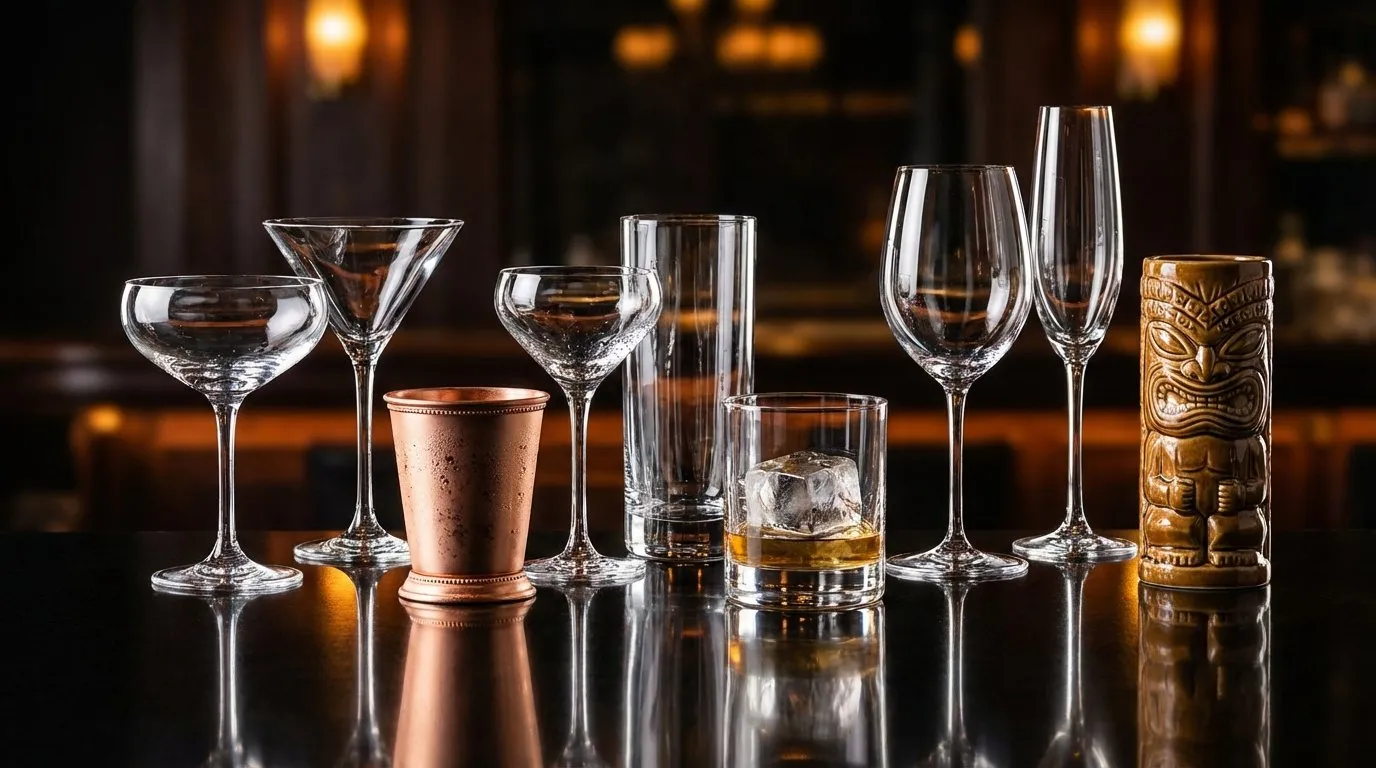
8. Glassware
The glass is the cocktail’s frame: it determines the visual experience, the serving temperature, the aromatic concentration and the ergonomics of drinking. Every design evolved to optimise specific categories of drinks. The Martini in a coupe, the Old Fashioned in a sturdy tumbler, the Highball in a tall cylinder: these aren’t arbitrary choices but functional decisions perfected over more than a century. Choosing the right glassware means respecting the cocktail’s identity.
Coupe Glass
A stemmed glass with a wide, shallow bowl, originally designed for champagne in the nineteenth century. Urban legend links it to Marie Antoinette’s breast (false). Today it’s the preferred glass for cocktails served “up” (without ice): its wide mouth releases aromas generously, the stem stops the liquid warming from the hand, and its shallow depth displays the cocktail elegantly. Typical capacity: 150-180ml. Ideal for Daiquiris, Sidecars, Last Words, Aviations. At Stillroom, the Green Margarita is presented in a classic coupe, showing off the green colour of the fat-washed tequila with the tomato air crowning the surface.
Martini Glass (Cocktail Glass)
An iconic inverted-V glass with a long stem, the universal symbol of the cocktail. The conical design concentrates aromas towards the nose as you drink; the long stem lets you hold it without transferring heat. Elegant but impractical: its high centre of gravity makes it prone to spills. Capacity: 90-150ml (modern giant versions of 300ml+ are aberrations that dilute classic proportions). Historically for Martinis and Manhattans, today many bartenders prefer the more stable coupe. The Martini glass communicates instant sophistication but demands a steady hand from the drinker.
Nick & Nora
A stemmed glass with a rounder bowl, smaller and deeper than the coupe, named after the leads of “The Thin Man” (1934). It’s seeing a contemporary revival for its practical elegance: the more closed bowl concentrates aromas better than the coupe, its contained size (150ml) forces correct proportions, and its deep shape minimises spills. Perfect for stirred, spirit-forward cocktails: Martinis, Manhattans, Negronis served up. It communicates vintage sophistication with modern functionality. Many contemporary bartenders consider it superior to the traditional Martini glass for its balance of aesthetics and usability.
Highball Glass
A tall, straight, cylindrical glass, designed for long drinks with plenty of mixer and ice. Typical capacity: 240-350ml. The tall shape preserves carbonation (less surface contact with air), holds enough ice to maintain temperature and allows generous mixer proportions. The Japanese Highball perfected the service: crystal-clear ice right to the top, precise proportions, impeccable carbonation. Essential for the Gin and Tonic, Cuba Libre, Whisky Highball, Moscow Mule (when not using a copper mug). At Stillroom, the Blue Tonic, Japanese Style, Highball Martini and Zest & Roots are served in a highball, honouring the family of refreshing long drinks.
Collins Glass
Similar to the highball but slightly taller and narrower, with a larger capacity (300-400ml). Named after the Tom Collins, designed to accommodate the extra volume of cocktails with plenty of soda. The difference from the highball is subtle: the Collins is more slender, emphasising verticality. In practice, many bars use highball and Collins glasses interchangeably. Purists reserve the Collins for its namesake cocktail and its variants (John Collins, Vodka Collins). The tall cylindrical shape with straight walls is constant in both, optimised for fizzy drinks served with a straw.
Old Fashioned / Rocks Glass
A short, sturdy, thick-walled glass, designed for cocktails served “on the rocks” with a large ice cube. Capacity: 180-300ml. The heavy design conveys solidity; the thick walls hold temperature; the wide mouth allows aromas through and accommodates large cubes or ice spheres. Named after the Old Fashioned cocktail, it’s the definitive vessel for spirit-forward drinks with minimal dilution: the Negroni, Old Fashioned, Sazerac, whisky neat. At Stillroom, the Punch, Super Fashion, Easy Way, Green Negroni and Tequila Honey are served in an Old Fashioned glass, honouring the tradition of short cocktails where the spirit is the star.
Double Old Fashioned (DOF)
An enlarged version of the Old Fashioned glass with greater capacity (350-400ml), keeping the same sturdy proportions and thick walls. It accommodates more ice and liquid for cocktails that need extra volume without losing the short-glass aesthetic. Popular for serving Negronis with plenty of ice, generous Old Fashioneds, or simplified tiki cocktails. Also common for serving spirits with large cubes or spheres where the ice takes up significant volume. The DOF allows for more dramatic presentations while keeping the rocks glass’s visual identity.
Wine Glass
A stemmed glass with a wide bowl, originally for wine, adopted in cocktail making for the Spritz and aperitivos. The globe shape concentrates aromas; the stem allows holding without warming; the generous volume (350-500ml) accommodates ice, wine, liqueur and abundant garnishes. The Aperol Spritz popularised the wine glass as a casual, social cocktail vessel. It also works for sangria, wine with fruit, and summer cocktails where informality is part of the experience. The large wine glass conveys generosity, accessibility and relaxed enjoyment.
Flute
A tall, narrow glass designed for champagne and sparkling cocktails. The tubular shape minimises surface contact with air, preserving carbonation and perlage (the bubbles). The long stem prevents heat transfer. Capacity: 150-200ml. Perfect for the French 75, Kir Royale, Bellini, Champagne Cocktail. The bubbles rise visibly through the narrow tube, creating spectacle. Some sommeliers argue the flute sacrifices aromatic expression to preserve effervescence; tulip glasses offer a compromise. For cocktails where the bubble is the star, the flute remains the undisputed classic choice.
Balloon Glass (Gin and Tonic Glass)
A large-volume glass (600-800ml) with a wide globular bowl and a short stem, popularised in Spain for the contemporary Gin and Tonic ritual. The wide mouth releases botanical aromas; the enormous volume accommodates plenty of ice, generous proportions and elaborate garnishes; the rounded shape shows off the colour and decorative elements. Originally a cognac/brandy glass, Spain adopted it for the Gin and Tonic, elevating it into a global phenomenon. Criticised for over-diluting and making correct proportions difficult; defended for its theatricality and immersive sensory experience. An icon of Spanish gin culture.
Tiki Mug
A sculptural ceramic vessel shaped like Polynesian idols, moai heads, pineapples, skulls or other kitsch tropical motifs. An essential part of the tiki experience: the cocktail isn’t just drunk, it’s performed. The mugs hide their contents, creating mystery; the elaborate shapes invite collecting; the ceramic material holds temperature. Variable capacity: 300-500ml. Originating in the Tiki bars of Don the Beachcomber and Trader Vic in the 1930s-40s, today they’re collector’s items. At Stillroom, the Tropical Tiki can be served in an appropriate ceramic mug to honour the genre’s escapist tradition.
Julep Cup / Pewter Cup
A metal cup (traditionally pewter or silver, today stainless steel or copper) with no stem, designed specifically for the Mint Julep. The metal conducts cold spectacularly: with crushed ice, the outside of the cup frosts over, creating a characteristic presentation. The frost indicates perfect temperature and is an essential part of the experience. It’s held only by the upper rim or the base, so as not to warm it with the hand or melt the frost. The Kentucky Derby standardised the pewter cup as its official vessel. It works for any cocktail with crushed ice where the frosted spectacle adds value.
Snifter
A short-stemmed glass with a wide bowl at the base that narrows towards the mouth, designed to concentrate the aromas of aged spirits. The hand wraps around the bowl, subtly warming the liquid and releasing volatiles; the narrow mouth directs the aromas towards the nose. Capacity: 180-350ml (only a small portion is poured). Classic for brandy, cognac and tasting whisky. In cocktail making, it’s used to serve complex aromatic cocktails or as a vessel for flaming (the narrow mouth concentrates the flame). Elegant for special presentations where aroma is the star.
Clay Cup / Sake Cup
An artisan ceramic vessel with a rustic aesthetic and tactile textures, traditionally used for sake and mezcal. The porous material interacts subtly with the liquid; the irregular shapes communicate craftsmanship; the absence of a stem connects the hand directly to the vessel. For sake, specific categories exist: ochoko (a small cup), guinomi (a larger cup), masu (a wooden box). The clay cup brings cultural authenticity and a tactile sensory experience. At Stillroom, the Satori Floral is considered for service in a sake or clay cup, to honour its Japanese ingredients: infused sake, yuzu, shiso, sakura blossom.
9. Service Terminology
Bar language is shared code between professionals and informed customers. These words and expressions —many inherited from English— communicate service preferences, recipe modifications and preparation styles with telegraphic precision. “Dry Martini, up, with a twist” conveys in five words exactly what the customer expects. Mastering this terminology means speaking the universal language of the bar, from Madrid to Tokyo.
Neat
A spirit served alone, at room temperature, with no ice, water or accompaniment. The liquid goes straight from the bottle to the glass, typically an Old Fashioned glass or a snifter. “Neat” is the purest way to appreciate a spirit: no dilution to soften it, no cold to numb the palate, no modifiers to mask it. Reserved for quality spirits where the aim is contemplative tasting. Not to be confused with “straight up” (which implies chilling and straining). Whisky neat, mezcal neat, cognac neat: they communicate respect for the spirit and a desire for an unmediated experience.
On the Rocks
Served over ice in a short glass (a rocks/Old Fashioned glass). The ice chills and gradually dilutes, softening the spirit and evolving its profile as it’s drunk. The quality of the ice matters enormously: large, dense cubes dilute slowly; small or hollow ice will water it down fast. “Whisky on the rocks” is a classic order; “Negroni on the rocks” is standard service. The term “rocks” refers to the ice. Some spirits (a mild bourbon, a reposado tequila) shine on the rocks; others (delicate single malts) drown. A legitimate personal preference.
Up / Straight Up
A cocktail shaken or stirred with ice, then strained and served without ice in a stemmed glass (coupe, Martini, Nick & Nora). The liquid is cold but the glass holds no ice: the stem lets you hold it without warming it up. “Martini up” is the classic service; “Daiquiri up” too. The critical difference from “neat”: straight up implies a chilling process with ice followed by straining. The cocktail is cold but clean, with no ongoing dilution. The temperature holds only briefly; drink it fairly promptly for the best experience.
Dirty
A modification that adds olive brine to a cocktail, mainly the Martini. The Dirty Martini includes a splash of brine that brings salinity, umami and a characteristic cloudiness. Gradations: “slightly dirty” (a little brine), “dirty” (the standard amount), “filthy” or “extra dirty” (plenty of brine, a dominant olive flavour). The quality of the olives and their brine directly affects the result. Beyond the Martini, “dirty” can be applied to any cocktail where that saline-olive profile is wanted. At Stillroom, the Highball Martini incorporates olive brine as a nod to the deconstructed Dirty Martini.
Perfect
A modification indicating equal parts red vermouth and dry vermouth, instead of using just one. The “Perfect Manhattan” carries half red vermouth, half dry; the “Perfect Martini” balances both vermouths. The term suggests “perfect balance” between sweet and dry. It doesn’t mean it’s better or worse than the standard version: it’s a specific variation with an intermediate profile. Useful for those who find the Manhattan too sweet or the Dry Martini too austere. Any cocktail with vermouth can be made “perfect” by splitting the ratio between both styles.
Twist
A strip of citrus peel (with no white pith) expressed over the cocktail to release its essential oils, optionally rubbed on the rim and dropped in as a garnish. “Martini with a lemon twist” indicates citrus aromatisation is wanted instead of an olive. The twist is cut with a peeler, held over the cocktail with the coloured side facing down, and folded sharply so the oils burst out in an aromatic spray. It can be flamed to caramelise. Types by citrus: lemon twist, orange twist, grapefruit twist. The twist transforms the aromatic profile of the first sip.
Wedge
A triangular citrus cut, typically 1/8 of the fruit. Used as both garnish and functional element: the customer can squeeze extra juice to taste. Common in the Gin and Tonic (a lime or lemon wedge), the Corona (a lime wedge pushed into the neck), Mexican beers. The wedge brings colour, aroma and the option to adjust acidity. Difference from the “wheel”: the wedge is three-dimensional and squeezable; the wheel is a decorative slice. “With a lime wedge” communicates exactly what garnish is expected. A standard mise en place cut in any bar.
Wheel
A full circular cut of citrus, a cross-section slice roughly 5mm thick. It’s placed on the rim of the glass, floating in the cocktail, or as decoration inside. Mainly decorative, though it releases aromatic oils on contact with the liquid. Common in the Collins, Highballs, long drinks where looks matter. A half-wheel is a frequent variation. Wheels are cut from firm fruit, with no visible seeds, using a sharp knife for clean edges. A fundamental part of the visual mise en place that communicates freshness and attention to detail.
Back / Chaser
A non-alcoholic drink served alongside the spirit or cocktail to “chase” or alternate with. “Whisky with a water back” means a glass of whisky accompanied by a separate glass of water. The back cleanses the palate, refreshes and lets you control dilution externally. A “pickleback” is a whisky shot immediately followed by a shot of pickle brine (an American trend). Soda back, ginger ale back, water back are common requests. The chaser isn’t mixed in: they’re two separate vessels the drinker alternates between as preferred.
Call
An order that specifies a particular brand of spirit instead of accepting the bar’s standard option (the well). “Gin and Tonic with Tanqueray” is a call drink: the customer “calls” for the desired brand by name. The cocktail’s price rises according to the difference between the well and the requested brand. Call drinks communicate an informed preference and willingness to pay for a specific quality. An intermediate category between well (the cheapest) and top shelf (premium). The bartender must confirm availability if the requested brand isn’t in stock.
Well
The house’s standard spirits, stored in the “well” (a quick-access bottle rack) at the workstation. They’re the default options when the customer doesn’t specify a brand: “a gin and tonic” with no further instruction uses the well gin. Well spirits are affordable and high-turnover; quality varies enormously depending on the establishment. In quality bars, even the well is drinkable; in others, they’re bottom-shelf spirits. A “well drink” carries the menu’s base price. Knowing a bar’s well policy tells you what to expect when ordering without specifying a brand.
Top Shelf
High-end spirits, typically placed on the top shelf of the back bar, where they’re visually displayed. These are the premium bottles: aged single malts, extra añejo tequilas, XO cognacs, limited-edition bourbons. “Top-shelf Margarita” indicates premium tequila is to be used instead of well or call. The price reflects the spirit’s category. Some bars distinguish between call (a standard quality brand), premium (high-end) and top shelf (the most exclusive). Terminology varies but the hierarchy is universal: well < call < premium < top shelf.
Virgin / Mocktail
A non-alcoholic version of a cocktail, keeping its flavour profile by substituting spirits with non-alcoholic ingredients. A “Virgin Mojito” drops the rum; a “Virgin Mary” is a Bloody Mary with no vodka. The term “mocktail” (mock + cocktail) describes cocktails specifically designed with no alcohol, not just neutered versions of classics. Alcohol-free cocktail making has evolved towards original creations with non-alcoholic spirits (Seedlip, Lyre’s), shrubs, mild ferments and techniques that add complexity without relying on ethanol. At Stillroom, the Pinkie and the Limonada Tropical prove that “alcohol-free” can carry just as much technical sophistication.
Aperitivo
A drink consumed before a meal to stimulate the appetite. Typical profile: bitter, dry, relatively low in alcohol and refreshing. Italian bitters (Campari, Aperol), dry vermouths, fino sherry and cocktails built on them are classic aperitivos. The Negroni Sbagliato, Americano, Spritz, Dry Martini all function as aperitivos. Aperitivo culture is a Mediterranean social ritual, especially Italian and Spanish: the moment between work and dinner devoted to socialising, drink in hand, over small bites. At Stillroom, the aperitivo philosophy runs through cocktails designed to open the palate before the gastronomic experience.
Digestivo
A drink consumed after a meal to aid digestion. Typical profile: more intense, often bitter or herbal, higher in alcohol, served in small measures. Amari (Fernet, Averna, Montenegro), cognac, brandy, grappa, herbal liqueurs (Chartreuse, Bénédictine) are classic digestivos. Digestivo cocktails tend to be short, intense, spirit-forward: the Stinger, Vieux Carré, Black Manhattan. The digestivo ritual closes the meal; some traditions have coffee, then digestivo. Bitterness stimulates bile production (the traditional theory) while the alcohol relaxes.
Long Drink
A generously sized cocktail (250-400ml), served in a tall glass with plenty of ice and mixer, designed for unhurried drinking. It contrasts with the “short drink” (short, intense cocktails, with no extended dilution). Highballs, Collinses, Mules, Spritzes are long drinks. The long format favours refreshment over intensity; the ice’s gradual dilution is part of the experience. At Stillroom, the Blue Tonic, Japanese Style, Tropical Tiki and Limonada Tropical are long drinks meant to be enjoyed over the sobremesa, an extended conversation or a relaxed aperitivo.
Short Drink
A concentrated cocktail of reduced volume (60-120ml), served in a stemmed glass or a short tumbler, where the spirit and modifiers dominate with no excessive dilution. The Martini, Manhattan, Old Fashioned, Negroni, Daiquiri are short drinks. The short format prioritises intensity, complexity and a direct alcoholic experience. They’re drunk fairly promptly (especially those served up) before the temperature rises or dilution ruins the balance. At Stillroom, the Green Margarita, Super Fashion, Punch and Green Negroni are short drinks where every sip delivers concentrated power.
Last Call
The bar’s announcement that closing time is approaching and it’s the last chance to order drinks. An Anglo-Saxon tradition where the bartender announces “last call for alcohol”, typically 15-30 minutes before legal closing time. In Spain, less formalised, but the concept exists. Culturally, last call marks the turning point of the night: the moment to decide whether to wind down the evening or order one last drink. Some bars turn it into a ritual: a bell, a verbal announcement, a lighting change. Respecting last call and closing time is what separates pleasant customers from problematic ones.
And when the last call is yours to make, this same vocabulary travels: we set the bar up in your own space with our cocktail catering.
A work in progress, produced together with AI Chef Pro and the cocktail team at Stillroom.
Frequently asked questions
What is mixology and how does it differ from cocktail making?
At Stillroom, we understand mixology as the discipline that applies scientific and technical principles to cocktail creation: temperature control, chemical reactions, textures and aromas. Cocktail making, by contrast, encompasses the art and craft of preparing mixed drinks, including classic recipes and their execution. The two aren’t opposites but complements: while the bartender masters traditional techniques such as the shake or the stir, the mixologist experiments with fermentations, clarifications and infusions to take that foundation a step further. In our house, both coexist: respect for tradition and the freedom of the laboratory.
What is the definition of cocktail making, and what does it mean exactly?
Cocktail making is the body of techniques, knowledge and traditions surrounding the preparation of cocktails. Its meaning goes beyond mixing drinks: it involves understanding proportions, balancing flavours, selecting ingredients and mastering methods such as shaking, stirring or muddling. At Stillroom we see it as an artisan craft with deep historical roots, from the seventeenth-century British stillrooms to the contemporary bar. To define cocktail making is to define a language: that of spirit, modifier, citrus and sweetness working in harmony to create something greater than the sum of its parts.
What is classic cocktail making, and which examples represent it?
Classic cocktail making brings together the recipes and techniques that laid the foundations of the craft between the nineteenth and twentieth centuries. These are cocktails with a simple, balanced structure, generally with few ingredients and refined execution. Essential examples: the Old Fashioned, which combines spirit, sugar, bitters and ice; the Martini, where vermouth tempers the gin; the Negroni, the perfect trinity of gin, Campari and red vermouth; and the Daiquiri, which proves that three well-proportioned ingredients are enough to create a timeless classic. At Stillroom, we build on these foundations to craft our cocktail menu.
What is a cocktail shaker, and how do you say “coctelero” in English?
A cocktail shaker is the essential tool for shaking and chilling cocktails that require vigorous integration of ingredients. In English, the Spanish word “coctelero” translates as bartender or mixologist: the former refers to the professional who serves and prepares drinks at the bar; the latter, to someone who applies technical and scientific knowledge to creating new recipes. At Stillroom we work with both the Boston shaker, the most common in professional service, and the Cobbler shaker, a three-piece design for home use. The choice between the two depends on the cocktail and the dilution control we’re after.
What does “bar rail drink” mean?
The expression “bar rail drink” refers to a cocktail made with the house’s standard spirits, kept on the rail or lower shelf of the bar for quick access by the bartender. In Spain we know this as a “copa de la casa” or “well drink”. These are affordable, high-turnover drinks, but on a bar like Stillroom’s, even the rail is held to a demanding standard of quality. When a customer orders without specifying a brand, the bartender uses those spirits; if they prefer a specific brand, we call that a “call drink”. Knowing this terminology helps you communicate exactly what you want.