Double strain: clean cocktails, no ice shards
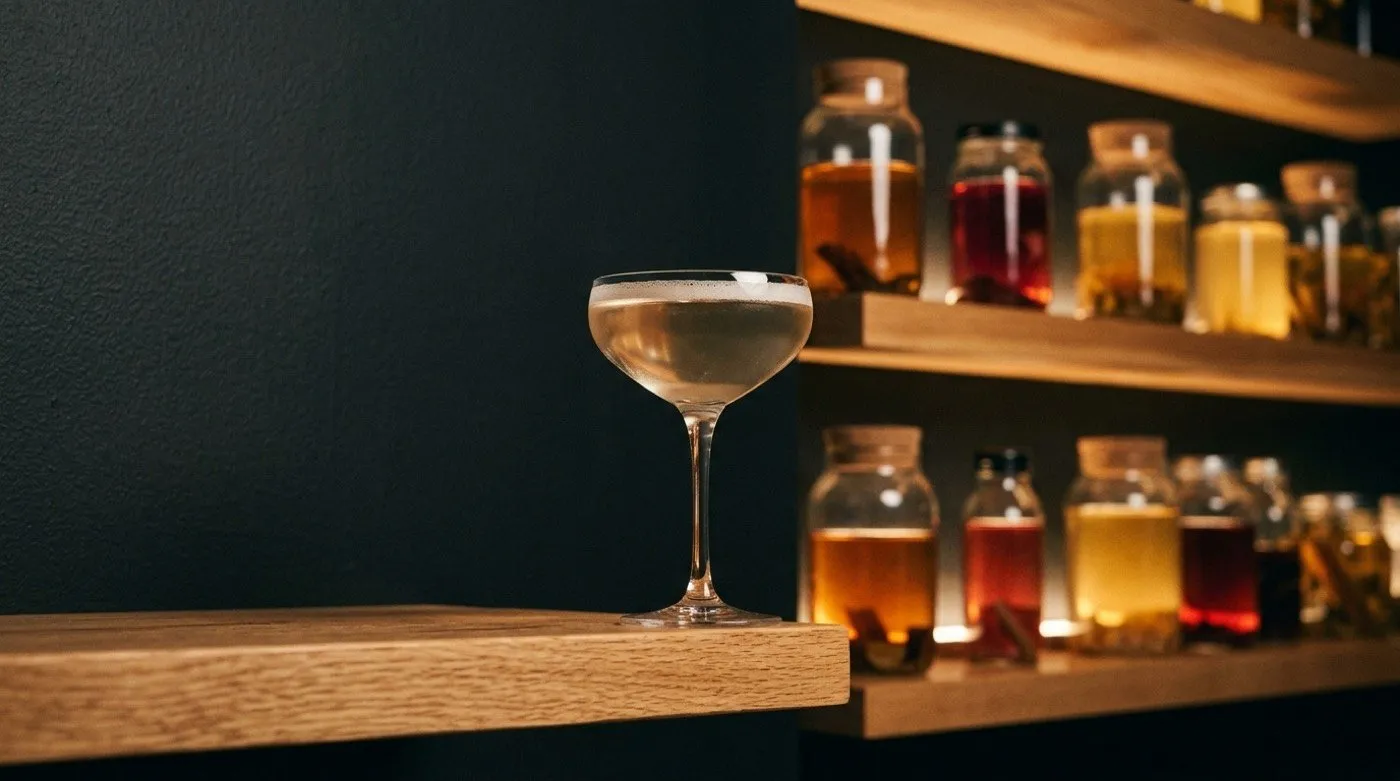
Double straining is a precision technique we use at STILLROOM to achieve a visually flawless cocktail with no unwanted residue: it consists of passing the liquid through the shaker’s strainer — usually a Hawthorne — and, at the same time, through a fine mesh strainer (a tea strainer). We apply it after shaking, especially on cocktails served without ice (up) or that contain citrus, fresh herbs, purées or egg white, to catch micro ice shards, pulp, seeds and plant fragments that would otherwise cloud the drink and water it down.
What double straining is and how it works
At first glance, a freshly served drink may look smooth, but if you look closely at a daiquiri that has only gone through the shaker’s strainer, you will see tiny ice shards floating and, often, a cloudy haze. Those almost invisible particles alter the experience: they melt the cocktail faster, water it down and blunt the definition of the acidic or citrus flavours. Double straining exists precisely to prevent this, and it is one of those technical gestures that mark the difference between a good bar and a great cocktail bar.
When we shake, the ice breaks and fragments into microscopic crystals that pass through the Hawthorne’s coil. What is more, if we are working with freshly squeezed lemon or lime juice, fruit pulp, egg whites or muddled herbs, all of that generates residue that no shaker strainer can filter out completely. The fine strainer, on the other hand, has a dense mesh (similar to that of a tea infuser) that catches particles down to 0.5 millimetres, guaranteeing a crystal-clear finish.
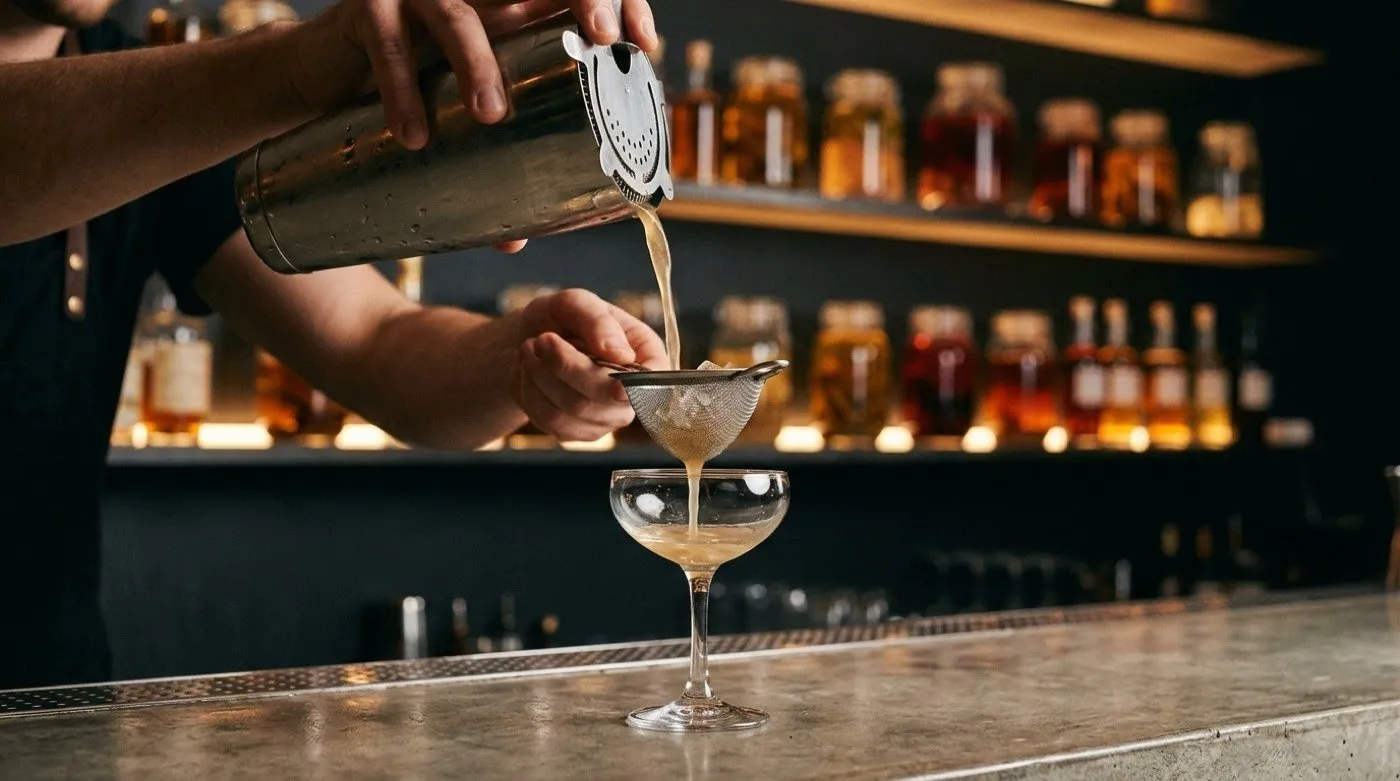
The execution is simple but requires coordination: after the shake, we open the shaker, fit the Hawthorne and, with the other hand, hold the fine strainer directly over the serving glass. We pour the liquid in a steady stream, letting the large ice stay behind in the shaker and the shards catch in the mesh. The result enters the glass clean and unhurried, with the exact shine we are after in a cocktail served up.
When is it not needed? When the cocktail is served on the rocks — with ice in the glass — the small shards are not a problem because the service ice itself takes care of maintaining the dilution and the temperature, and we are after a more direct evolution on the palate. We also skip double straining on stirred cocktails (stir) such as a Martini or a Negroni, where the silky texture comes from stirring rather than shaking, so no ice fragments are generated to filter out.
Strainers in cocktail making: Hawthorne, Julep and fine strainer
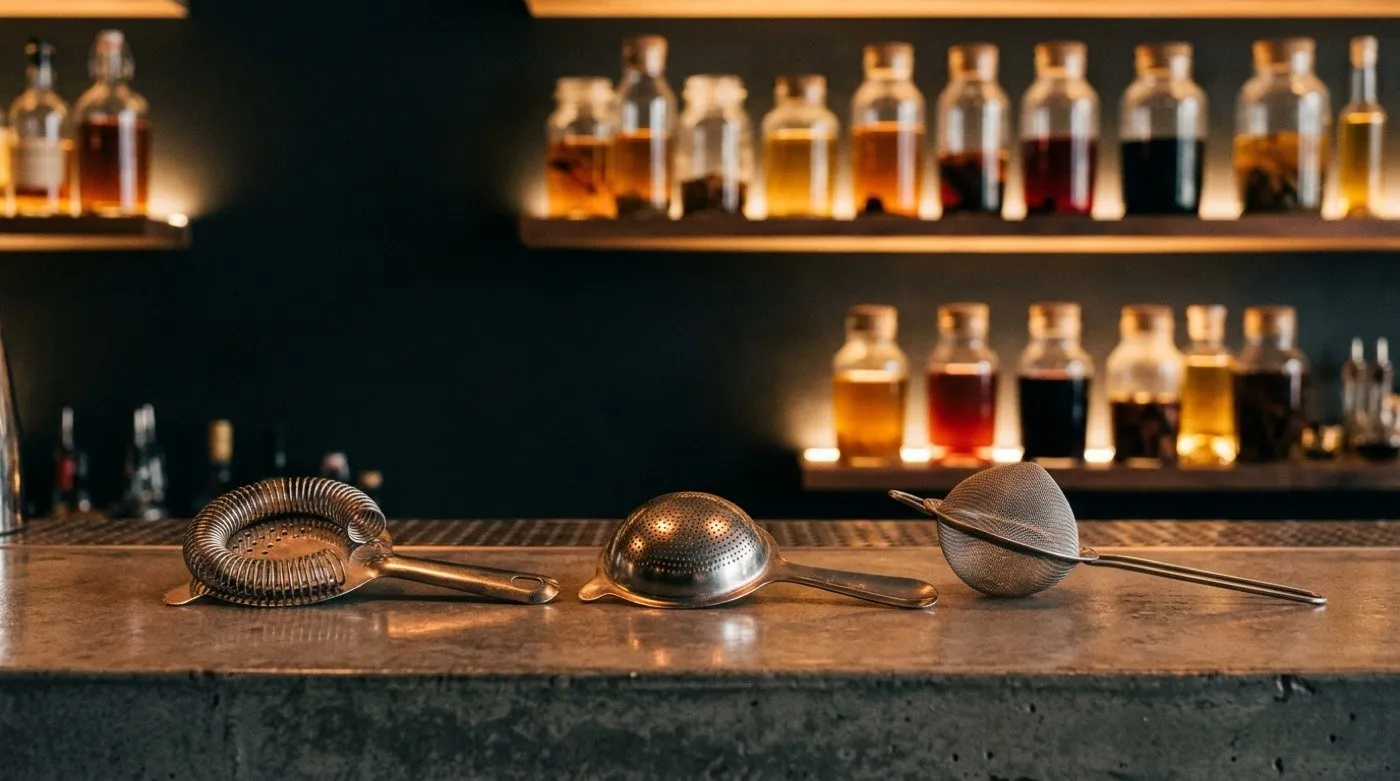
To understand when and why we apply double straining, it helps to know the three essential strainers we use behind the bar and what function each one performs within the ritual of mixing.
| Strainer | What it catches | When it is used |
|---|---|---|
| Hawthorne | Large ice, macerated fruit, whole herbs | After shaking; cocktails served up or on the rocks |
| Julep | Large ice, minimal plant residue | After stirring; spirit-forward cocktails such as Martini or Manhattan |
| Fine strainer (tea strainer) | Micro ice shards, pulp, seeds, fine particles | Double straining on shaken cocktails with juices, purées or egg white |
The Hawthorne is the inseparable companion of the three-piece shaker (the most common in signature cocktail making). Its perimeter coil fits the mouth of the shaker and holds back chunks of ice and the coarser elements, but lets tiny shards through. The Julep, by contrast, is a perforated bowl strainer that fits the mixing glass: we only use it with stirred cocktails, where we are not after aeration or foam and no ice fragments are produced. The fine strainer acts as a secondary filter, and using it at the same time as the Hawthorne is what defines the double strain technique.
When to apply double straining depending on the type of cocktail
It is not a universal dogma: double straining makes sense when a clean texture, free of interference, is key to the glass. This table sums up the most common situations we come across in service and our choice in each case.
| Type of cocktail | Double strain? | Why |
|---|---|---|
| Sour served up (whisky sour, pisco sour) | Yes | The egg white generates foam and fluffiness; double straining catches the large bubbles, the un-emulsified egg white residue and the ice shards that would spoil the silky texture. |
| Daiquiri | Yes | Served up; the freshly squeezed lime juice carries pulp that must be kept out, and we want total shine and clarity. |
| Martini (or any stirred cocktail) | No | Stirred, not shaken. Stirring barely releases particles; the Julep is enough for a clean service with no extra dilution. |
| Highball with ice (gin and tonic, paloma) | No | Built over ice in the glass; double straining would chill it unnecessarily and would remove microtextures that do not bother anyone in these formats. |
| Smash with fresh herbs | Yes | After muddling basil, mint or spearmint, plant residue floats and looks unsightly; the fine strainer catches it in the mesh. |
The criterion is functional, not aesthetic: double filtering protects the controlled dilution we have calculated during shaking, maintains the flavour balance we have adjusted in the laboratory, and guarantees the guest receives exactly the glass we have designed, with no foreign bodies and no unwanted cloudiness.
How we use it at STILLROOM
At our bar in Madrid, double straining is not a flourish; it is built into our workflows as one more step in the technical rigour we apply to every recipe. We work with fermented bases, precision cordials and clarifications that demand an impeccable texture on the pour, so we take care over every detail of the filtering.
When we prepare a cocktail that requires the shake technique, we time the shake to control dilution and temperature, and when pouring, we always carry the fine strainer in the other hand if the recipe calls for it. If, instead, the drink is built on the stir, we rely on the Julep and avoid any extra filtering that would strip density from the cocktail. It is all part of a set of advanced cocktail techniques we handle every day: centrifuging, fat washing, ultrasonic infusions and, of course, two-step filtering whenever the sensory profile calls for it.
Three ideas for getting started
If you want to practise double straining at home, or simply understand when it makes a difference, these three drinks are an excellent starting point. All of them work with basic kit: a three-piece shaker, a Hawthorne and a fine kitchen or tea strainer.
Daiquiri served up
The daiquiri is the bartender’s thermometer: white rum, lime juice, sugar. Shake it energetically and serve it without ice in a chilled glass, double straining. You will notice a crystal-clear shine in the liquid and a cleaner acidity, with no bitter pulp notes and no watery dilution from micro-shards.
Sour with egg white
A whisky sour or a pisco sour depends on the egg white’s emulsion to build a silky, stable foam. Double straining catches the bits of egg white that have not integrated and the coarser bubbles, leaving only the fine foam that crowns the cocktail.
Fresh mint or basil smash
When you muddle fresh herbs in the shaker, essential oils are released but tiny fragments also come loose. The fine strainer stops those little bits from floating in the glass and distracting the palate, leaving a translucent green liquid and a clean aroma.
Frequently asked questions
What is double straining in cocktail making?
It is a filtering technique that uses two strainers at once: the shaker’s own strainer (a Hawthorne) and a fine mesh strainer. As the cocktail is poured, the liquid passes through both, removing fine particles such as ice shards, fruit pulp or herb fragments. It aims for a crisp finish and a cleaner texture in the glass.
When should you double strain?
It is applied after shaking cocktails that are served without ice (up) and that contain citrus juices, purées, egg white or muddled herbs. If the cocktail is served with ice (on the rocks) or has been stirred, it is generally not necessary.
Which strainer is used for double straining?
You need two pieces: the Hawthorne strainer, which you fit onto the shaker, and a fine strainer (a tea-strainer type), which you hold over the glass to filter out the smallest particles. You should not swap the Hawthorne for a Julep in this case, since the latter is designed for pouring from the mixing glass.
Is double straining the same as normal straining?
No. Normal straining (simple strain) uses a single strainer to separate the ice and the large solid ingredients. Double straining adds a second filtering step that catches micro-shards and residue that the Hawthorne lets through.
Do you need to double strain a cocktail served with ice?
Generally no. In cocktails served over ice, the tiny shards blend in without negatively affecting the experience, and the ice in the glass will keep diluting the mix slightly. If the cocktail contains herbs or purée, we might consider it, but it is not usually necessary. If you want to try cocktails where double straining and other precision techniques are applied rigorously, we invite you to explore our cocktail menu. Every recipe reflects meticulous laboratory work and, of course, impeccable filtering. You can also book a table and see it live at our bar on Calle Moreto 9, next to El Retiro. And if you would like to keep exploring, do not miss our cocktail glossary, where you will find detailed definitions of every term we use at STILLROOM.