Liquid Nitrogen in Cocktail Making: Technique, Safety and Why It Wows
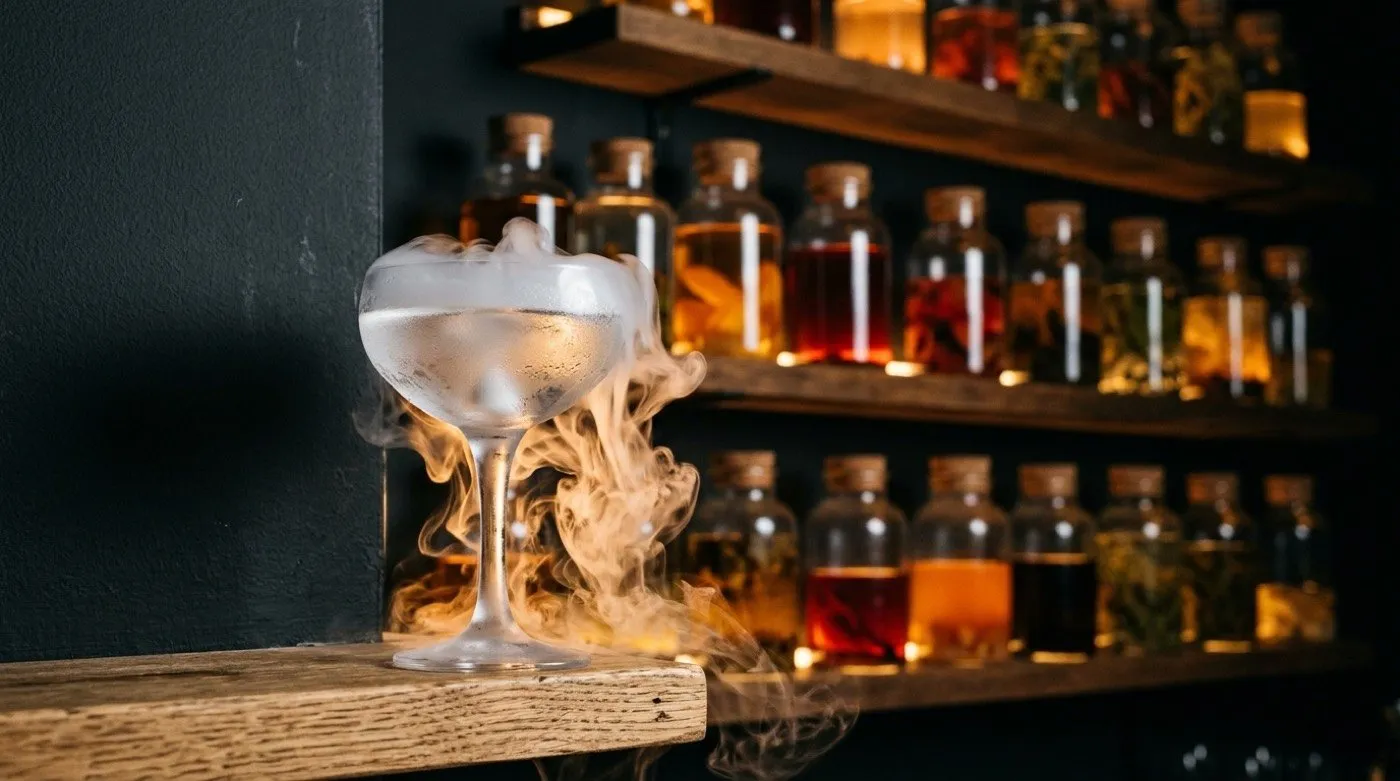
At STILLROOM we use liquid nitrogen as a laboratory tool applied to the bar: at -196°C, it lets us carry out flash freezes, chill glasses in seconds and generate the iconic fog effect that turns a cocktail into a multisensory experience. Its use in cocktail making goes far beyond visual spectacle: it’s technique, precision and, above all, an unwavering commitment to safety.
What It Is and How It Works in Cocktail Making
Nitrogen, that inert gas that makes up almost 80% of the air we breathe, becomes a transparent liquid when we bring it down to cryogenic temperatures: -196°C. At that temperature, anything that comes into contact with it has its structure altered instantly; at the bar, that translates into three very specific and spectacular possibilities.
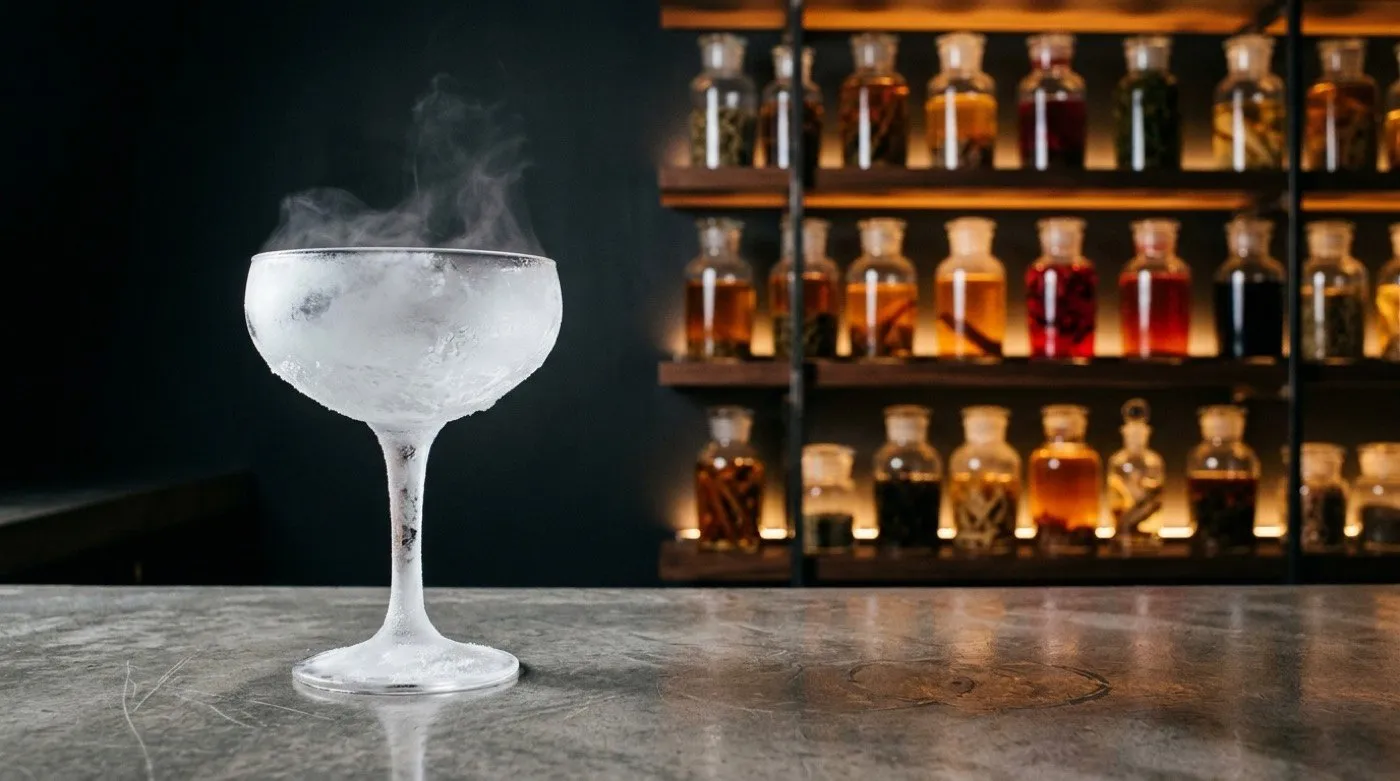
The first, flash freezing: any liquid preparation — a fruit purée, a well-balanced cocktail mix — turns into an ultra-fine-textured slush or sorbet in barely a couple of seconds. The second, ultra-fast glassware chilling: we don’t need ice or long minutes; a minimal bath of liquid nitrogen leaves a glass perfectly frosted, with a natural frost that chills the drink without diluting it. The third, the fog effect: when liquid nitrogen evaporates, it cools the surrounding air below the dew point and condenses the ambient water vapour; the result is a dense, harmless and purely aqueous cloud that envelops the presentation of the cocktail.
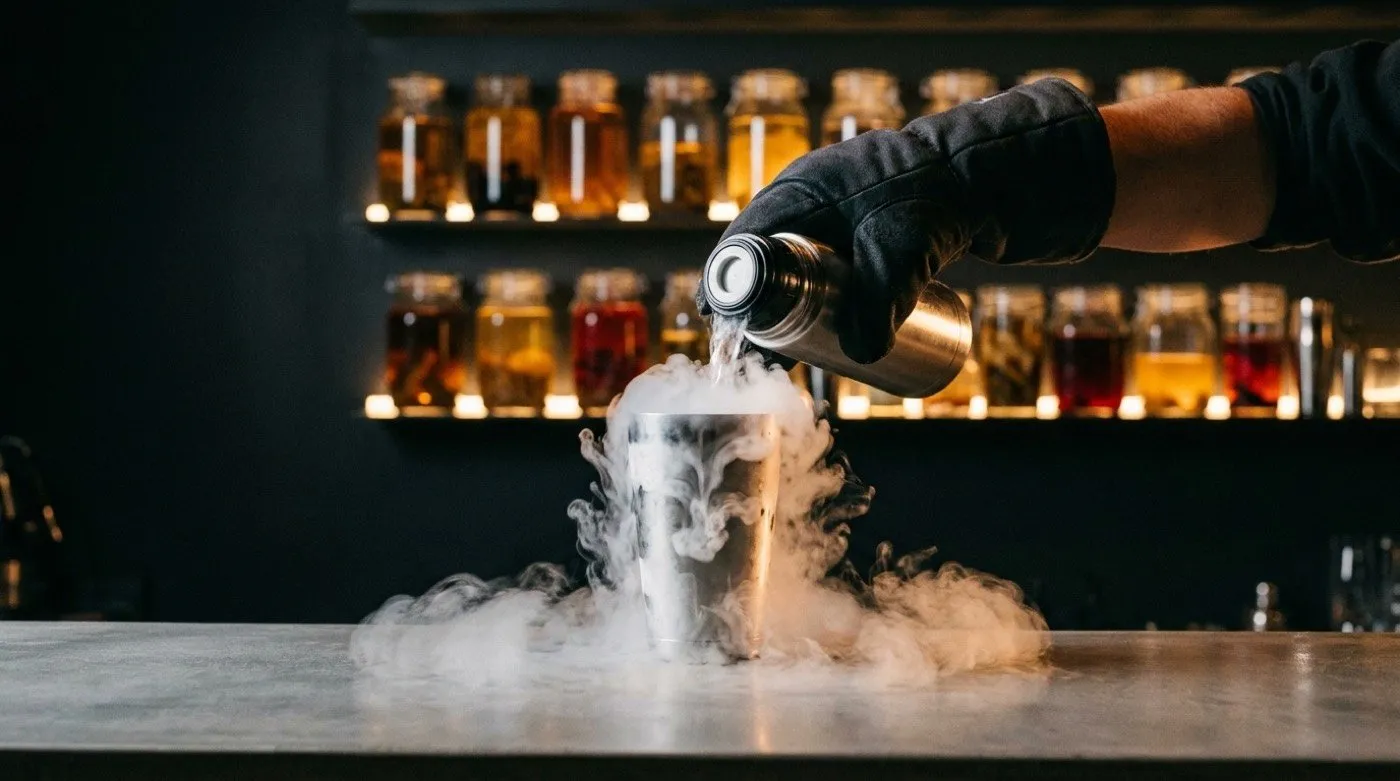
The golden rule every technical bartender must burn into memory is that liquid nitrogen is only safe once it has fully evaporated. The fog is not the nitrogen: it’s condensed water vapour. Nitrogen, being a colourless and odourless gas, disperses into the atmosphere without a trace. That’s why we never serve a cocktail with visible traces of liquid at the bottom; only once all the LN2 has returned to the gas phase and the surface temperature of the glass or the preparation has risen to a level that poses no risk.
Uses, Effects and Precautions at the Bar
Handling liquid nitrogen in a cocktail-making environment means anticipating every gesture. In this table we summarise the four most common uses we give it at STILLROOM, along with the effect we’re after and the key precaution we never skip:
| Use at the bar | Effect | Key precaution |
|---|---|---|
| Flash slush | Creamy texture and freezing with no large crystals | Verify full evaporation before serving; the spoon must never touch the surface if it’s still bubbling. |
| Glass frosted in seconds | Natural frost that keeps the drink cold with no dilution | Handle the glass only with cryogenic tongs or gloves; direct contact with the glass at -196°C causes cold burns. |
| Fog or visual effect | Dense cloud that envelops the glass and enhances the sensory experience | The fog is water vapour, not nitrogen; ensure proper ventilation in the room to avoid a build-up of inert gases. |
| Frozen sphere | Cocktail pearls or spheres that burst in the mouth | Never eat the sphere while its interior is below 0°C; only after controlled tempering. |
Real Risks and How We Avoid Them at STILLROOM
Viral videos only show the fog, but any serious professional trains in the risks first. This table gathers the four main hazards of liquid nitrogen in cocktail making, why they occur and how we manage them at our laboratory bar:
| Risk | Why it happens | How we avoid it |
|---|---|---|
| Extreme cold burns | Direct contact between liquid nitrogen and skin freezes the tissue: the Leidenfrost effect only protects for an instant and stops doing so if exposure is prolonged or there are splashes. | We always use cryogenic gloves, long tongs and protective goggles; we also never decant LN2 openly near the guest. |
| Oxygen displacement in enclosed spaces | As it evaporates, gaseous nitrogen displaces the oxygen in the air; in a small volume with no ventilation this can cause anoxia. | Our bar has forced ventilation; we never store the Dewar flask in confined spaces and we regularly measure O₂ concentration. |
| Ingesting liquid nitrogen | If a guest drinks a cocktail with LN2 still in liquid phase, the extreme cold can seriously damage the oesophagus and stomach. | We serve the cocktail only and exclusively once no bubbling liquid remains; we train the whole team in the waiting and verification protocol. |
| Pressure in sealed containers | Storing liquid nitrogen in an airtight container generates explosive pressure because the gas expands to 700 times its liquid volume. | We use cryogenic Dewar flasks with a pressure-relief valve and never seal any container that has held LN2 airtight. |
Insisting on these points isn’t unfounded alarm: it’s the standard of any scientific laboratory, and that’s exactly what we are — a bar with the mindset of a laboratory but the soul of relaxed hospitality.
How We Use It at STILLROOM
When we bring liquid nitrogen into our signature cocktail offering, we do it with the same philosophy we apply to other laboratory techniques: absolute respect for the product, control of every variable and flawless execution on the pass. It’s not a magic trick, it’s a technical resource that dialogues with processes such as vacuum distillation (rotovap), sous-vide infusions or the set of advanced cocktail-making techniques that define our identity.
In our day-to-day at Calle Moreto 9, right in the heart of Los Jerónimos, liquid nitrogen lets us, for example, spherify a citrus cordial and present it over a smoked, fog-wrapped glass right at the moment of service. Or prepare a passion-fruit sorbet in front of the guest, having adjusted the acidity and sweetness beforehand with the precision our in-house laboratory gives us. The technique is at the service of flavour, never the other way round.
Three Ideas to Get Started (Without Fear and With Judgement)
Flash-Frozen Gin and Tonic Slush with Fresh Botanicals
Prepare a tonic cold-infused with juniper, cardamom and grapefruit zest. Pour it slowly over liquid nitrogen while stirring with a silicone stirrer; in three seconds you have an airy-textured slush. Serve in a pre-frosted glass with a splash of premium gin on top. The contrast in temperatures and the intensity of the botanicals with no dilution is stunning.
A Glass Frosted in Ten Seconds for a Flawless Martini
Pour a small amount of LN2 into a Martini glass you’ve just taken out of the freezer. Let it frost over until the nitrogen evaporates. The glass ends up at such a low temperature that the Martini can be poured into it without losing a scrap of chill or gaining any extra water. This minimalist gesture completely transforms the experience of a classic.
Fog Presentation on the Pass
A bitter-based cocktail, with notes of chocolate and orange, arrives at the table under a cloche that traps the fog generated with liquid nitrogen. When the cloche is lifted, the water vapour escapes, carrying the volatile aromas with it and wrapping the guest in a cold, scented cloud. The surprise effect is immediate, but the safety is total: not a single drop of LN2 remains in the glass.
Frequently asked questions
What is liquid nitrogen and why is it so cold?
It’s nitrogen (N₂), an inert gas that makes up 78% of the air, liquefied at a temperature of -196°C through industrial compression and cooling processes. It’s so cold because almost all of its thermal energy has been removed for it to change from gas to liquid.
Is it dangerous to drink a cocktail with liquid nitrogen?
It can be very dangerous if the nitrogen hasn’t fully evaporated before the drink is consumed. That’s why at STILLROOM we never serve anything that still contains traces of cryogenic liquid; we wait until everything has returned to the gas phase and the temperature is safe for consumption.
What is liquid nitrogen used for in cocktail making?
It’s used to instantly freeze mixtures (slushes, sorbets), chill glasses in seconds with no dilution, and create visual effects with dense fog. Its use allows for textures impossible with conventional ice and adds a layer of technical theatre to the service.
Can liquid nitrogen be used at home?
We don’t recommend it. Handling liquid nitrogen without cryogenic training, without suitable protective equipment (gloves, goggles, ventilation) and without a Dewar flask with a pressure-relief valve carries serious risks of burns and explosions. It’s a tool for professionals.
Is the fog on the cocktail the nitrogen itself?
No. The white fog you see is water vapour condensed from the air by the extreme cold of the nitrogen as it evaporates. Nitrogen gas is colourless and odourless, so the cloud that wraps around the cocktail is simply water, completely harmless. Liquid nitrogen is, without doubt, one of those resources that divide the bar world between mere visual spectacle and well-founded technical cocktail making. At STILLROOM we use it with the training and rigour that any laboratory tool demands, but also with the passion of someone who wants every cocktail to tell a memorable story. If you’d like to see it in action, we invite you to discover our cocktail menu or to book a table and experience it live. And if you fancy continuing to explore concepts like this one, don’t miss our cocktail glossary, where we break down every technique honestly and without pretence.