Vacuum distillation (rotary evaporator) in cocktail making: impossible aromas
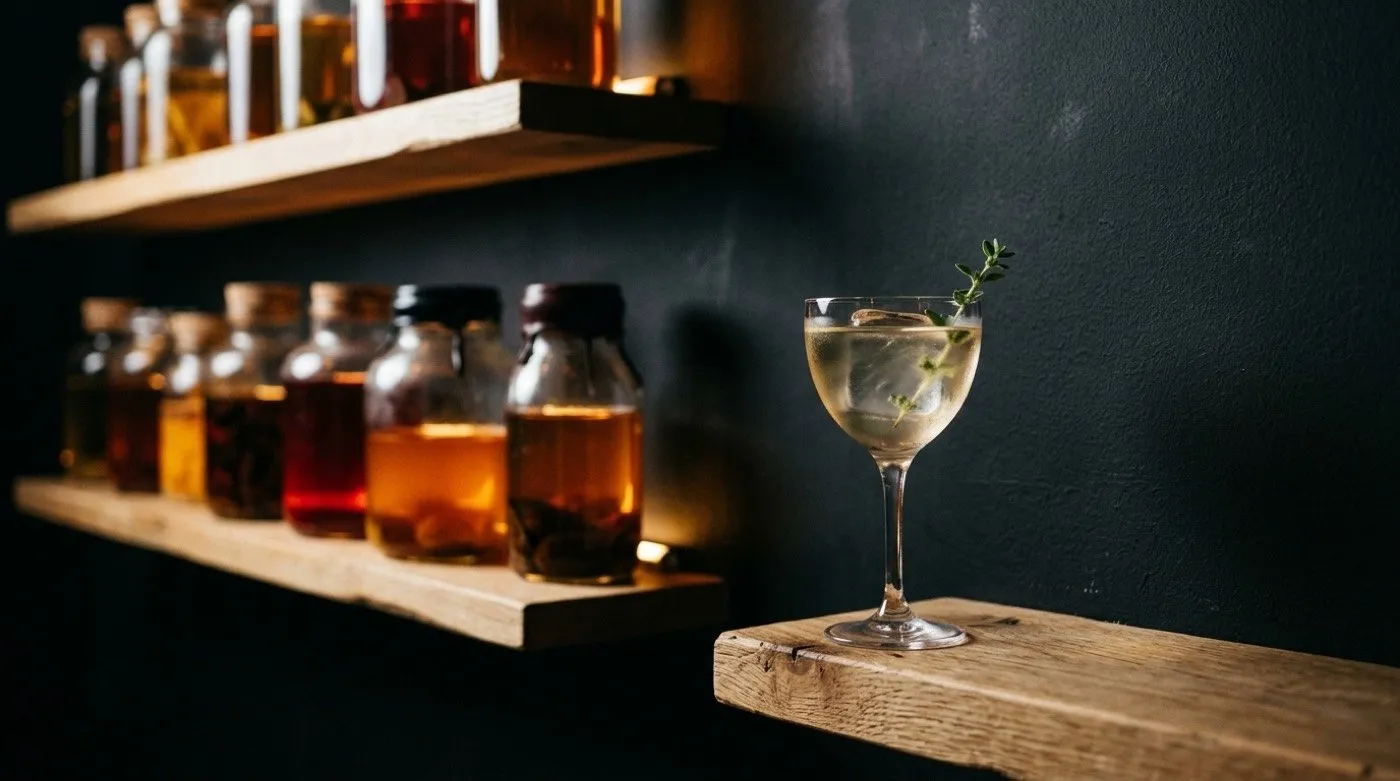
Vacuum distillation in cocktail making — which we carry out with a rotary evaporator, or “rotovap” — is a laboratory technique applied to the bar that lets us separate aromatic compounds at very low temperatures, usually between 30 and 40°C, thanks to the controlled reduction of pressure. At STILLROOM we use it to capture impossible profiles that traditional heat would destroy, achieving crystal-clear distillates, freshly cut grass essences, notes of wet earth, or even the subtle salinity of an oyster, without losing a single shade of freshness.
What vacuum distillation is and how it works in a rotary evaporator
Distillation is, in essence, the art of separating liquids by taking advantage of their different boiling points. In a classic distillation we heat a mixture until the most volatile component evaporates, guide it through a cooling circuit and condense it back into liquid form. The problem arises when what we are after are extremely delicate aromas: many of the compounds that give personality to a fresh herb, a flower or a ripe fruit break down or evaporate before the water even reaches boiling point.
This is where the physics of the vacuum comes into play. When we reduce the pressure inside a closed system, the boiling point of any liquid drops drastically. At sea level, ethanol boils at around 78°C and water at 100°C, but if we lower the pressure to 40-50 millibars, we can distil at just 30 or 35°C. That temperature is below the threshold at which the most volatile aromas start to suffer. In other words: we distil without cooking the nuances.
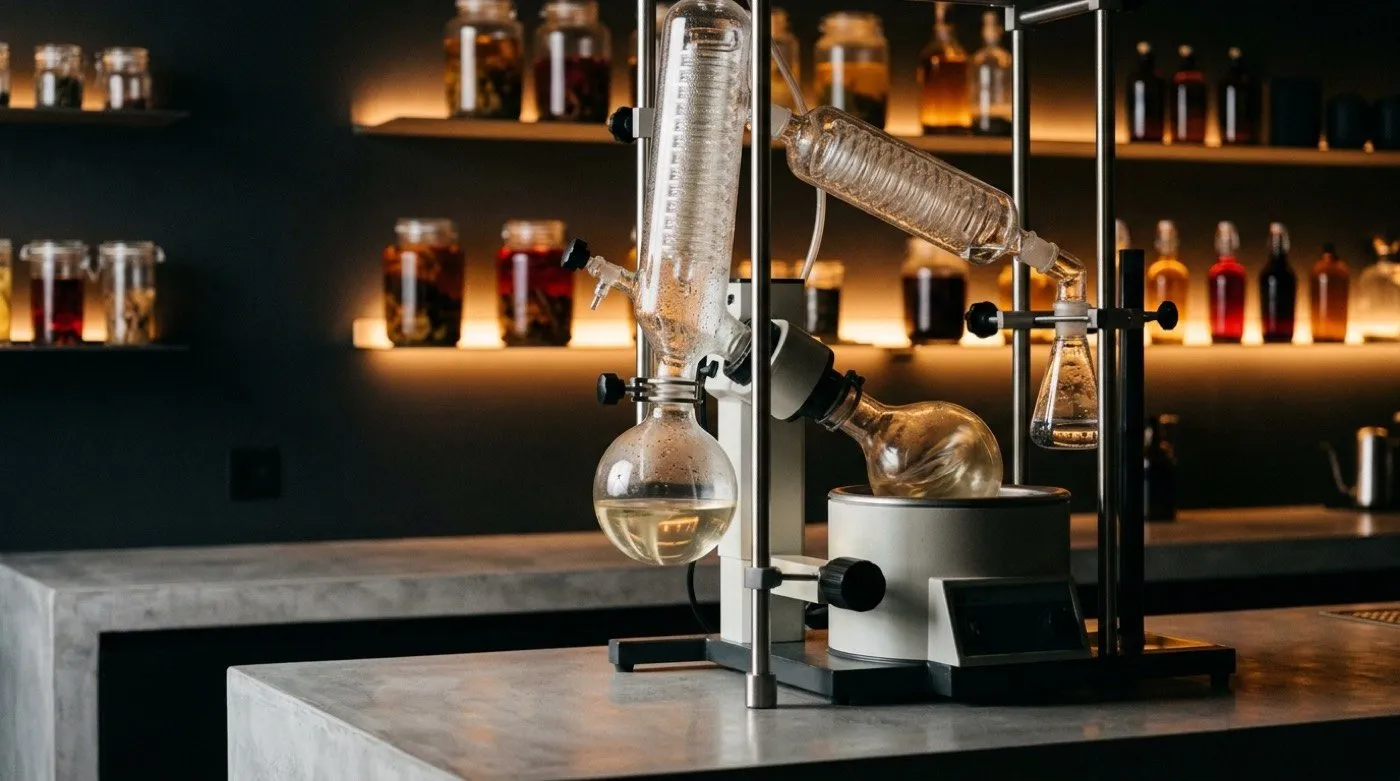
The rotary evaporator — or rotovap, as we call it day to day — is the equipment that makes this controlled distillation possible. It consists of a thermostatic bath that gently heats an evaporation flask, a motor that rotates it to increase the exchange surface and avoid localised heat spikes, a cooled condenser (usually water-cooled or fitted with a recirculation system) and a vacuum pump that keeps the pressure low and stable. As it spins, the liquid spreads into a thin film on the wall of the flask, which speeds up evaporation without the need for aggressive temperatures and without dragging along any impurities.
The result is two extremely pure products: a transparent alcoholic distillate that concentrates the fat-soluble aromas and volatile alcohols, and an equally crystal-clear aqueous hydrosol that retains the most water-soluble notes. Both are clean, with no trace of cloudiness or of those “cooked” notes that appear when heating in excess.
Traditional distillation versus vacuum distillation
When we explain this technique to someone who has just sat down at the bar, we usually sketch out a comparison in our heads. It is not about dismissing classic distillation — without it there would be no gin, no whisky and no modern cocktail making — but about understanding that they are complementary tools. One seeks intensity and structure; the other, aromatic precision and freshness. Here are the key differences:
| Concept | Traditional distillation | Vacuum distillation (rotovap) |
|---|---|---|
| Working temperature | 78-100°C (depending on atmospheric pressure) | 30-40°C (with a vacuum of 40-60 mbar) |
| Aromas preserved | More robust aromas, but with a loss of delicate volatile notes | Maximum aromatic fidelity; captures compounds that heat would destroy |
| Clarity of the distillate | May require further filtering when working with fresh botanicals | Naturally crystal-clear distillate, with no cloudiness |
| Type of ingredients | Grains, roots, barks, juniper, dried spices | Fresh herbs, flowers, delicate fruits, vegetables, salty and umami ingredients |
| Cost and equipment | Copper pot still or column; medium-high investment | Laboratory rotary evaporator; high investment and specialised maintenance |
What aromas can be captured with a rotovap
The beauty of the rotary evaporator is that it lets us put into the distillation flask ingredients that would never survive a classic pot still. It is, literally, a machine for creating impossible essences. Below is a sample of what we work with at STILLROOM and how we translate those distillates into cocktails that make sense:
| Ingredient | Aroma it captures | Use in a cocktail |
|---|---|---|
| Fresh basil | Green, aniseed and slightly peppery notes, with no trace of cooking | Cold-distilled gin for a herbaceous Martini with a kitchen-garden character |
| Ripe strawberries | Intact fruity esters, aroma of freshly cut strawberry | Transparent distillate as the base of a spring sour, with no colourings or pulp |
| Fresh oyster | Marine salinity, iodine notes and subtle umami | Saline essence for a Dry Martini with an Atlantic-coast air |
| Forest earth (humus) | Echoes of undergrowth, mushrooms and dampness, pure terroir | Hydrosol for an earthy cocktail that dialogues with a mezcal or a peated whisky |
| Peppermint | Intense freshness, without the bitterness that appears when macerating hot | Spirit for a Julep with a mint clarity impossible to achieve through maceration |
| Cucumber and dill | Crisp, refreshing vegetal note, with the aromatic punch of fresh dill | Base for a summery highball with soda, lemon and a touch of salt |
How we use it at STILLROOM: from the beaker to the glass
In our laboratory on Calle Moreto, the rotary evaporator is not a gadget for showing off: it is a daily tool of creation. We integrate it with the rest of our battery of techniques to build cocktails that tell a complete sensory story. Sometimes we start from an agar clarification to obtain an absolutely transparent juice, and then vacuum-distil it to isolate only its most ethereal fragrance. Other times, we combine a prior sous-vide infusion — which extracts deep flavours without oxidation — with a later distillation that polishes the profile and makes it weightless.
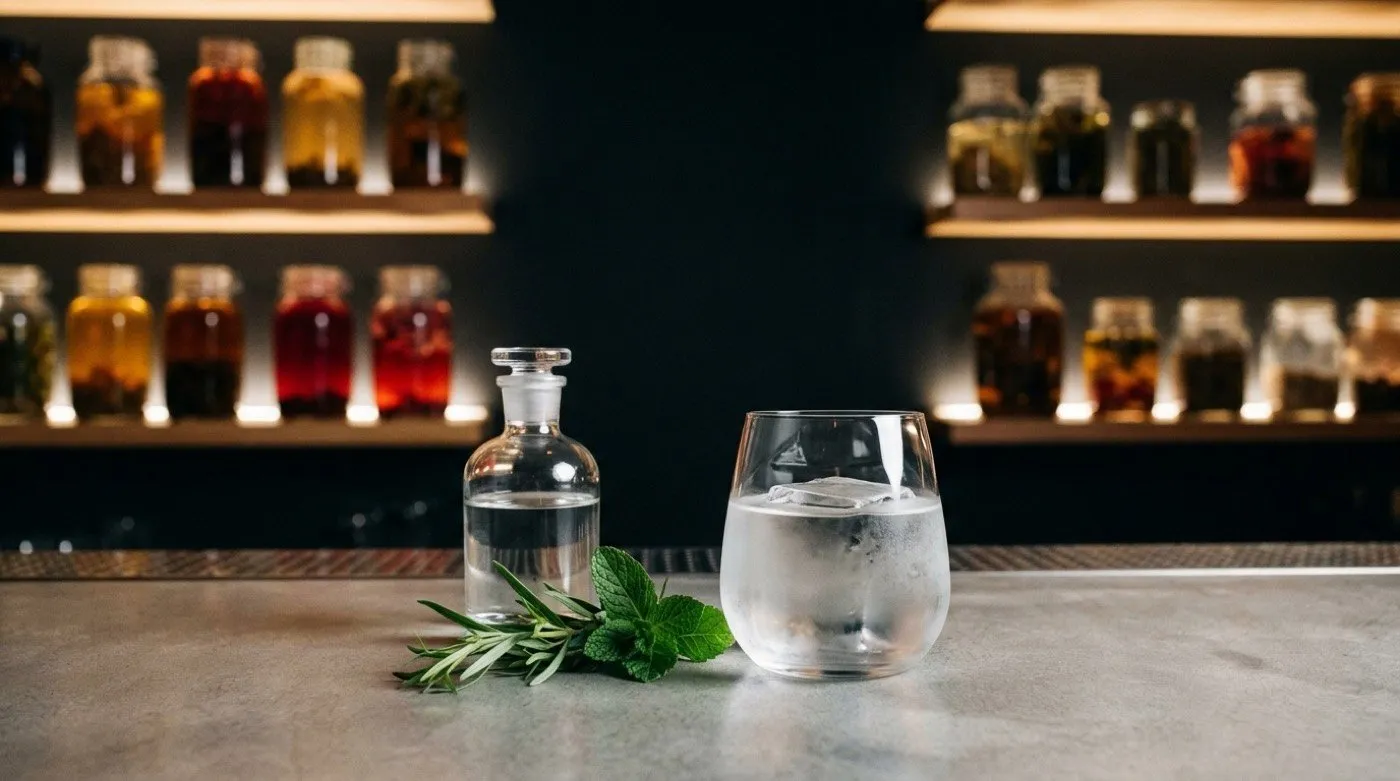
The dialogue between disciplines is constant. A fat washing with toasted butter gives us a silky texture and an indulgent flavour, but if we then run that distillate through the rotovap, we remove all the residual fat and are left exclusively with the aromatic echo of the butter, clean as a whistle. It is exactly this level of detail that turns a laboratory technique into a bar experience. If you would like to dig deeper into the philosophy that ties all these tools together, take a look at our tour through advanced cocktail techniques.
Three ideas for starting to distil under vacuum
Whether you are behind a bar or simply dream of setting up a small laboratory at home — with the limitations we will come to below — these three ideas will help you understand just how far a well-tuned rotovap can send your creativity:
A gin distilled with cucumber and dill
We lightly macerate juniper, coriander seed, lemon peel and a touch of cardamom in grain alcohol for a few hours. We add fresh sliced cucumber and dill, transfer everything to the flask and distil at 35°C and 50 mbar. The result is a bright, white gin that smells of a freshly watered kitchen garden and tastes of crisp cucumber with not the slightest vegetal bitterness. Perfect for a Gin and Tonic with a neutral tonic and a paper-thin cucumber slice.
A transparent strawberry distillate
We chop very ripe strawberries, cover them with neutral alcohol diluted to 20% and leave them to rest overnight in the cold. The next day we vacuum-distil, discard the heads and tails and collect the heart of the distillate. What we get is a colourless liquid that looks like water but, brought close to the nose, explodes like a basket of wild strawberries. We use it as the base for a sour with clarified lemon juice and a touch of vanilla syrup.
A saline essence for a Martini
We place freshly opened oysters, liquor and all, directly into the rotovap flask together with a small volume of vodka. We distil at 38°C until we get a transparent liquid that is pure sea iodine, Atlantic breeze and minerality. Just a few drops of this essence added to a classic dry Martini — London Dry gin, white vermouth, an olive — are enough to make whoever tastes it close their eyes and swear they are drinking by the sea.
Frequently asked questions
What is vacuum distillation in cocktail making?
It is an extraction technique that uses a rotary evaporator to reduce the pressure inside a closed system and so distil liquids at very low temperatures (usually between 30 and 40°C). Behind the bar it lets us obtain distillates and essences that preserve volatile, fresh aromas that heat would destroy, applying laboratory principles to the creation of signature cocktails.
What is a rotary evaporator used for at the bar?
The rotary evaporator is used to create crystal-clear distillates and impossible aromatic essences from heat-sensitive ingredients, such as fresh herbs, flowers, delicate fruits or seafood. It is also used to concentrate flavours, separate alcohols from complex macerations, and obtain hydrosols with very precise aromatic profiles that are then incorporated into high-end cocktails.
At what temperature does a rotary evaporator distil?
Depending on the vacuum pressure applied, a bar rotary evaporator usually distils between 30 and 40°C. With a vacuum of around 40-50 millibars, ethanol can evaporate at as little as 25-30°C, which lets us work well below the threshold at which the most delicate aromatic compounds are lost.
Can you do vacuum distillation at home?
It is not, strictly speaking, a domestic technique. Rotary evaporators are costly laboratory equipment, requiring a vacuum pump, a cooling circuit and precise control of pressure and temperature. What’s more, handling high-proof spirits in pressurised systems carries risks that call for proper training. That said, if you have access to the equipment and the know-how, you can experiment on a small scale, but always prioritising safety.
Which STILLROOM cocktails use vacuum distillates?
At STILLROOM we work with vacuum distillates as part of our liquid laboratory philosophy. Several of our seasonal creations incorporate essences obtained with the rotovap, from a Martini with a saline oyster distillate to herbaceous cocktails with a cucumber-and-dill gin. We recommend checking our current menu or asking directly at the bar: there is almost always something on offer that hides an aromatic “ghost” captured at low temperature. If your curiosity is piqued and you want to see how we apply this technique — together with a few other laboratory tools — to glasses that are drunk, smelled and remembered, we invite you to explore our cocktail menu. And if you would rather experience it live from the bar at Moreto 9, you can book a table and let the team guide you. To keep unpacking this technical language, drop by our cocktail glossary too.