Milk clarification in cocktail making: the milk wash technique explained
· Updated

At STILLROOM, our bar on Calle Moreto 9 in the Los Jerónimos neighbourhood works as an experimental cocktail laboratory where every cocktail is the result of a carefully calculated process. Among the techniques that define our signature menu, milk clarification holds a special place: it is invisible to the naked eye, yet its effect completely transforms the drinking experience. This technique, which looks as though it were lifted from a food-chemistry laboratory, allows us to offer cocktails that combine aromatic intensity with a silky texture and a stability that few methods can match.
In this article we explore in depth what milk clarification is, why it works from a chemical standpoint, how it has evolved from the seventeenth century to today and, above all, how we integrate it with other advanced techniques in our signature cocktails to create drinks that are hard to find anywhere else in Madrid.
If you are a mixology enthusiast, a hospitality professional or simply someone curious to understand what lies behind a crystal-clear, silky cocktail, this post is for you.
What milk clarification is and why it matters
Milk clarification, known in the English-speaking world as milk washing (also written milkwash), is a filtration technique that uses milk as a clarifying agent to turn cloudy cocktails into crystal-clear liquids. It is not simple filtering: it is a chemical process in which the milk protein, called casein, coagulates in the presence of acid and traps the particles responsible for cloudiness, the harsh tannins and the pigments that give a cocktail an opaque appearance.
The result goes far beyond the aesthetic. A milk-clarified cocktail acquires an extraordinarily smooth mouthfeel, as though it had undergone an invisible refinement. The aromatics express themselves more clearly because the suspended particles no longer interfere with olfactory perception. What is more, the cocktail’s shelf life multiplies: while an unclarified cocktail can deteriorate within hours, one clarified with milk can stay in optimum condition for days or even weeks, provided it is stored correctly. At STILLROOM, this technique allows us to prepare elaborations in advance without sacrificing quality, ensuring that every glass we serve meets our standards of excellence.
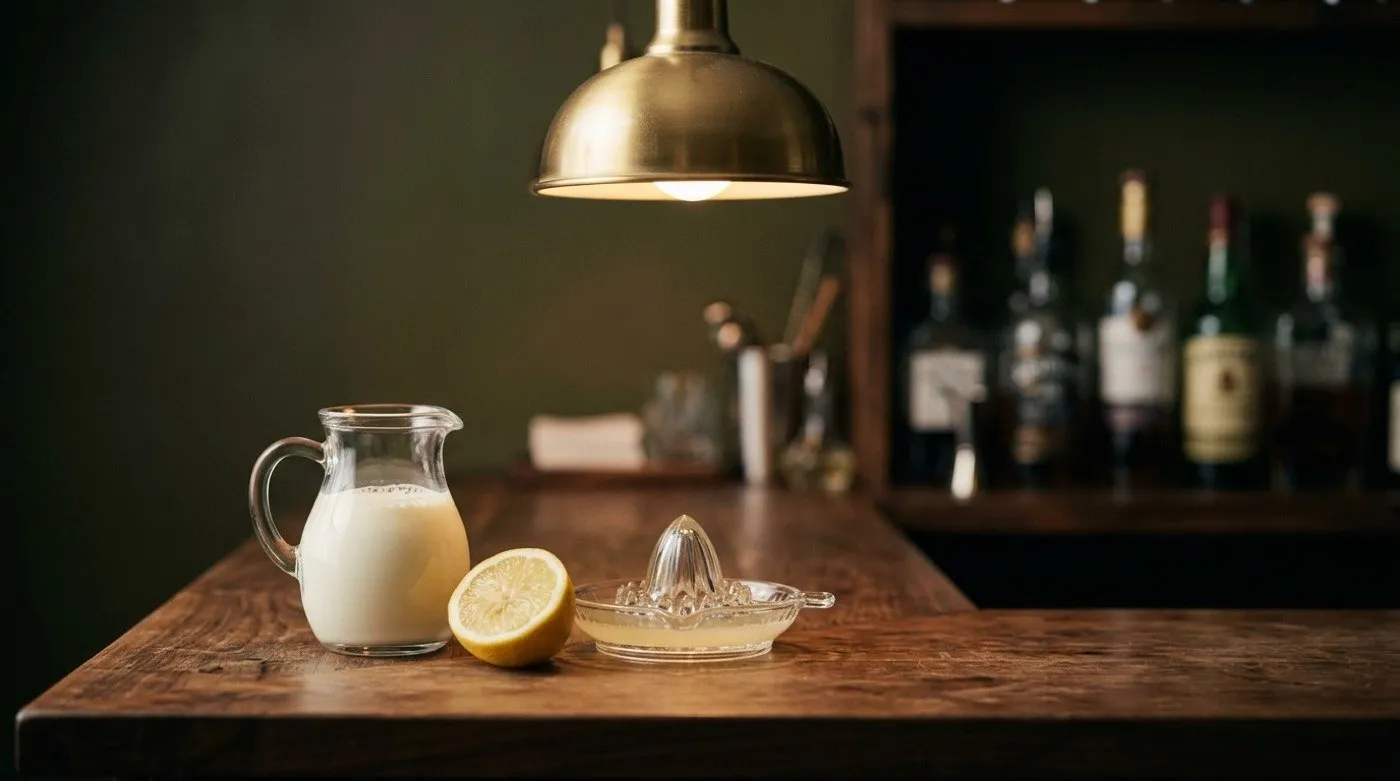
History: from the seventeenth-century Milk Punch to modern milk washing
The earliest records of milk-clarified drinks come from seventeenth-century England. Mary Rockett, an Elizabethan-era housewife, left recipes for what was then known as milk punch, a drink that combined brandy, sugar, lemon and milk. The original intention was not aesthetic: with no refrigeration available, milk clarification acted as a preservation method, allowing drinks to last for months without spoiling. Casein coagulation not only removed cloudy particles but also neutralised compounds that encouraged microbiological degradation.
Aphra Behn, the celebrated seventeenth-century novelist and playwright, also documented variants of this drink in her writings, helping to spread milk punch among English high society of the time. These early recipes laid the foundations of what we know today as milk clarification, although the method remained in the background for centuries, overshadowed by other preservation and preparation techniques.
The revival of milk clarification in signature cocktail making arrives in the 2010s, led by visionary bartenders such as Dave Arnold, whose book Liquid Intelligence became required reading for understanding the chemistry applied to mixology. In cities such as London, New York and Madrid, the technique moved from being a preservation method to becoming a creative tool: it was no longer used only to clarify, but to transform the tasting experience. The term milk washing became popular to distinguish this refined application from the historic milk punch, and since then it has been adopted by the most prestigious bars in the world to create cocktails that defy the guest’s expectations.
The chemistry: casein, acid, coagulation, filtering
Understanding why milk clarification works requires delving into the biochemistry of milk proteins. Milk contains casein, a globular protein that remains stable in suspension thanks to the balance between its negative charge and the slightly acidic environment of fresh milk. When we introduce an external acid, whether lemon, lime or any other citrus, the overall pH drops below casein’s isoelectric point, normally at pH 4.6. At that moment, casein molecules lose their stability and begin to aggregate, forming a three-dimensional network known as curd.
This curd is not a useless by-product: it acts as a microscopic molecular trap. The cloudy particles in the cocktail, which include tannins, polyphenols, natural pigments and pulp remnants, become trapped in the protein matrix while the surrounding liquid, now free of impurities, can flow through it during filtering. The result is a crystal-clear liquid that retains the cocktail’s essential aromatics but has lost the original opacity and heavy texture.
Temperature plays a critical role in this process. A temperature that is too high speeds up coagulation unevenly, while one that is too low slows it down excessively. At STILLROOM, we work with milk at room temperature or lightly chilled, and allow a resting time of between thirty minutes and two hours before filtering. This contact time is necessary for the casein to complete its work of capturing particles. Filtering must be slow and controlled: filtering too fast would drag through particles that should remain trapped, while filtering too slowly could clog the curd barrier.
Compared with other clarifying agents such as egg white or gelatine, milk contributes a unique feature: a subtle dairy note that enriches the cocktail’s complexity without dominating it. Egg white produces powerful but flavour-neutral clarification; gelatine adds body but can leave unwanted nuances. Milk, by contrast, adds a flavour dimension of its own that integrates with the other ingredients, creating a more complete and sophisticated profile.
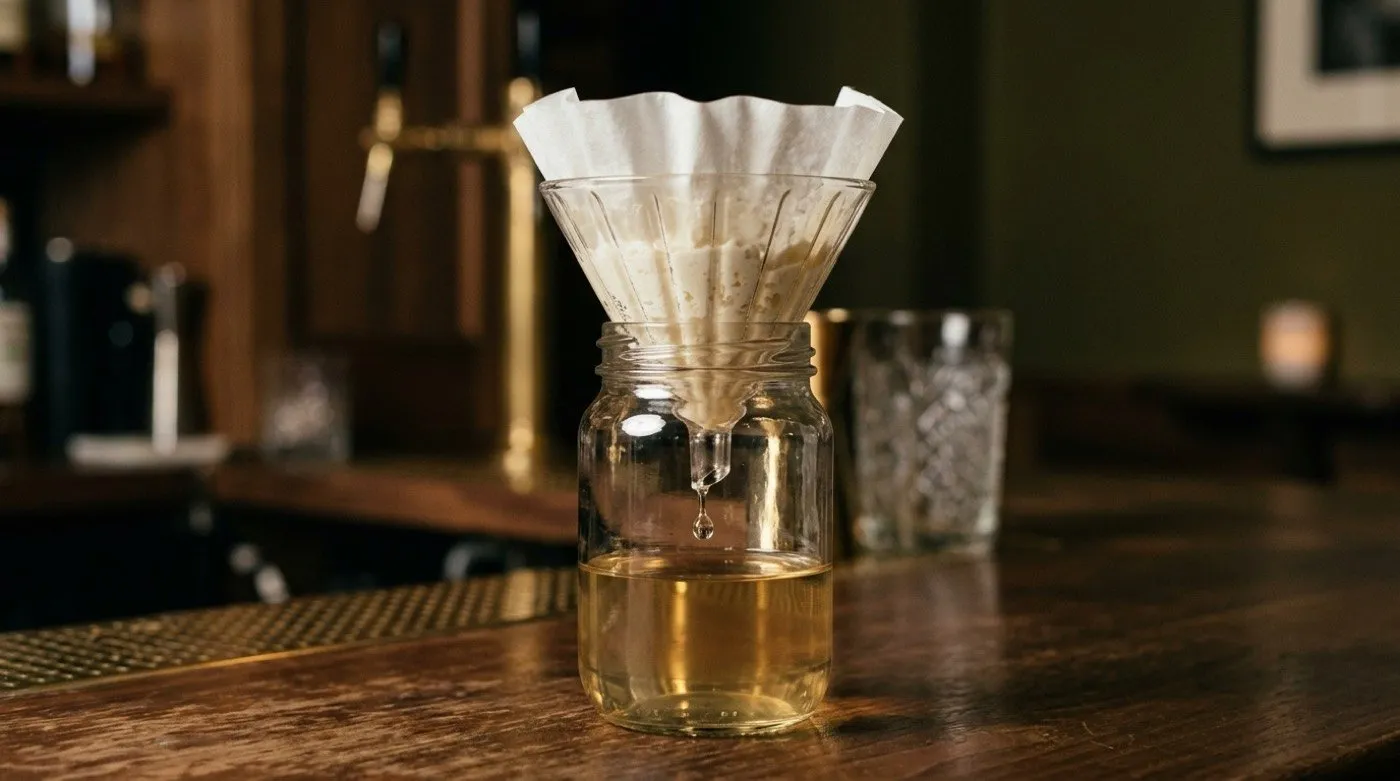
Milk’s casein, on coagulating with an acid, traps the cocktail’s cloudy compounds and retains them while filtering the liquid. The result is not simply a transparent cocktail: it is a cocktail with a silky texture, an extended shelf life and a subtle dairy note that adds dimension without taking centre stage.
Unclarified vs. milk-clarified cocktail: five differences you can notice
To understand the real impact of milk clarification, nothing works better than comparing two versions of the same cocktail. Below, we detail the five most significant differences that can be seen both with the naked eye and in the drinking experience.
| Attribute | Unclarified cocktail | Milk-clarified cocktail |
|---|---|---|
| Appearance | Cloudy, opaque, with visible particles in suspension | Crystal-clear, as clear as spring water, bright |
| Mouthfeel | Heavier, with a sense of pulp or sediment | Silky, light, enveloping, almost oily |
| Shelf life | Hours, deteriorating quickly through oxidation | Days or weeks, keeping the aromatic profile intact |
| Aromatics | Muted by the particles in suspension | More expressive, cleaner, with greater definition |
| Perceived alcohol | Harsher, especially in high-alcohol cocktails | Rounder, the alcohol integrates better with the other flavours |

Five cocktails transformed by milk washing
Milk clarification is not a universal technique: its effect varies according to the composition of the cocktail and the bartender’s goals. Here are five examples of cocktails where the technique produces remarkable transformations worth experiencing at a signature bar.
- Classic Milk Punch: This cocktail, whose roots lie in the seventeenth-century milk punch, is the most direct example of the technique. The clarified version keeps the complexity of the original but with a surprising transparency and a texture that seems to defy logic: a milk-based cocktail that looks like water yet tastes of complexity.
- Clarified Daiquiri: The combination of rum, lemon and sugar is seemingly simple, but milk clarification reveals layers of flavour that go unnoticed in the traditional version. The citrus becomes more defined, the rum more expressive, and the texture takes on an almost creamy quality without containing any dairy product.
- Clarified Piña Colada: One of the heaviest, densest cocktails on the traditional menu turns into something completely unexpected. On clarifying, the coconut cream loses its heaviness and the pineapple reveals its subtler notes, creating a drink that seems far more sophisticated than its origins suggest.
- Inverted Negroni: The Negroni’s characteristic deep red colour becomes an almost transparent, straw-coloured liquid after milk clarification. The visual change is dramatic, but the flavour impact is just as powerful: the bitter notes of the vermouth and the bitter liqueur integrate more harmoniously, creating a completely different experience.
- Clarified Bloody Mary: One of the most complex and controversial cocktails is simplified without losing intensity. By removing the tomato pulp and the spice particles, clarification leaves only the most refined aromatics, creating a cocktail that works better as a sophisticated aperitif than as the boldest drink of a brunch.
How we apply it at STILLROOM: its relationship with fat washing and lacto-fermentation
At STILLROOM, milk clarification never works as an isolated technique. Our approach is built on the strategic combination of multiple advanced techniques to create signature cocktails that could not exist any other way. Milk clarification is integrated with two other techniques that define our menu: fat washing and lacto-fermentation.
Fat washing allows us to infuse spirits with fats from various sources, creating flavour profiles that range from smoked bacon to beurre noisette or olive oil. When we combine fat washing with milk clarification, the result is unique: the fat is introduced first to add aromatic complexity, and it is then clarified to remove the opacity the fat has generated. The cocktail keeps the flavour of the fat but loses its heavy texture, creating a mouthfeel found nowhere else.
Lacto-fermentation, for its part, adds acidic depth and microbiological complexity to the ingredients. In some of our signature cocktails, we subject the citrus to a lactic fermentation process before adding milk clarification. The result is a cocktail that has undergone two transformations: first fermentation develops new aromatic compounds, and then clarification refines and stabilises the whole. This combination of techniques is what allows us to create cocktails with a complexity that is hard to achieve with traditional methods.
If you would like to explore each of these techniques further, you can browse our advanced cocktail techniques section, where we detail the theoretical and practical foundations of fat washing, lacto-fermentation and other elaborations we use at our bar on Calle Moreto 9.
Frequently asked questions
Which STILLROOM cocktails are milk-clarified?
Some of our signature cocktails include milk clarification as part of their preparation. The list varies by season and ingredient availability. We invite you to ask our bar team when you book your table at Calle Moreto 9: our bartenders will be delighted to explain which techniques have been applied to each cocktail and how they affect your drinking experience.
Does clarification add a milky flavour to the cocktail?
The milk clarification process leaves a subtle dairy note that adds depth without taking centre stage. We are not talking about a directly perceptible milk flavour: it is more a sense of roundness and complexity that enriches the cocktail as a whole. In our experience, this subtle touch is one of the elements that sets a milk-clarified cocktail apart from one clarified with egg white or gelatine, which are completely neutral in flavour.
Can I do milk clarification at home?
Milk clarification is a technique that requires temperature control, resting time and a precise filtering process to achieve satisfactory results. Although it is technically replicable at home, results can vary significantly depending on the ingredients used and the precision of the process. At STILLROOM we have refined our methodology over years to guarantee the consistency and quality of our cocktails. We look forward to welcoming you to our bar so you can experience the technique in its most polished form.
How long does a clarified cocktail keep?
One of the most practical benefits of milk clarification is the extended shelf life of the cocktail. While a traditional cocktail must be drunk immediately to appreciate all its qualities, a milk-clarified cocktail can stay in optimum condition for days or even weeks if stored correctly, refrigerated and in suitable containers. This allows us to prepare elaborations in advance and guarantee that every glass we serve keeps the same level of quality.
Does skimmed or plant-based milk work just as well?
Clarification depends on casein, a protein found exclusively in milk of animal origin. Skimmed milk contains less casein and fat, resulting in less effective clarification and less textural contribution. Plant-based drinks, such as oat, almond or soy milk, contain no casein and therefore do not produce the coagulation the process needs. To achieve the results we are after at STILLROOM, we work exclusively with high-quality whole milk.
Why don’t you use egg white instead?
Egg white is another valid clarifying agent that produces transparent cocktails, but its sensory profile is completely different. Clarification with egg white produces a flavour-neutral result, whereas milk contributes that subtle dairy note which adds an extra dimension to the cocktail. The texture resulting from milk clarification is also silkier and more enveloping. In our approach, each technique is chosen according to the result we want to achieve, and milk clarification is the preferred choice when we are after that unique combination of transparency, texture and aromatic complexity.