Spherification in cocktail making: pearls and spheres that burst in your mouth
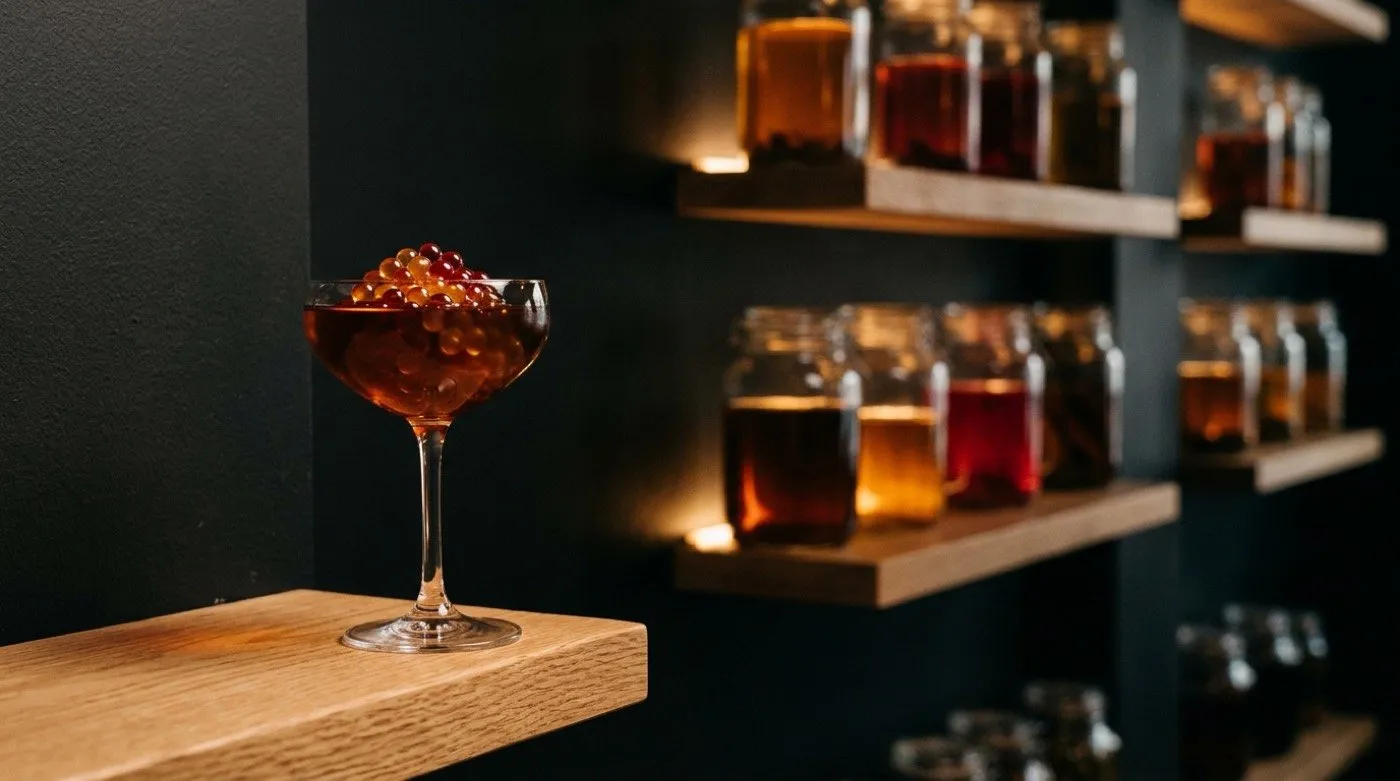
Spherification is a molecular cocktail-making technique that lets us encapsulate a liquid in a thin gel membrane, creating small pearls or spheres that burst in the mouth and transform the experience of drinking a cocktail. At STILLROOM we use both direct and reverse spherification — the latter essential when working with alcohol or highly acidic ingredients — to bring surprising textures and bursts of flavour that play with the palate.
What it is and how it works: the science of a liquid explosion
In essence, spherification is based on an almost magical reaction: sodium alginate — a polysaccharide extracted from brown algae — gels instantly on contact with calcium ions dissolved in water. This reaction forms a thin, flexible membrane around any liquid containing one of the two reagents, and that membrane solidifies just enough to hold the liquid inside, yet breaks at the slightest pressure from the tongue, releasing all the flavour at once. It is the technique that allows us to serve mojito “caviar” or bloody mary pearls that concentrate the essence of the cocktail into small doses.
The key lies in controlling the reaction time: the longer the drop stays in contact with the reactive bath, the thicker the sphere’s wall will be. If we are after an immediate burst, we limit that time to seconds; if we want a more stable sphere that will hold up on a plate or in a glass, we leave it a little longer. There are two fundamental paths: direct spherification and reverse spherification, and choosing one or the other is what separates a brilliant result from a slimy failure.
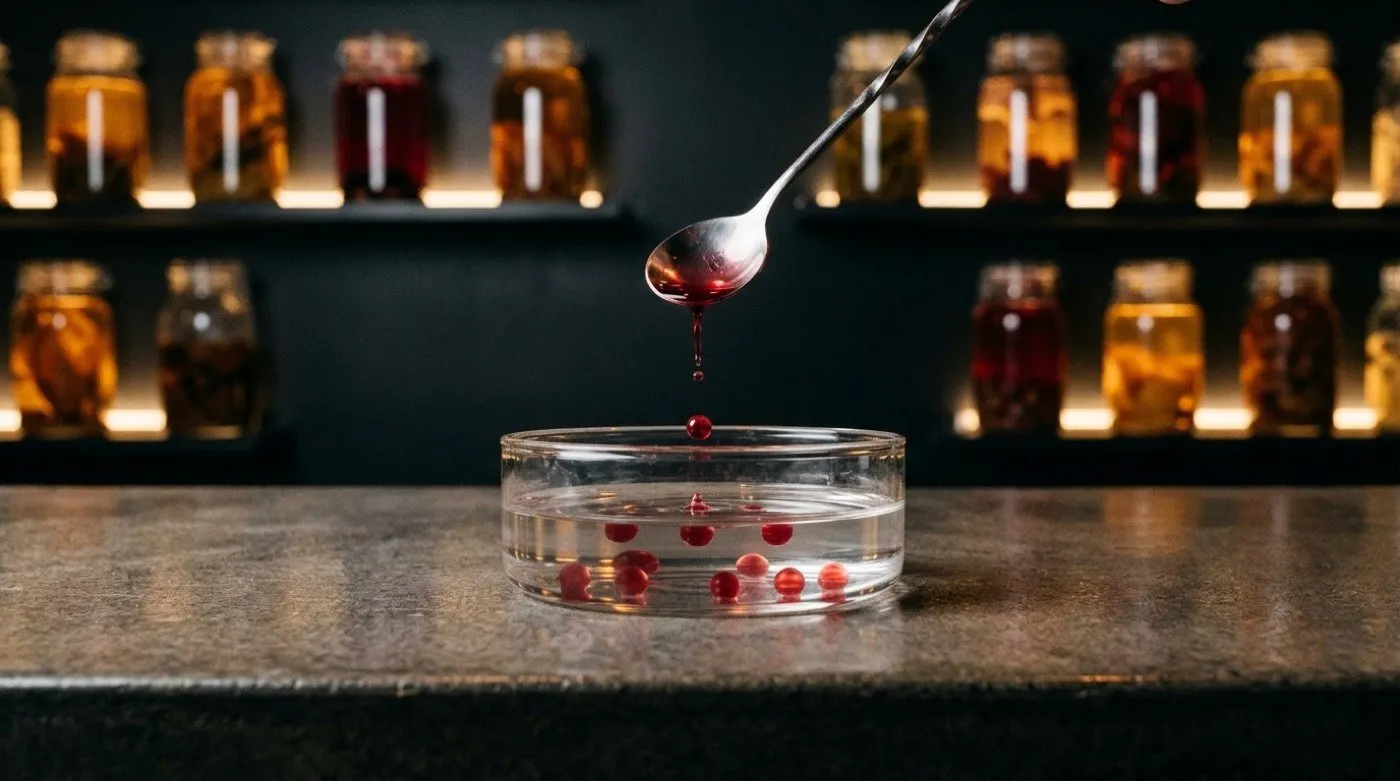
Direct spherification involves mixing the liquid we want to encapsulate with sodium alginate and then dropping that mixture into a calcium-rich water bath (usually calcium lactate or gluconate). On contact, the alginate reacts with the calcium and forms the membrane. It is perfect for neutral or low-acidity liquids without alcohol: mild fruit juices, syrups, teas or flavoured waters. However, it has a clear limit: it does not work well below a pH of 4.5 or with a significant alcohol content, because both factors inhibit gelling. What is more, the reaction keeps working inward over time, so if the spheres are not eaten straight away, they end up gelling all the way through.
For alcohol and acidic liquids — that is, for most bases used in cocktail making — the great ally is reverse spherification. Here we swap the roles: we dissolve the calcium inside the cocktail liquid and, instead of dropping it into a calcium bath, we drop it into a sodium alginate bath. The membrane forms from the outside in and stops advancing after a while, which makes it possible to obtain spheres that stay stable for hours, even with very low-pH liquids (such as our lacto-fermented lemon juice) or a moderate-to-high alcohol content. That said, the membrane’s texture in reverse spherification tends to be a little thicker and more gelatinous, a detail we fine-tune at STILLROOM with precise gram measurements and rinsing baths that soften the experience in the mouth.
The real limits we run into behind the bar are honest ones: a pH below 3.0 may require adding a sequestrant such as sodium citrate to stop the calcium precipitating too soon, and alcohol contents above 25-30% ABV can compromise membrane formation even with reverse spherification. The liquid’s viscosity also plays a part: if it is too dense, the drops do not form well; if it is too watery, the membrane can be fragile. Measuring, testing and adjusting is part of the STILLROOM method.
Comparison: direct spherification versus reverse spherification
| Parameter | Direct spherification | Reverse spherification |
|---|---|---|
| Who carries the calcium | The bath (water + calcium lactate/gluconate) | The cocktail liquid (carries the dissolved calcium) |
| Ideal for | Neutral liquids without alcohol or high acidity: teas, syrups, mild juices, flavoured waters | Spirits, citrus juices, dairy, preparations with very low pH or moderate-to-high alcohol content |
| Membrane stability | Very thin and fragile; the reaction keeps working inward, gelling everything within minutes or hours | Thicker and more resistant; the membrane seals and stops the reaction, stable for hours |
| Difficulty | Medium: sensitive to pH, alcohol and needing to be served immediately | High: requires control of the alginate bath, viscosity and adding sodium citrate for very acidic liquids |
Key ingredients and guideline doses
So you can get a real sense of the proportions we work with at STILLROOM, here is a table with the main ingredients, their function and a guideline starting dose. The exact gram measurements depend on each liquid, but these values will serve as a starting point for your first experiments at home or behind a professional bar.
| Ingredient | Function | Guideline dose |
|---|---|---|
| Sodium alginate | Gelling agent that reacts with the calcium to form the membrane (direct spherification or the reverse bath) | 0.5 – 1.5 g per 100 g of liquid (direct); 0.5 – 1.0 g per 100 g of water (reverse bath) |
| Calcium lactate or gluconate | Provides the calcium ions needed for gelling (bath in direct spherification; inside the liquid in reverse) | 1.5 – 2.5 g per 100 g of water for the bath (direct); 1.0 – 2.0 g per 100 g of cocktail liquid (reverse) |
| Base liquid | The cocktail, juice, infusion or cordial we want to encapsulate | 100 g as a reference for calculating the other ingredients |
| Sodium citrate (optional but key) | Sequestrant that reduces free acidity, stopping the calcium from precipitating prematurely in very acidic liquids (pH below 3.5-4.0) | 0.2 – 0.5 g per 100 g of acidic liquid; dissolve before adding the calcium |
An important note: alginate does not dissolve well when hot if there is a lot of sugar, and it should always be hydrated with a powerful stick blender to avoid lumps. In the reverse spherification bath it is advisable to let the alginate solution rest for at least 2 hours (or better still, overnight) to remove air bubbles, or degas it under vacuum directly if you have the equipment. These details make the difference between a clean sphere and one with imperfections.
How we use it at STILLROOM
In our laboratory on Calle Moreto 9, spherification is not a fairground trick, but a narrative tool. We apply it when we want a bite to tell a story or a cocktail to evolve in stages on the palate. One of our favourite explorations is combining reverse spherification with other cutting-edge techniques: for example, we encapsulate a citrus cordial that we have previously clarified with agar-agar until it turns crystal-clear, so the pearl is transparent and, on bursting, reveals an extremely clean flavour. We also play with temperatures: a reverse sphere of gin and tonic served over dry ice or paired with a touch of liquid nitrogen that creates a visual effect and a brutal thermal contrast in the mouth.
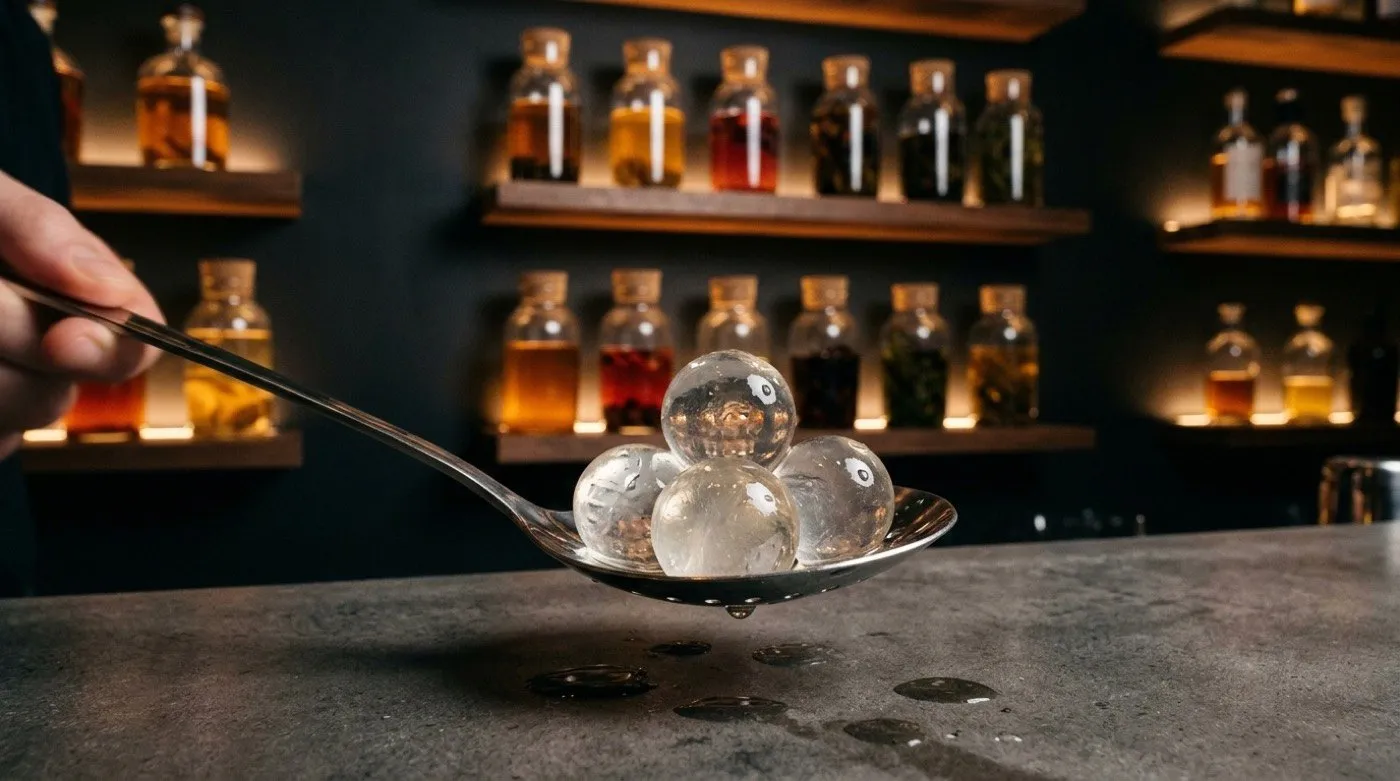
Reverse spherification also allows us to prepare the “caviars” and spheres for service in advance, keep them in a holding liquid for several hours and plate them just before serving. We build these elaborations into pairing dishes or straight into the glass, always looking for the texture to be in dialogue with the rest of the drink. If you would like to dig deeper into the technical world STILLROOM moves in, we recommend our page on advanced cocktail techniques, where we cover the whole arsenal: from fermentations and fat washing to spherification itself.
There is an unwritten rule we follow to the letter: if the sphere does not add complexity, it does not go on the menu. We do not encapsulate for the sake of it. Every pearl serves a purpose of flavour or texture, and it is almost always tied to an ingredient we have developed in-house, such as our fermented cordials or our vacuum-infused spirits. The technique is the means, not the end.
Three ideas for starting to experiment
If you are curious and want to try it at home or behind your own bar, here are three examples of increasing complexity. All of them use reverse spherification because they work with alcohol or acidity, so you will need sodium alginate for the bath and calcium lactate to dissolve in the base liquid.
Campari pearls over a spritz
The idea is simple and striking: we prepare a 0.7% alginate bath and dissolve 1.5 g of calcium lactate in 100 g of Campari (with a touch of sodium citrate if we want to fine-tune it). We drop droplets with a syringe or a caviar dispenser into the bath, leave them for 1 to 2 minutes, rinse them in clean water and place them over a classic spritz. The pearls contribute a bitter, herbal burst that transforms every sip. You can prepare them in advance and keep them in a little diluted Campari.
Gin and tonic “caviar”
Here we encapsulate the gin and tonic itself before carbonating. Dissolve 1.2 g of calcium lactate in 100 g of a mix of gin (25% of the total volume) and flat tonic water, adjust the pH if necessary and drop it into the 0.6% alginate bath. You will get small spheres that concentrate the flavour of the gin and tonic and that you can serve over a cold oyster, over a blini with soured cream or straight from a spoon as an appetiser. The tonic’s carbonation is lost in the process, but the bitterness of the quinine stays intact.
Large mojito sphere that bursts in the mouth
For this preparation you need a hemispherical mould and a tablespoon or a small spherical scoop. We prepare our mojito (rum, lime juice, sugar and infused mint) and dissolve 1.8 g of calcium lactate in it per 100 g of liquid. We pour the mix into the moulds and freeze it. We then submerge the frozen discs in the 0.8% alginate bath and let them react for about 3-4 minutes. On thawing, the inside becomes liquid again while the membrane stays firm. We serve each sphere in a rocks glass with a splash of soda and crushed ice; on biting into it (or pressing it against the palate), the whole mojito explodes in the mouth. It is one of the most spectacular bites you can prepare with reverse spherification.
Frequently asked questions
What is spherification in cocktail making?
It is a molecular cocktail-making technique that involves encapsulating a liquid — usually a cocktail, a juice, a cordial or an infusion — inside a thin edible gel membrane. It is achieved through the reaction between sodium alginate and calcium ions, and the result is small pearls or spheres that burst when bitten, releasing the liquid inside all at once. In short, it turns a sip into a bite and allows you to play with textures and contrasts unthinkable in a traditional glass.
What is the difference between direct and reverse spherification?
In direct spherification, the liquid we want to encapsulate contains the sodium alginate and is dropped into a calcium bath. In reverse spherification, the liquid carries the dissolved calcium and is dropped into an alginate bath. Direct spherification produces very thin membranes, ideal for liquids without alcohol and with low acidity, but the spheres must be eaten almost immediately. Reverse spherification produces more stable membranes and is the right choice for cocktails with alcohol, highly acidic or dairy ingredients, and it also allows the spheres to be prepared in advance. Both share the same chemistry, but reverse spherification reverses the direction of gelling to get around the limitations of the direct method.
Why is reverse spherification used for alcohol?
Alcohol and high acidity inhibit the alginate’s ability to gel properly in direct spherification; the membrane either fails to form or forms unevenly, breaking apart or gelling the whole interior. In reverse spherification, by dissolving the calcium directly in the alcoholic liquid and dropping it into the alginate bath, the gelling reaction happens from the outside in and is not affected by the alcohol content inside. This is how we achieve stable spheres of gin and tonic, bloody mary, daiquiri or any cocktail with a significant alcohol content. That said, above 30% ABV it is worth testing, because alcohol can dehydrate the membrane and make it tougher.
What ingredients are needed for spherification?
There are four basic ingredients: sodium alginate (gelling agent), a calcium source (usually calcium lactate or gluconate, which do not add bitterness the way calcium chloride does), the liquid to be encapsulated and, for very acidic liquids, sodium citrate as a sequestrant to stop the calcium precipitating too soon. Xanthan gum can optionally be used to adjust the viscosity of the bath or the base liquid, but it is not essential. With these four products, a precision scale and a stick blender, you can set up a small laboratory at home.
Can you do spherification at home?
Yes, absolutely. You do not need professional equipment to start experimenting with spherification in your kitchen. With a gram scale (0.1 g precision), a stick blender, syringes or a kitchen squeeze bottle and the basic ingredients (alginate, calcium lactate and sodium citrate if you are working with citrus fruit) you can create your first pearls. We recommend starting with a simple reverse spherification of fruit juice, or with Campari pearls over a spritz, and gradually getting a feel for the timings and textures. The key is to respect the gram measurements, hydrate the alginate well and take your time. If you get stuck, at STILLROOM you can always come and taste the results of plenty of trial and error and take home ideas to keep tinkering at home. If reading all this has given you the itch to try what we do with spherification and the rest of our laboratory techniques, nothing would make us happier than seeing you at the bar. Take a look at our cocktail menu, where there is always some seasonal serve with pearls or spheres, and if you want to secure a table on Calle Moreto 9, you can book a table directly. And if you enjoy diving into the vocabulary of mixology, do not miss our cocktail glossary, where we define everything from A for ABV to Z for zest.