Airs in cocktail making: ultralight foams with lecithin
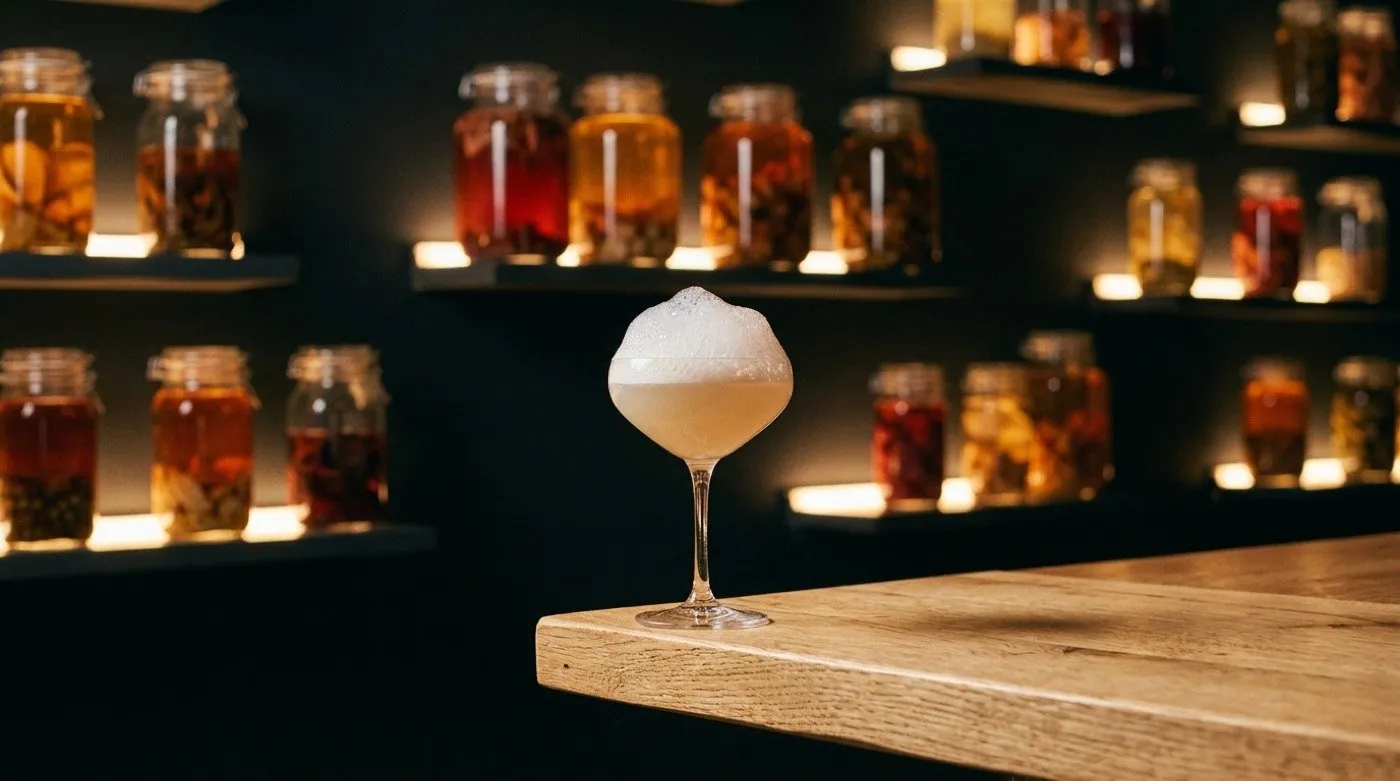
In cocktail making, an air is an ultralight, almost ethereal preparation achieved by emulsifying a flavoured liquid with soy lecithin and air using a stick blender. Unlike a siphon foam — denser, stable and with body — an air is a cloud of extremely fine bubbles that disappears in seconds over the surface of the cocktail, releasing aroma without altering the texture of the drink. At STILLROOM we work with it as a tool of high sensory precision: a laboratory device that turns the first sip into an olfactory experience before a gustatory one.
What an air is and how it works
An air is nothing more than a foam taken to its lowest possible density. The magic happens thanks to soy lecithin, a natural emulsifier that stabilises the air bubbles we incorporate mechanically. When a liquid is blended with a very low proportion of lecithin — usually between 0.3% and 0.6% of the total weight — a structure of microscopic bubbles forms, far more fragile than those of a siphon foam, but also far lighter.
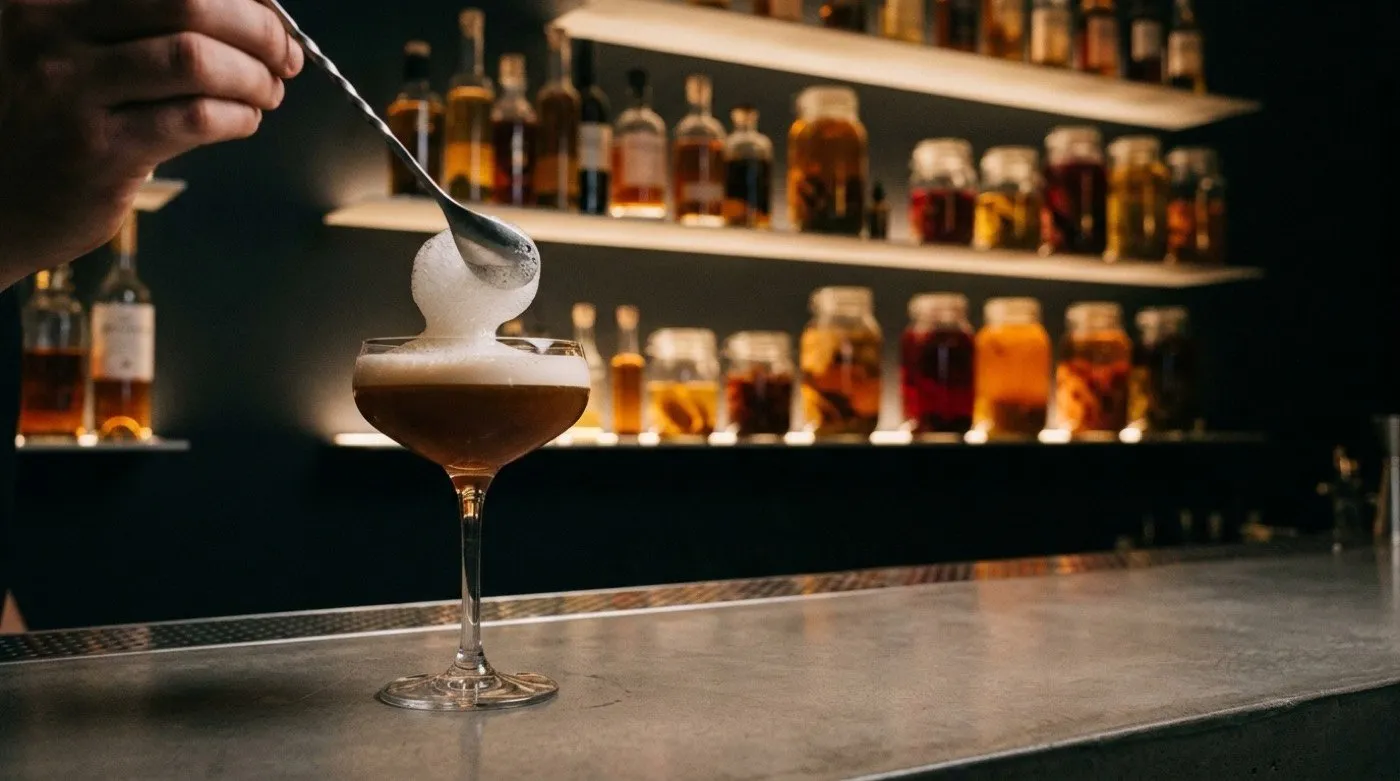
The technique is deceptively simple: an aromatic base liquid is prepared (a clarified juice, an infusion, a saline broth), the powdered lecithin is stirred in and left to hydrate for a few minutes. Then, with a tilted stick blender, it is blended right at the surface of the liquid, without submerging it fully, to trap as much air as possible. Within seconds a dense cloud of bubbles forms, which is scooped up with a spoon and delicately placed over the cocktail. No siphon is needed, no pressurised gas: just a blender and a steady hand.
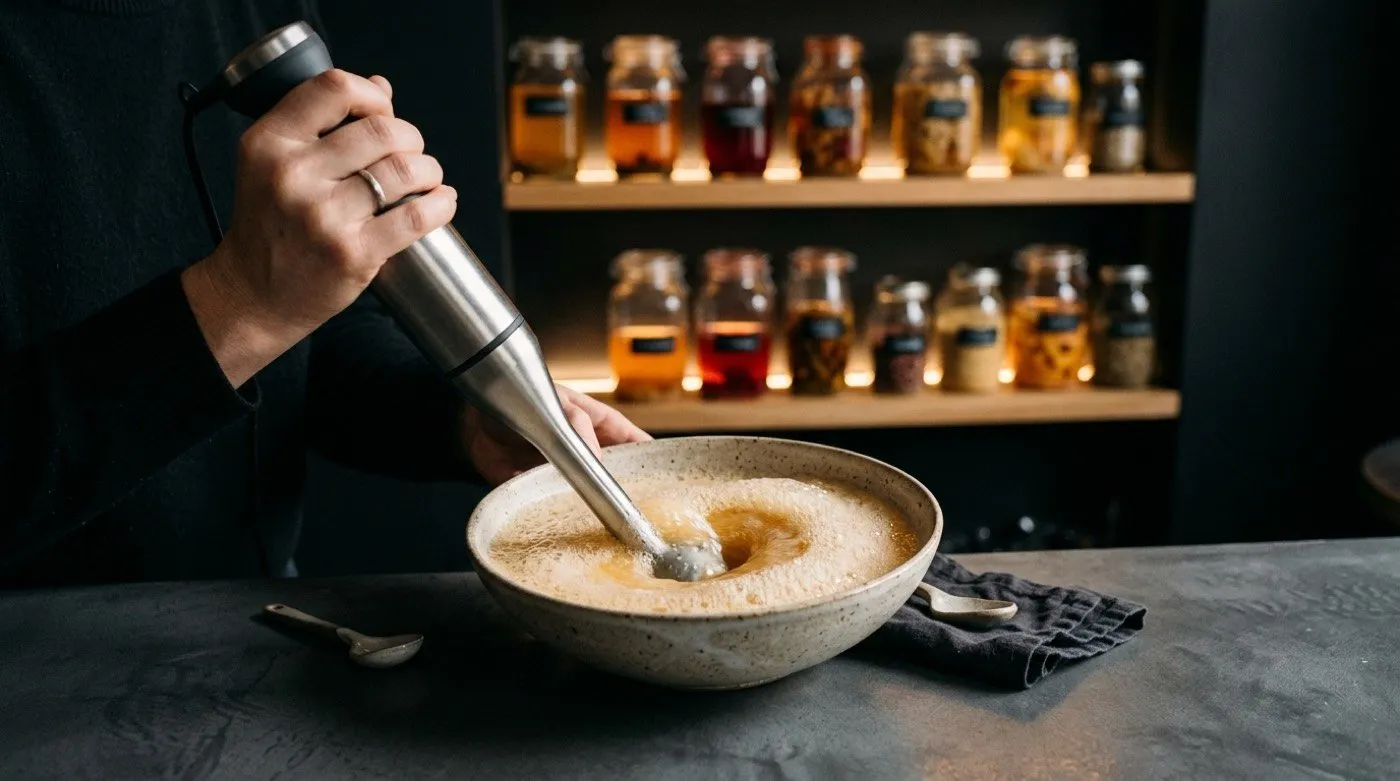
The result is as fleeting as it is elegant. A well-made air adds no body, does not change the fluidity of the sip and barely registers any weight in the mouth. What it does deliver is an intense aromatic charge that hits the nose right before drinking, shaping the perception of the cocktail in a subtle yet powerful way. In our laboratory on Calle Moreto 9, in the Los Jerónimos neighbourhood, we use this technique to add layers of complexity without masking the prior work of clarification, fermentation or cordial-making.
Air vs. foam: two textures, two purposes
In signature cocktail making it pays not to confuse an air with a foam, even though both are gas-in-liquid dispersions. The difference lies in density, stability and the equipment required. While siphon foam uses pressurised nitrous oxide (N₂O) to create a creamy, persistent structure, an air forms through mechanical agitation and lives for barely a few moments. Here is a direct comparison we use daily at the bar:
| Criterion | Air (lecithin) | Foam (siphon) |
|---|---|---|
| Density | Extremely low, light cloud | Medium to high, creamy body |
| Duration | Fleeting (seconds to a couple of minutes) | Persistent (several minutes) |
| Equipment needed | Stick blender, wide vessel | Kitchen siphon, N₂O chargers |
| Mouthfeel | Imperceptible, aroma only | Light cream, adds texture |
| When to use it | To add an aromatic layer without altering the cocktail’s body | To add texture and volume to the drink |
In short: if you want the cocktail to change texture, go for the foam. If what you are after is perfuming the first contact without touching the liquid structure, the air is your technique. At STILLROOM we live with both, but each has its exact moment in the sequence of sips.
Base liquids for airs: the real secret
An air will only be as good as the liquid you use to generate it. Lecithin is a neutral, flavourless vehicle, so all the aromatic weight falls on the base. That is why we work with very intense, clarified or filtered preparations to avoid solids that would break the bubbles. Here is a table of combinations we have tested that work beautifully:
| Base liquid for the air | Dominant aroma | Cocktail where it shines |
|---|---|---|
| Clarified lime juice | Bright, citrusy, acidic | Gin Sour, Margarita |
| Filtered olive brine | Salty, umami, vegetal | Dirty Martini |
| Fresh basil infusion | Herbaceous, green, sweetish | Red berry spritz |
| Ginger and cardamom water | Spiced, mildly hot | Penicillin, Mule |
| Clarified beetroot broth | Earthy, sweet, deep | Signature mezcal cocktail |
The key lies in intensity: a mild liquid will give an air that is invisible to the nose. That is why at STILLROOM we reduce, cold-infuse or adjust the pH before emulsifying. A citrus air over a sour, for instance, boosts the acidity without adding more juice; a saline one over a Dirty Martini doubles the salty sensation without needing more olive. It is pure aromatic precision.
How we use it at STILLROOM
At our bar on Calle Moreto, the air is not a garnish: it is one more ingredient in the construction of the drink. We build it into the sequence of sips to create contrast or to reinforce a note already present in the liquid. Sometimes the same cocktail carries a clarified base and an air that echoes its main aroma, creating a double reading: the palate detects the structure, the nose receives the echo.
This technique dialogues naturally with others we already handle in the laboratory. Siphon foams give us the texture the air cannot provide; liquid nitrogen lets us fix extreme temperatures at exactly the right moment. And all of that lives under the umbrella of our advanced cocktail techniques, where every tool — from the rotary evaporator to the stick blender — has its part to play in the final score.
Three ideas to get started
If you want to explore airs at home or behind your own bar, these three combinations are a foolproof starting point. They need no strange equipment, just a blender, a fine strainer and a willingness to play with aromas.
Citrus air over a Gin Sour
Mix 100 ml of clarified lime juice (you can pass it through a coffee filter) with 0.5 g of powdered soy lecithin. Leave to hydrate for 5 minutes, blend at a tilt and scoop up the cloud. Place it over a classic Gin Sour just before serving. The hit of lime on the nose primes the palate for the drink’s acidity with no need to squeeze more citrus.
Saline air over a Dirty Martini
Use 80 ml of well-filtered green olive brine and add 0.4 g of lecithin. Blend until a dense cloud forms and lay it gently over the freshly poured Martini. The result is a Dirty Martini that smells of olive before the glass even reaches your lips, yet keeps the dry elegance of the gin and vermouth on the palate.
Fresh herb air over a spritz
Prepare a cold infusion of basil and mint (50 g of fresh leaves per litre of water, 12 hours in the fridge, strain well). Take 100 ml, add 0.5 g of lecithin and emulsify. Serve over a red berry or cava spritz. The herbaceous sensation floats above the sparkling wine’s bubbles and turns a simple aperitivo into a signature cocktail.
Frequently asked questions
What is an air in cocktail making?
An air is an extremely light, fleeting foam made by emulsifying an aromatic liquid with soy lecithin and air using a stick blender. It delivers an aromatic cloud that disappears quickly, without altering the cocktail’s texture.
What is the difference between an air and a foam?
The main difference lies in density and duration. An air is ultralight, made without a siphon and lasts seconds; a siphon foam is creamier, more persistent and needs pressurised gas. The air perfumes, the foam adds texture and volume.
What lecithin is used to make airs?
We use defatted, food-grade soy lecithin in powder form. It is a natural emulsifier that stabilises the air bubbles without adding flavour or colour. The usual ratio is between 0.3% and 0.6% of the liquid’s weight.
Do I need a siphon to make an air?
No. An air is made exclusively with a stick blender, with no need for a siphon or gas chargers. Simply blending the liquid with lecithin at the surface is enough to generate the cloud of bubbles.
How long does an air last on the cocktail?
It is very fleeting: it can last anywhere from a few seconds to a couple of minutes, depending on the temperature, the lecithin ratio and the ambient humidity. That is why it is always added at the very last moment, just before serving. If reading this has made you curious to try an air live, we invite you to explore our cocktail menu, where these techniques live alongside ferments, cordials and clarifications in seasonal creations. And if you would like to see it up close, you can book a table at STILLROOM, right in the heart of Los Jerónimos, Madrid. To keep discovering terms and techniques, do not miss our cocktail glossary, where we add a new definition every week with the same laboratory-and-bar outlook we apply here.