Smoked cocktails: the smoking technique in cocktail making
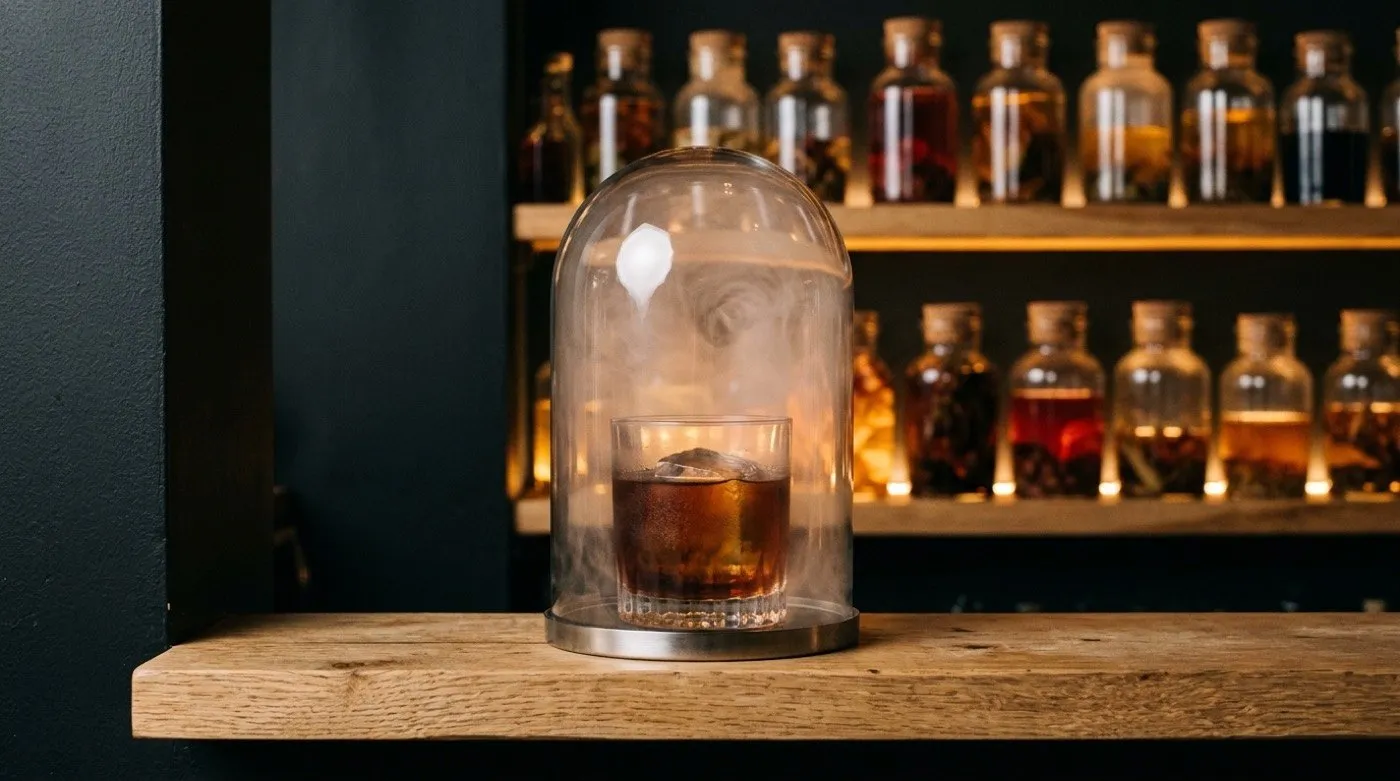
At STILLROOM we understand smoking a cocktail as the controlled addition of an aromatic layer of smoke — generated by the slow combustion of woods, herbs or spices — that is transferred to the glass or to the liquid itself just before service. The technique aims to wrap the drink in an aromatic veil that changes the perception of the sip from the very first approach of the nose to the glassware, without dominating the balance of the drink. It is normally achieved by trapping the smoke under a glass cloche or through cold infusion, and in our case it forms part of that laboratory-based signature cocktail making that defines us.
What smoking in cocktail making is and how it works
Smoking a cocktail is, in essence, capturing the volatile aromatic compounds released by an organic material when we subject it to incomplete, controlled combustion. We are not talking about burning or charring, but about making small chips, dried herbs or even hay release a white, fragrant smoke, laden with phenols, aldehydes and other molecules that our sense of smell processes as “smoky”.
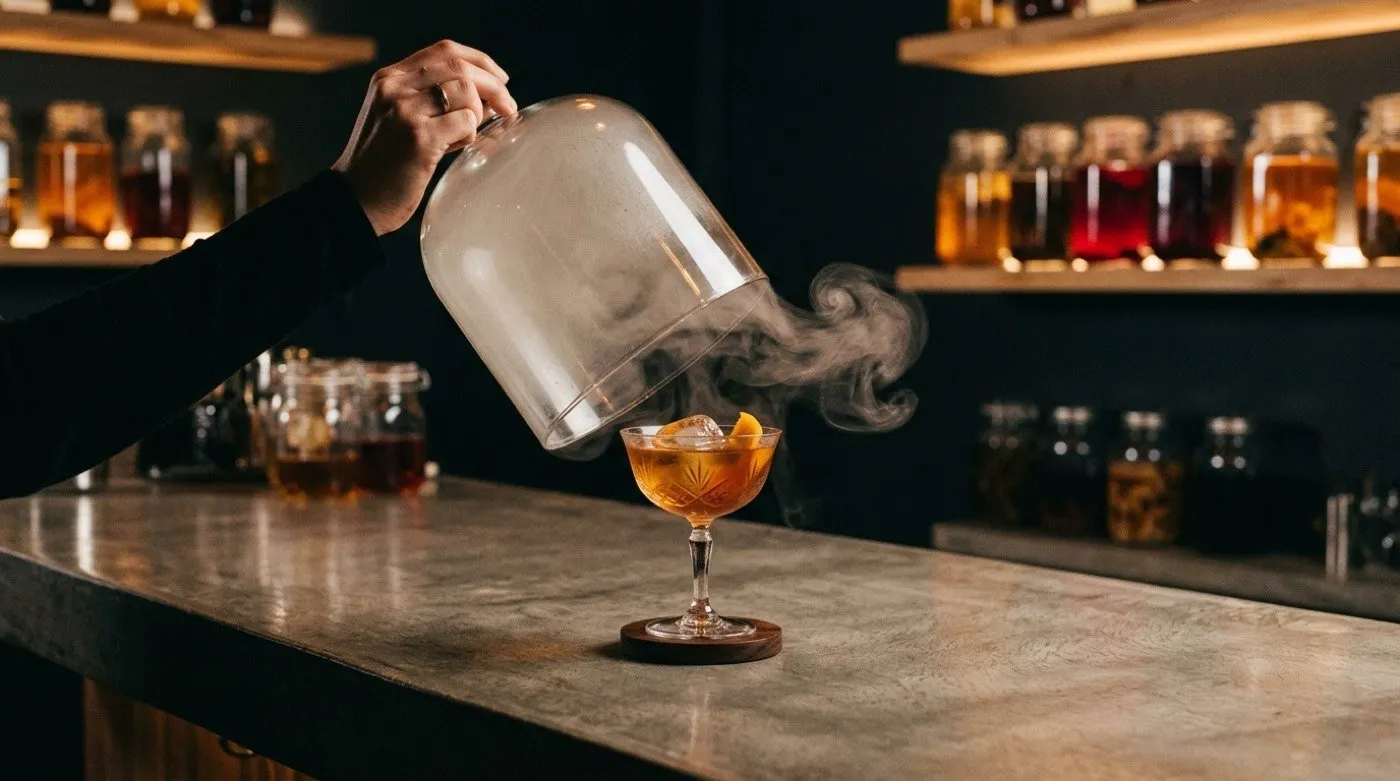
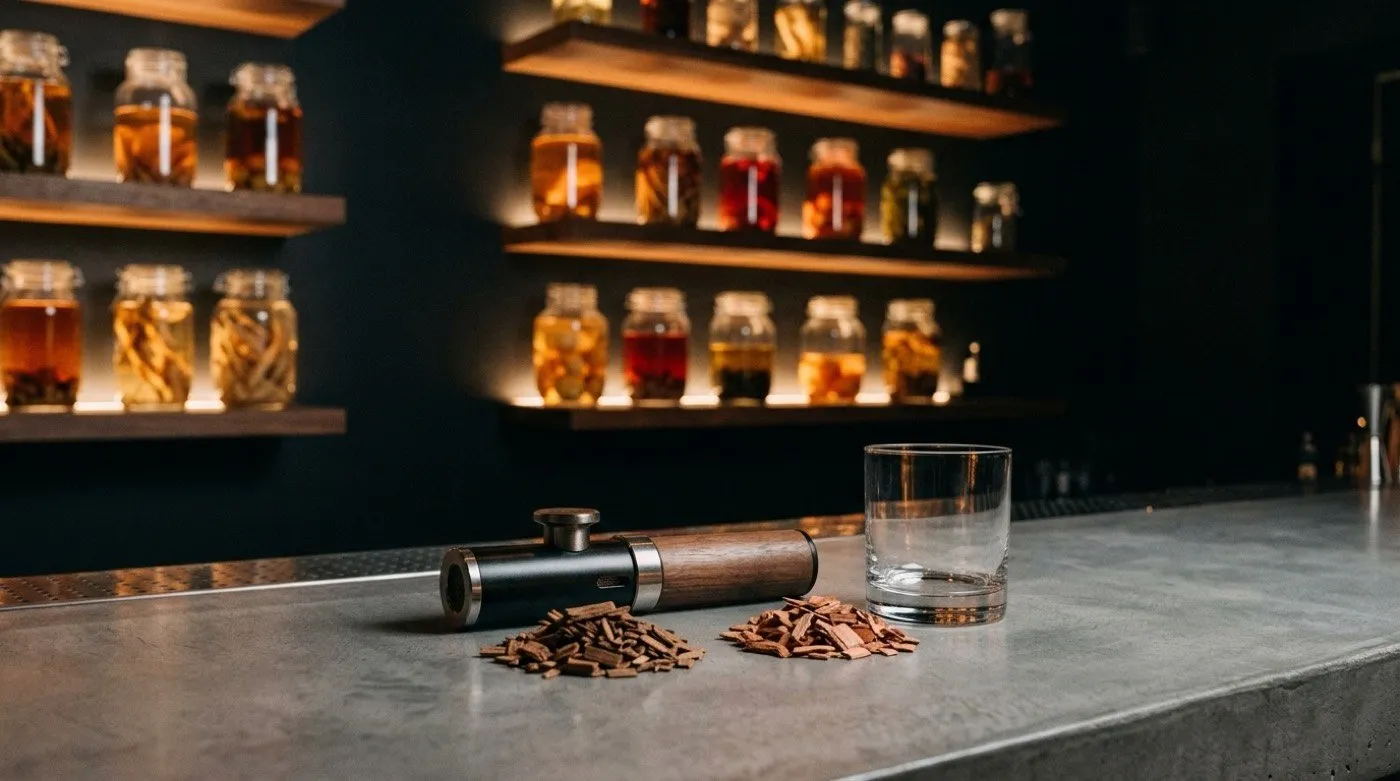
The smoke is generated with a handheld smoker — sometimes a smoking gun, sometimes bellows with an electric element — and is channelled directly into a glass cloche we have previously placed over the glass, or into an airtight container holding the liquid. Within seconds, the aroma of the smoke permeates the surface of the glass and clings to its walls, so that when the guest raises it to their lips, the first thing they perceive is that aromatic layer. If we also smoke the liquid itself, part of those compounds dissolve into the alcohol and the aqueous phase, subtly altering the flavour.
The most interesting thing from an organoleptic point of view is that smoking does not only contribute a recognisable “smoky” note; depending on the wood or herb chosen, hints of vanilla, clove, pepper, leather, caramel or even dried flowers can appear. What changes is the depth of the drink: a cocktail that was flat on the palate gains layers, becomes more complex and plays with the guest’s olfactory memory.
It is worth distinguishing two broad approaches: smoking the glass and smoking the liquid. The first has an almost entirely aromatic impact, with very little flavour transfer, and is perceived mainly through the nose. It is pure theatre and tableside spectacle. The second, on the other hand, integrates the aromas of the smoke into the drink and keeps them throughout the experience. We often combine both to build a complete sensory arc: a smoky welcome in the glass and a lasting undertone on the palate. And of course, this has nothing to do with flaming a citrus peel, which is another equally valid technique but based on the essential oils in the peel, not on the combustion of a wood.
Woods, herbs and elements for smoking: how to choose the right profile
Not all woods or plant materials smell the same when burned slowly. The choice of the element we are going to smoke completely shapes the final character of the cocktail, and here the criterion is similar to that of smoked cuisine: each wood imprints a different character. This table sums up the profiles we use or recommend most from our laboratory back room:
| Wood or element | Aromatic profile | Pairs well with |
|---|---|---|
| Oak | Notes of vanilla, caramel, coconut and sweet spice. Round, enveloping smoke. | Whisky, bourbon, aged rum, cocktails with red vermouth. |
| Cherry | Fruity, lightly sweet, with a tangy note reminiscent of stone fruit. | Gin, vodka, white spirits and combinations with red berries. |
| Walnut (hickory) | Powerful, deep smoke, earthy and roasted-nut notes. | Mezcal, reposado tequila, dark rum and cocktails that already carry smoky notes. |
| Rosemary | Herbal, camphor-like, with a resinous, balsamic, very Mediterranean edge. | Gin and tonic, citrus cocktails, combinations with honey or thyme. |
| Black tea | Tannic, dry, with hints of toasted leaves and a slightly bitter undertone. | Cocktails with sherry, manzanilla, agave spirits or even a dry Martini. |
| Hay | Vegetal, sweetish, like dried meadow. Very subtle and evocative. | Cocktails with a dairy or fermented profile, apple or pear cordials, sparkling drinks. |
It is worth remembering that, as with almost everything in cocktail making, less is more. Some very resinous or treated woods can turn bitter or leave an unpleasant aftertaste, so we always work with chips and herbs specifically intended for food use, free of varnishes or additives. The dose of smoke, moreover, is controlled by exposure time: ten or fifteen seconds under the cloche are enough to make the difference without overdoing it.
Smoking methods: from the cloche to smoked ice
There is no single way to smoke a cocktail, and the choice of method changes both the final intensity and the moment in the service at which the smoke appears. We have systematised the four procedures we use most, with their advantages and particularities:
| Smoking method | How it’s done | Intensity | When to use it |
|---|---|---|---|
| Glass under cloche | The empty or already-served glass is placed on a base, smoke is injected and it is covered with a glass cloche. The guest lifts it and receives the first aromatic impact. | Medium-high in the nose, low on the palate | For theatrical tableside presentations, ideal for cocktails such as the Old Fashioned or the Negroni. |
| Cold liquid | The smoke is introduced into an airtight container (jar, vacuum bag or siphon) together with the already-mixed cocktail and left to infuse for a few minutes. It is then filtered and served. | Medium in the nose, medium-high on the palate | When you want the smoking to form an integral part of the flavour, as with a smoky mezcal or a whisky cocktail. |
| Chip torched directly on the surface | A chip is lightly burned with a blowtorch and rested on the rim of the glass or on a heatproof coaster, so the smoke rises right in front of the guest. | High in the nose, fleeting | For an ephemeral, highly visual touch, useful in short cocktails drunk quickly. |
| Smoked ice | Smoked water is prepared — smoking cold water in an airtight container — and used to make ice cubes. As they melt, they progressively release the smoke. | Low-medium, progressive | Cocktails that stretch out over time, such as a highball or a soda-based drink, where an aromatic evolution is desired. |
In every case, smoking is a fast but precision technique: one second too many or a poorly chosen material can turn an elegant touch into an ashtray note. That is why at STILLROOM we time every exposure and test every combination before it reaches the menu.
How we use it at STILLROOM
Smoking is not, for us, an isolated bar trick, but one more tool within a technical ecosystem that includes other laboratory approaches. Often, before reaching the smoke, we have taken the ingredients through earlier processes seeking texture, transparency or fat integration.
For example, a spirit we first work through vacuum distillation in a rotary evaporator to isolate its most delicate notes can end up finished with cherry-wood smoke that gives back a certain fruity warmth without masking the earlier work. Other times we combine smoking with fat washing: a fat infused cold (toasted butter, sesame oil or ham) is cleaned by freezing and the cocktail is then finished under the cloche with walnut smoke, generating an interplay between the unctuousness and the dryness of the smoke’s aroma. In both cases, smoking acts as the closing note of a sensory story that begins much earlier, in the laboratory.
We also like to bring smoking into presentations where the room itself becomes part of the show: serving a transparent cocktail — clarified, without a single particle in suspension — and covering it with a cloche from which rosemary or hay smoke escapes generates an anticipation that no other gesture achieves. Our advanced cocktail techniques always seek that balance between science and experience, and smoking is probably the most direct bridge between laboratory precision and the guest’s emotional memory.
Three ideas for getting started with smoked cocktails
If you want to explore this technique at home or better understand what to expect when you see it at a professional bar, these three classic proposals serve as a template for what smoke can contribute:
Old Fashioned smoked under a cloche
Bourbon, sugar and Angostura bitters form a rich, warm base that naturally welcomes oak or cherry smoke. In this case the cocktail is served whole, covered with the cloche, the smoke is injected and left to rest for a few seconds. On uncovering it, the nose is flooded with an aroma of toasted wood that prepares the palate for the spiced sweetness of the drink. The key is not to overdo the time so the smoke does not mask the perfume of the whisky itself.
If you want the base before adding any smoke, the ratios and the step-by-step are in our Old Fashioned recipe.
Mezcal enhanced with walnut smoke
Mezcal already carries a smoky note from origin, but when we combine it with walnut (hickory) smoke we achieve a kind of amplified echo: the external smoke and the internal one converse with each other. The technique can be twofold: a light cold infusion of the mezcal with walnut smoke and then a burst from the cloche just before serving. The result is an earthy, deep profile, ideal to drink neat or in variations of a smoked Margarita.
Negroni smoked with rosemary
The traditional Negroni — gin, red vermouth and Campari — has a bitterness and botanical complexity that welcomes a herbal counterpoint. A sprig of dried rosemary placed on the smoker’s board and gently burned just before covering the glass with the cloche releases a resinous, Mediterranean smoke that wraps the cocktail without sweetening it. It is a version that respects the Italian character but carries it off to scrubland, to rosemary and to dry-country air.
Smoking is one of those tools that, well understood, turns cocktail hour into a small ritual. If you would like to see how we put it into practice in Madrid or try some of the combinations born in our laboratory, we invite you to browse our cocktail menu or book a table to experience it live at STILLROOM, on Calle Moreto 9, beside El Retiro. And if you are left wanting more technique and definitions, take a look at our cocktail glossary, where we unpack every concept of the craft at leisure.
Frequently asked questions
What is a smoked cocktail?
A smoked cocktail is one to which smoke has been added, generated by the controlled combustion of wood chips, herbs, spices or other plant materials, in order to contribute an aromatic layer and, occasionally, a light smoky flavour. The technique can be applied to the glass alone or to the liquid as well.
How do you smoke a cocktail?
The most widespread method involves using a handheld smoker — electric or bellows-operated — loaded with chips of the chosen material. The chips are lit, the smoke is channelled into a glass cloche covering the glass or into a sealed container holding the cocktail, and it is left to rest for ten to twenty seconds so the aromas permeate the surface or the liquid.
Which woods are used to smoke cocktails?
The most common are oak — which contributes vanilla and caramel notes —, cherry — fruity and subtle — and walnut or hickory — intense and earthy. Herbs such as rosemary, thyme or hay are also used, and even black tea or dried citrus peel, depending on the aromatic profile sought.
Do you smoke the glass or the liquid?
Both options are valid and pursue different effects. Smoking the glass alone mainly affects the cocktail’s olfactory phase, leaving a hint of smoke in the nose that does not substantially alter the flavour. Smoking the liquid itself — through cold infusion or with smoked ice — adds a more integrated, lasting flavour dimension. Many bartenders combine both techniques to play with the drink’s evolution.
Which cocktails work best smoked?
Spirit-forward cocktails, such as the Old Fashioned, the Manhattan, a good Negroni or any combination based on whisky, mezcal or aged rum, are the ones that best support and enhance smoky notes. However, smoking also works with light, refreshing cocktails looking for aromatic contrast, provided it is applied with restraint so as not to unbalance the whole.