Clear ice in cocktail making: technique and formats
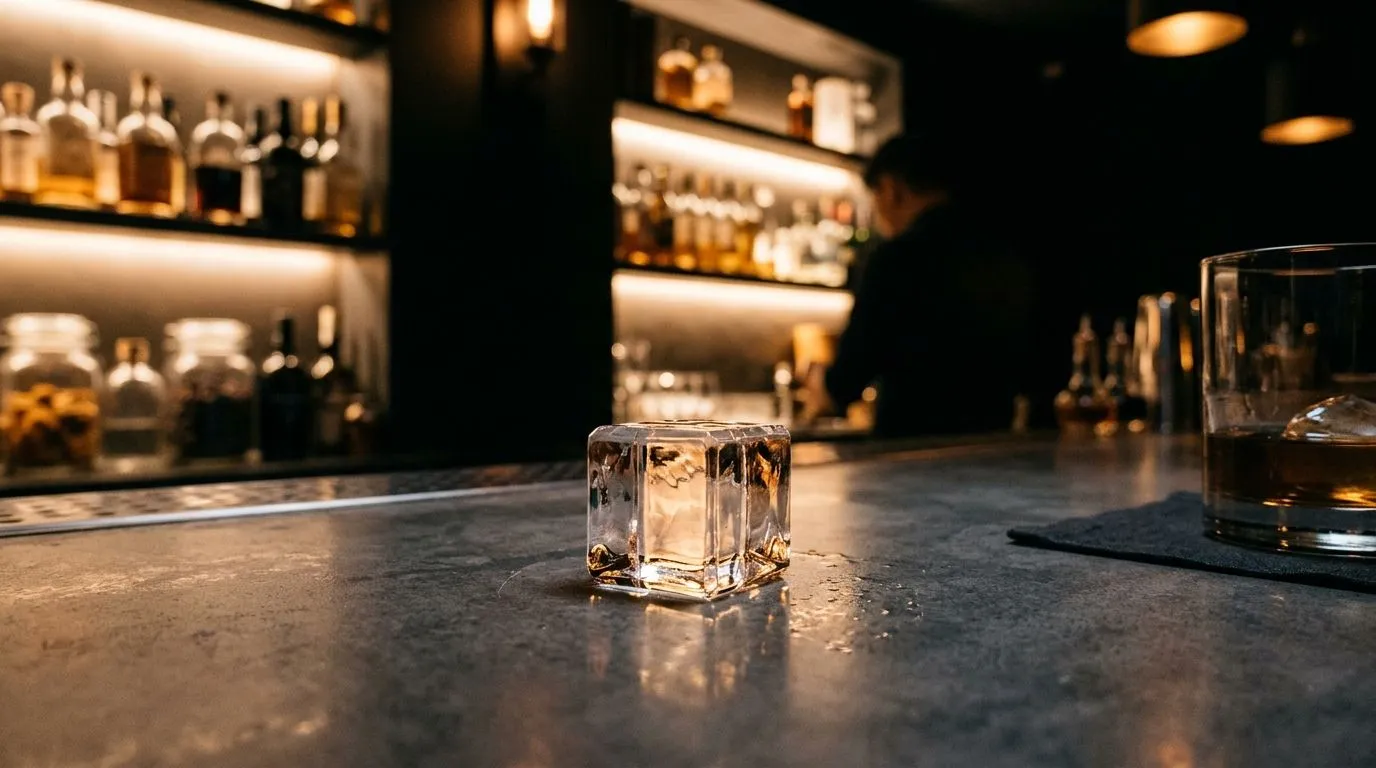
At STILLROOM we often say that ice is the ingredient nobody looks at and that decides everything. Clear ice in cocktail making is not an aesthetic whim: it is water frozen slowly and in an orderly way, with no trapped air or impurities, that chills just as well, melts more slowly and lets the cocktail keep its balance from the first sip to the last. Choosing the right format for each glass is the other half of the job.
Why cloudy ice ruins a cocktail
A cocktail is, in large part, water. When we stir or shake it, the ice melts and contributes between 20% and 30% of the final volume; when we serve it over ice, that dilution carries on in the glass as you drink. That is why the state of the ice affects two things at once: the flavour and the speed of dilution.
Cloudy ice, the kind that comes out of a household ice tray, has a white core full of air microbubbles and concentrated mineral salts. That core makes it fragile: when it receives a room-temperature liquid, the cube cracks, breaks into smaller pieces and multiplies its contact surface. More surface means faster melting, and faster melting means a watery drink before its time. Add to that the flavour: if the starting water has chlorine or a lot of limescale, or if the ice has shared the freezer with other food, all of that ends up in the glass.
Clear ice, on the other hand, is dense, homogeneous and free of internal fractures. It chills just as effectively, but it melts more slowly and predictably, which lets us control dilution precisely, just as we control the seconds of a stir in a mixing glass or the intensity of a shake in a shaker.
Directional freezing: how to get crystal-clear ice
The key lies in understanding how water freezes. In an ice tray, the cold enters from every side at once and the ice advances from the outside in. The dissolved air and the minerals, which do not fit into the crystal structure of the ice, are pushed towards the centre, the last point to freeze. The result: a cube with a white heart.
Directional freezing changes the rules. If we insulate the walls and the base of the container and leave only the surface exposed to the cold, the water freezes in a single direction: from the top down. The ice front advances like a layer sinking downwards and pushes the air and impurities towards the bottom, which stays liquid for longer. The top of the block is left clean, as clear as glass.
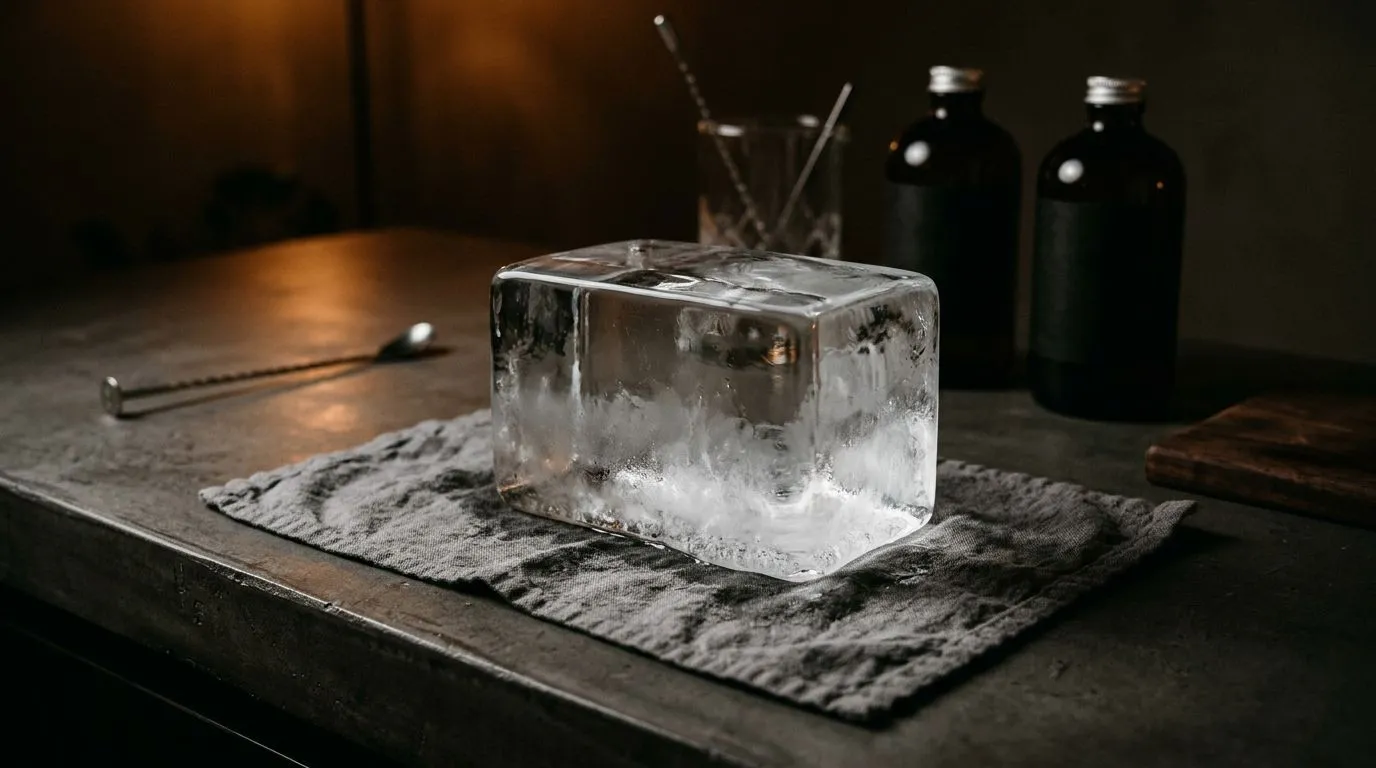
The most effective home method is surprisingly simple: a small cool box, the kind you take on a picnic, filled with filtered water and without its lid, inside the freezer. The insulated walls do the rest. The trick is not to let it freeze completely: when roughly three quarters of the water has solidified, we take the block out, turn it out and remove the cloudy lower portion. If we wait for it to freeze entirely, the water at the bottom, already loaded with air, pushes as it expands and can crack the block.
On popular tricks, it is worth being honest. Boiling the water once or twice removes some of the dissolved air and helps a little, but it does not solve the underlying problem: if it then freezes from every side, whatever minerals and gas remain will concentrate in the centre again. Using filtered water improves the flavour, but it is not enough on its own either. What really makes the difference is the direction of freezing.
| Factor | Ice-tray ice | Directional-freezing ice |
|---|---|---|
| Direction of freezing | From every side towards the centre | From the top down, in a single direction |
| Appearance | White core with bubbles and fractures | Clear, homogeneous, no trapped air |
| Resistance to thermal shock | Low: cracks on receiving the liquid | High, as long as it is tempered before use |
| Speed of dilution | Fast and irregular | Slow and predictable |
| Ideal use | Shaking in the shaker, where it will be strained | Serving in the glass: large cubes, spears, spheres |
Cutting, tempering and ice formats by glass
A block fresh out of the freezer is so cold that, if we try to cut it straight away, it splinters. That is why we let it temper for a few minutes on a board, until the surface goes from opaque to glossy. Then we mark a line with a serrated knife, rest the blade on the mark and give it a sharp tap with a mallet: the ice splits cleanly along the line. First into slabs, then into bars, then into cubes or spears. It is work for patience, not force.

Each format follows a logic of surface and volume. The larger and more compact the ice, the less surface it exposes per gram and the more slowly it melts. The smaller and more fragmented, the faster it chills and the faster it dilutes. That is the rule that guides our choice:
| Format | Approximate size | Glass | Typical cocktails | Why |
|---|---|---|---|---|
| Large cube | 5 × 5 cm | Short glass (rocks) | Old fashioned, short drinks over ice | Dilutes slowly and keeps the drink stable throughout the whole serve |
| Ice spear | Long bar that fills the height of the glass | Tall glass (highball, collins) | Highballs, gin and tonic, long drinks with bubbles | Fills the column of the glass, reduces gaps and protects the carbonation |
| Crushed ice | Irregular fragments of a few millimetres | Tall glass, julep cup, tiki glass | Swizzles, juleps, tiki drinks | Extreme, immediate cold, deliberately fast dilution, frost on the glass |
| Sphere | 5-6 cm in diameter | Short glass | Spirits neat over ice, aromatic drinks | Minimum surface per volume: the slowest dilution possible |
| Standard cube | 2.5-3 cm, dry and very cold | Shaker or mixing glass | Any shaken or stirred cocktail | Enough surface to chill and dilute in seconds before straining |
The large cube is the natural companion of our old fashioned recipe: a drink that is sipped slowly and that appreciates ice that does not drown it. The spear is the backbone of a good gin and tonic and, in general, of the whole format we explain in our article on the highball. And crushed ice has its own territory, that of the swizzle, where quick dilution is not a flaw but part of the design.
Ice in a professional bar
In a professional bar, ice is treated with the same attention as a homemade cordial or a clarified juice. Three habits sum it up. The first: serving ice is not the same as working ice. The ice that goes into the shaker or the mixing glass does its job and is strained out; the ice that ends up in the glass at the table has to be dense, clean and in the right format, because it will accompany the cocktail for its whole life.
The second: the glass gets chilled too. Clear ice in a room-temperature glass starts to melt before the drink reaches the table. Chilling the glass beforehand is the simplest way to extend the life of the ice.
The third: ice is never touched with the hands, nor scooped directly with the glass, which could chip. Tongs or a scoop, always. They are small, almost invisible gestures, and precisely for that reason they fit our way of understanding cocktail making: the art of what you cannot see but notice in every sip.
Three ideas to improve your ice at home
1. Your first directional block
Find a small cool box that fits in your freezer, fill it with filtered water up to a couple of fingers from the rim and put it in without its lid. Start checking after 18 hours: when you see that the bottom still has liquid water, it is time. Turn it out, temper it and discard the cloudy part.
2. Large cubes without cutting tools
If you do not want to cut, use large silicone cube moulds placed inside the open cool box, surrounded by water. Directional freezing works on them too and you will get much cleaner cubes than from a normal ice tray.
3. Crushed ice on the spot
For a swizzle or a julep, wrap cubes in a clean tea towel and hit them with a mallet or a rolling pin. The towel absorbs some of the water and leaves you with dry, cold crushed ice, ideal for frosting the glass from the outside.
Frequently asked questions
Why does homemade ice turn out white?
Because in an ice tray the water freezes from every side at once: from the walls, the base and the surface towards the centre. As the ice advances, it pushes the dissolved air and mineral salts towards the heart of the cube, which is the last part to freeze. There they get trapped as microbubbles and fractures, and that is what we see as a white cloud. It is not dirt: it is concentrated air and minerals. But that cloudy core makes the ice more fragile, more prone to cracking on contact with the liquid and less attractive in the glass.
How do you make clear ice at home?
With directional freezing. Fill a small cool box (the kind you take on a picnic) with water, leave it without its lid and put it in the freezer. The insulation of the walls and the base forces the water to freeze only from the top down, so the air and impurities are pushed towards the bottom. Take the block out when roughly three quarters of the volume has frozen (between 18 and 30 hours, depending on your freezer and the amount of water), turn it out, let it temper for a few minutes and discard the cloudy lower part. What remains is a crystal-clear block ready to be cut into cubes or spears.
Which ice should be used for each cocktail?
It depends on the glass and on the dilution the drink is looking for. A large cube of about 5 cm for short cocktails served over ice, such as the old fashioned, because it dilutes slowly. A long ice spear for tall glasses and highballs, because it fills the column of the glass and protects the bubble. Crushed ice for swizzles, juleps and tiki drinks, where we want extreme cold and quick dilution. A sphere for spirits served neat over ice or for very aromatic drinks. And standard cubes, dry and very cold, for shaking in the shaker or stirring in the mixing glass.
Does ice change the flavour of a cocktail?
Yes, and far more than it seems. Ice melts and becomes part of the cocktail: between 20% and 30% of what you drink in a stirred or shaken drink is water from the ice. If that ice tastes of chlorine, limescale or whatever else is stored in the freezer, the cocktail will taste of that too. On top of that, the format and density of the ice decide how fast it dilutes: cloudy ice full of fractures breaks and melts sooner, watering down the drink; dense, clear ice keeps the balance for longer.
How long does ice keep, and how do you store it without it picking up smells?
In a freezer at around -18 °C ice keeps for weeks without a problem, but it absorbs smells easily, especially if it shares space with food. Always store it in tightly sealed freezer bags or airtight containers, away from strongly scented food, and renew your stock often: the ideal ice for a cocktail is the one made a few days ago. It is also best to stop it from frosting over too much; ice with a layer of frost sticks together and breaks unevenly. If you would like to see in the glass what well-treated ice means, we look forward to seeing you at STILLROOM, Calle Moreto 9, Madrid. Take a look at our cocktail menu and, if you want to secure a spot at the bar, book your table. And if you feel like sharpening your vocabulary further, in our cocktail and mixology glossary you will find every term explained with the same rigour we apply behind the bar.