Cocktail measures: jigger, dash and parts
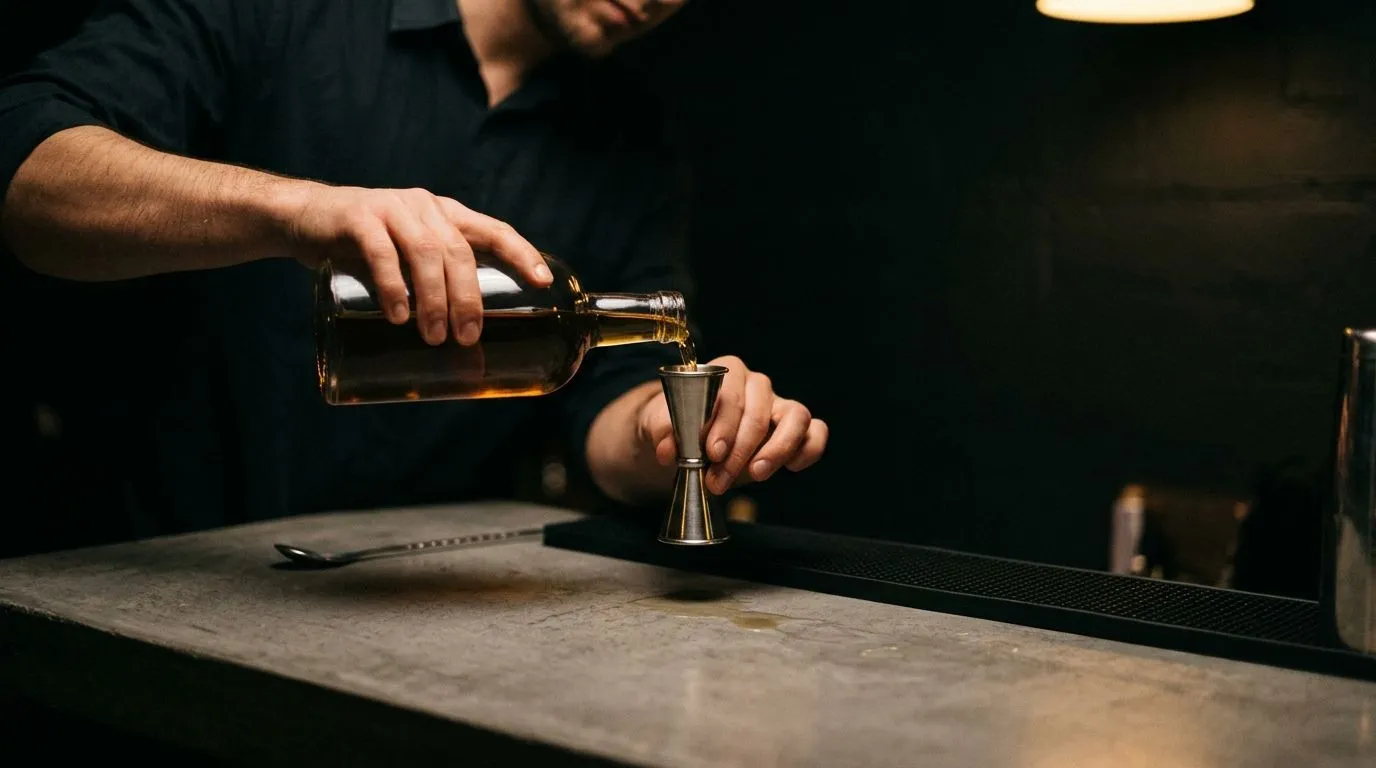
At STILLROOM we measure every cocktail. Not out of rigidity, but because cocktail making is, above all, a question of balance, and balance is written in proportions. Cocktail measures — the jigger, the dash, the barspoon and the logic of parts — are the common language that lets a recipe work the same at our bar on Moreto 9 as in your kitchen. Mastering them is the first foundation of everything else.
The jigger: the tool that turns a recipe into a cocktail
The jigger is the double-ended measure you see in any serious bar: two cones or cups joined at the base, each with a different capacity. Its function is simple and crucial: to always serve the same amount of each ingredient.
The most common confusion comes with units. Classic cocktail making was born in Anglo-Saxon bars that measured in ounces, and a fluid ounce equals about 29.6ml, which we round to 30. In Spain and much of Europe, on the other hand, round millilitres are used. Hence two major standards coexist: the 50/25ml jigger, the most common in our country, and the 60/30ml one, which almost exactly replicates the 2 oz and 1 oz of the original recipes.
The third major model is the Japanese jigger: taller, narrower, thin-walled and with intermediate internal markings. The narrow mouth reduces spills, the tall profile makes it easier to read the meniscus and the markings let you measure fractions — 15, 20 or 45ml — without changing tools. It does not measure differently; it measures more comfortably.
| Type of jigger | Usual measures | Equivalence | Strong point |
|---|---|---|---|
| European double-cone | 50 / 25ml | Round measures in ml | The standard in Spain; fits recipes in the metric system |
| Anglo-Saxon double-cone | 60 / 30ml | ≈ 2 oz / 1 oz | Translates classic recipes in ounces with no calculation |
| Japanese | 60 / 30ml or 45 / 30ml, with internal markings | Intermediate fractions marked | Narrow mouth, fewer spills, precise meniscus reading |
| Graduated, test-tube style | Continuous scale from 5 to 60ml | Any quantity | Ideal for developing new recipes and adjusting to the millilitre |
A technical detail that makes the difference: the jigger is filled to the brim, not “nearly”. Surface tension lets the liquid form a small convex meniscus, and that is the correct measure. A jigger filled only halfway for each ingredient can easily take 10% off the cocktail and unbalance the relationship between sour and sweet.
Dash, barspoon and other small measures
Some ingredients are so intense that the jigger is too big. For them there are smaller units, some precise and some more intuitive.
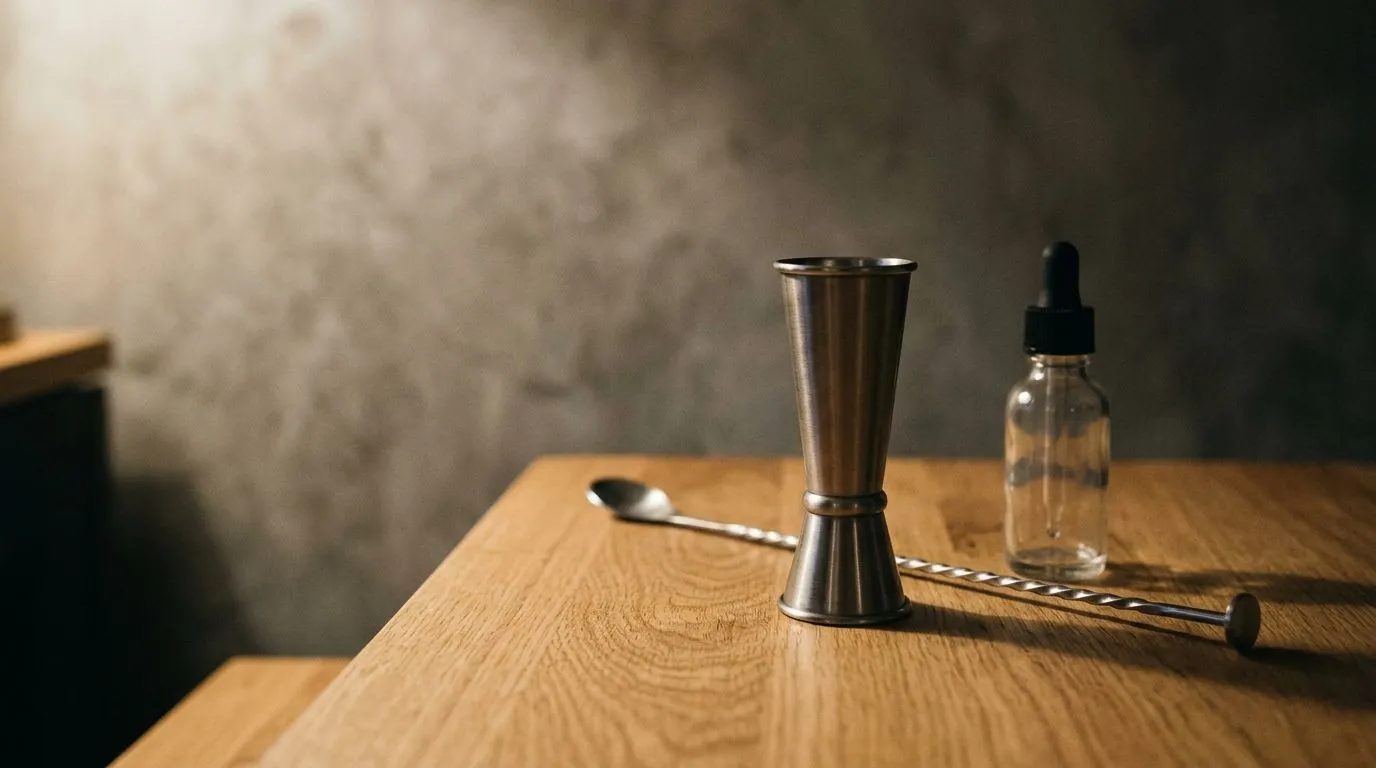
The dash is the best known: the sharp splash that comes out of a bottle of bitters with a dasher top when you invert it decisively. As a rough guide, it comes to between 0.6 and 1ml, but it depends on the dasher, the level in the bottle and the gesture. Bitters are dosed in dashes because they are very concentrated extracts: two dashes of aromatic bitters are the backbone of an old fashioned, and a third one too many can mask the spirit.
The barspoon, besides being used to stir, works as a measure: one barspoon comes to around 5ml, although it varies slightly by model. It is the perfect unit for rich syrups, very sweet liqueurs or a touch of absinthe.
| Measure | Approximate equivalence | When it is used |
|---|---|---|
| Drop | ≈ 0.05ml | Saline solutions, tinctures, essential oils, floral waters |
| Dash | ≈ 0.6-1ml | Aromatic and citrus bitters, concentrated tinctures |
| Barspoon | ≈ 5ml | Rich syrups, sweet liqueurs, touches of absinthe or maraschino |
| “Splash” | ≈ 5-15ml, informal | A little soda or juice to open up or lengthen |
| Top up (top) | Until the glass is full | Soda, tonic or sparkling wine at the end of the build |
The splash is the least exact measure in cocktail making, and it should be treated for what it is: an indication of intent rather than of quantity. When a recipe says “a splash of soda”, it is asking for a touch that opens up the drink, not one that lengthens it.
Thinking in parts: why ratios matter more than ml
If we had to keep just one idea from this article, it would be this: a cocktail is a proportion, not a list of quantities. That is why many classic recipes are written in parts.
The perfect example is the negroni, a 1:1:1 of gin, red vermouth and Italian bitter. It does not matter whether you use 30ml of each, 25ml of each or a litre of each for a batch: as long as you respect the proportion, the character of the cocktail will be the same. The recipe is the ratio.
The sour family illustrates it even better. Its classic structure is 2:1:1: two parts of spirit, one of citrus and one of sweetener. With a 50/25 jigger, that translates into 50ml of spirit, 25ml of citrus and 25ml of syrup. With a 60/30 one, into 60, 30 and 30. From there, each bar fine-tunes: many bring the citrus and the sweetener down to three quarters of a part for a drier drink. We explain it in depth in our article on the acid balance of sours.
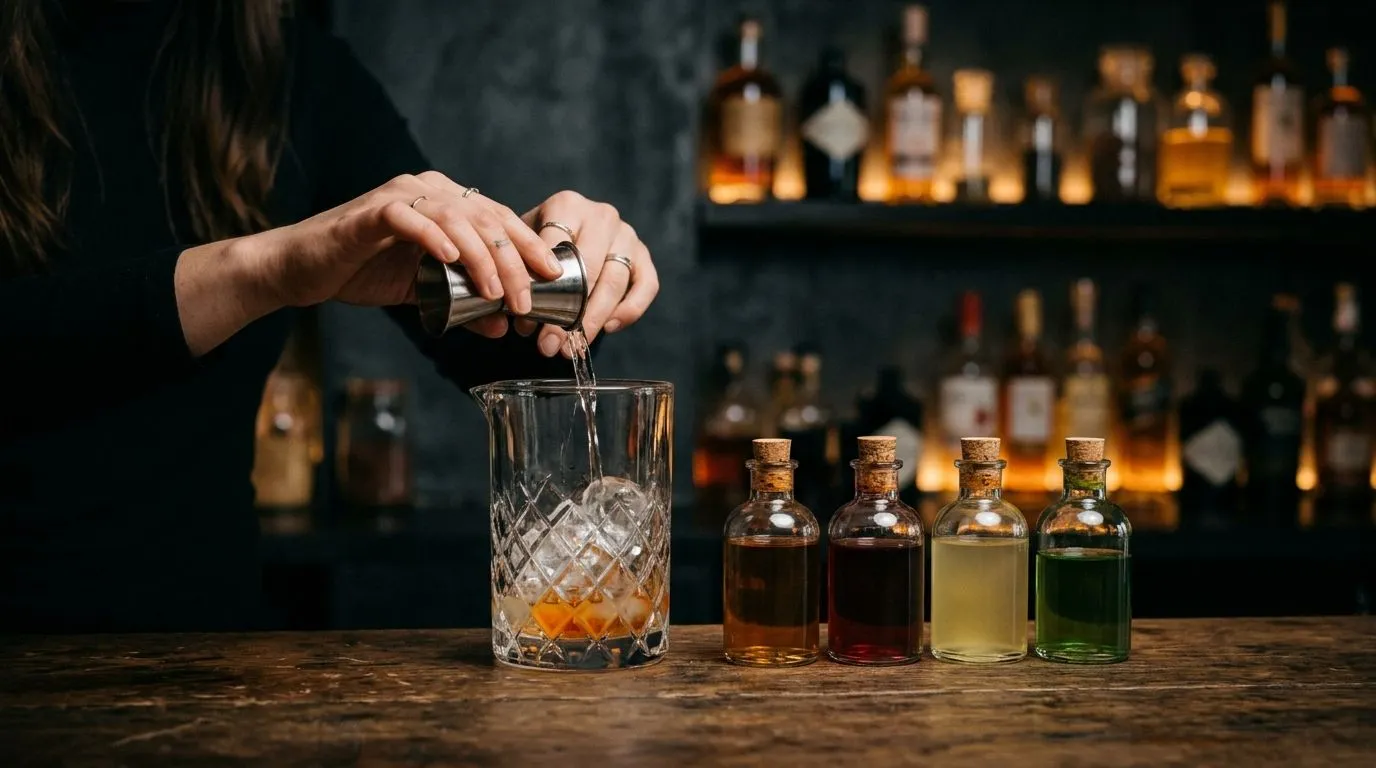
Thinking in parts has three practical advantages. It lets you scale without errors, from a single glass to a jug for ten. It lets you adapt the recipe to any jigger. And above all, it lets you understand a cocktail at a glance: as soon as you see a 2:1:1 you know you are looking at a sour, balanced drink; in a 2:1 with dashes, at a stirred, aromatic classic.
Scaling in parts is also the safest way to prepare batch cocktails for a get-together. If you want ten negronis, you do not need to multiply any odd figure: ten parts of each ingredient, in whatever unit is comfortable for you. The only thing that does not scale on its own is dilution. A batched cocktail does not go through the ice of the shaker or the mixing glass, so the water has to be added by hand, at around 20-25% of the total volume for a stirred drink, and the mixture kept cold. Dashes, on the other hand, should be adjusted with caution: simply multiplying them can leave a batch too bitter, because their intensity is perceived differently in large volumes. Better to add slightly less than calculated, taste and correct.
That said, parts describe the ingredients, not the finished drink. There is one invisible component missing: the water from the ice. A stir in a mixing glass or a shake in a shaker adds between 20% and 30% dilution, and that water is part of the recipe just as much as the spirit. Measuring well in the jigger and then diluting without control is like weighing the flour to the gram and baking by eye.
How we use it at STILLROOM: free pour, jigger and consistency
Free pour, serving by hand while counting, is a respectable skill. Some bartenders can nail 50ml again and again, and in high-volume bars it makes sense. But in our house we measure, and the reason is one word: consistency.
Our cocktails rest on our own preparations — homemade cordials, ferments, clarified juices, spirits worked with fat washing — whose intensity is calculated to the millilitre. A cordial with a touch too much acidity, served by eye, unbalances an entire drink. Measuring with a jigger guarantees that the cocktail you try on a Wednesday morning is identical to the one we serve on a Saturday at midnight, and that anyone on the team prepares it the same way.
Measuring also makes us better at creating. When we develop a new recipe, we work with graduated measures, note down every adjustment and only then translate it into parts and jigger. And after the mixing, the straining: a well-done double strain is the last control measure, the one that makes sure only what should reach the glass does.
Three ideas to train your precision at home
1. The water test
Fill your jigger with water to the brim, pour it into a graduated measuring glass and check whether it measures what it says. Repeat with the small side. It is surprising how many jiggers have small deviations.
2. Calibrate your dash
Place a measuring glass on a precision scale, make ten dashes of your bitters and divide the weight by ten. Now you know how much your dash is with that bottle and that gesture.
3. Rewrite three recipes in parts
Take three cocktails you like, convert their quantities into proportions and compare them. You will discover whole families hidden behind different names.
Frequently asked questions
How much is a dash in cocktail making?
A dash is the sharp splash that comes out of a bottle of bitters with a dasher top when you invert it with a quick, firm movement. As a rough guide, it equals between 0.6 and 1ml, although it varies with the size of the dasher, how full the bottle is and the energy of the gesture. That is why, in recipes where the bitters are the star, it is best to always use the same bottle and the same gesture, or to transfer the bitters to a dropper for finer control. A drop, which is an even smaller unit, comes to around 0.05ml.
Which jigger should I use?
To start with, a double steel jigger with 50 and 25ml measures, which is the most widespread standard in Spain and suits most recipes in ml. If you work with Anglo-Saxon recipes in ounces, the 60 and 30ml one (roughly 2 oz and 1 oz) will make conversions easier. The Japanese jigger, slimmer and taller, is the favourite in many bars because its narrow mouth reduces spills and it usually has intermediate internal markings. What matters is that it has legible internal markings and that you always use the same one: consistency is worth more than the model.
What does “parts” mean in a cocktail recipe?
It means the recipe is expressed as a proportion rather than a fixed quantity. A negroni “in equal parts” (1:1:1) contains the same amount of gin, red vermouth and bitter whatever the unit: 30ml of each, 25ml of each or a litre of each for a batch. A classic sour at 2:1:1 contains two parts of spirit, one of citrus and one of sweetener. Thinking in parts lets you scale a recipe, adapt it to your jigger and understand its structure and balance at a glance.
Is free pour better than the jigger?
Free pour, serving by hand while counting, is a real skill: a trained bartender can be very precise, and in high-volume bars it makes sense. But even the best drift by a few millilitres when they change bottle or pourer, or when they are tired at the end of a shift. In signature cocktail making, where a badly measured cordial or acid breaks the balance, we prefer the jigger because it guarantees that the cocktail you serve today is identical to tomorrow’s. It is not a question of better or worse, but of what each bar prioritises.
How many ml does a standard cocktail contain?
It depends on the family. As a technical reference, the alcoholic base of a cocktail usually sits between 45 and 60ml. A short stirred cocktail, such as a martini or a manhattan, ends up at around 90-120ml after dilution. A shaken sour comes to around 120-150ml. A highball or a long drink with a soft drink or soda reaches 200-300ml, because most of the volume is the mixer. Those ranges include the water from the ice, which in stirred or shaken drinks contributes between 20% and 30% of the final volume. If you would like to see how that precision translates into the glass, we look forward to seeing you at STILLROOM, Calle Moreto 9, Madrid. Take a look at our cocktail menu and, if you want to secure a spot at the bar, book your table. And to keep sharpening your technical vocabulary, drop by our cocktail and mixology glossary.