Stir in cocktail making: the art of stirring (not shaking) a cocktail
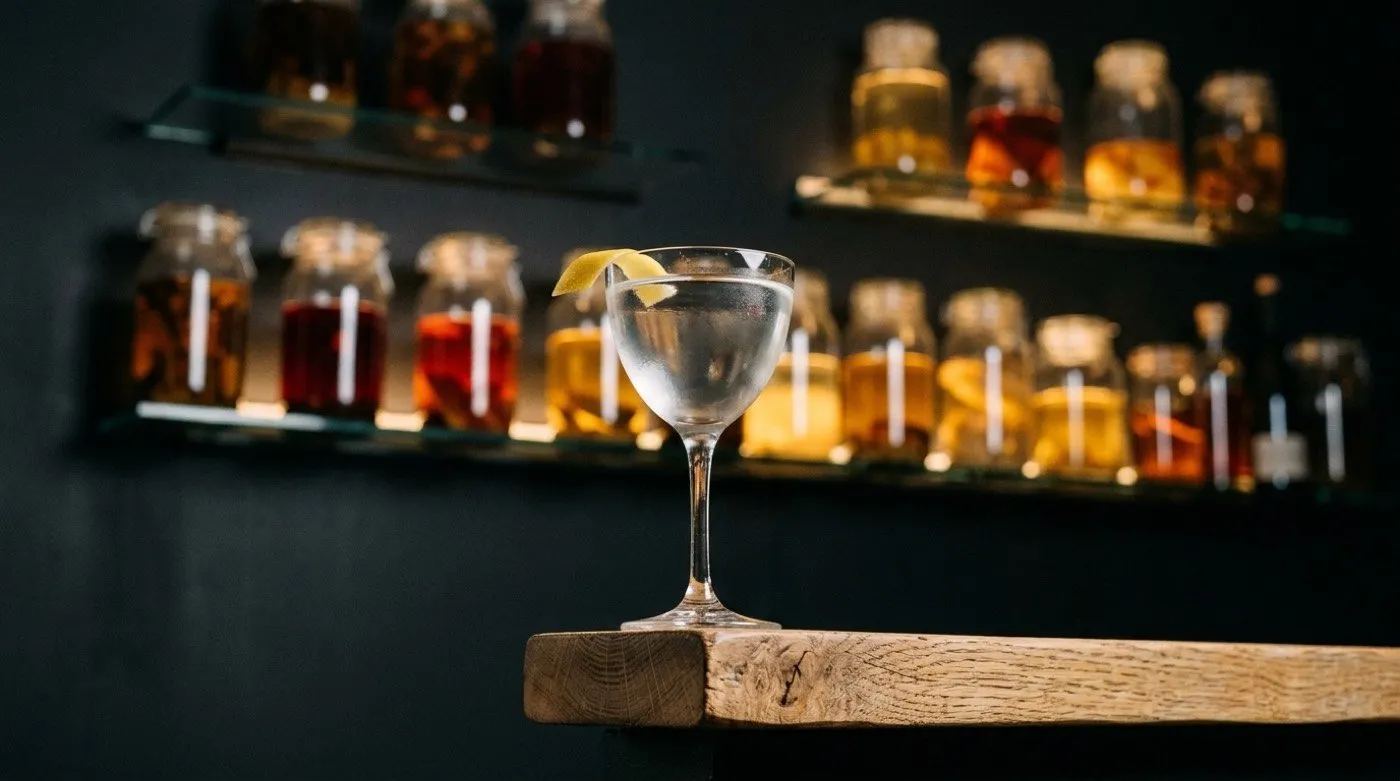
At STILLROOM we understand stir in cocktail making as the technical gesture that chills and dilutes a cocktail in a controlled way without introducing air, keeping it crystal-clear with an unmistakably silky texture. We stir (not shake) when every ingredient is translucent and the recipe rests entirely on spirits: think the Martini, the Negroni or the Manhattan. The key lies in respecting the clarity and achieving a precise dilution that rounds off the alcohol without clouding or breaking the drink’s structure.
What stir is and how it works in cocktail making
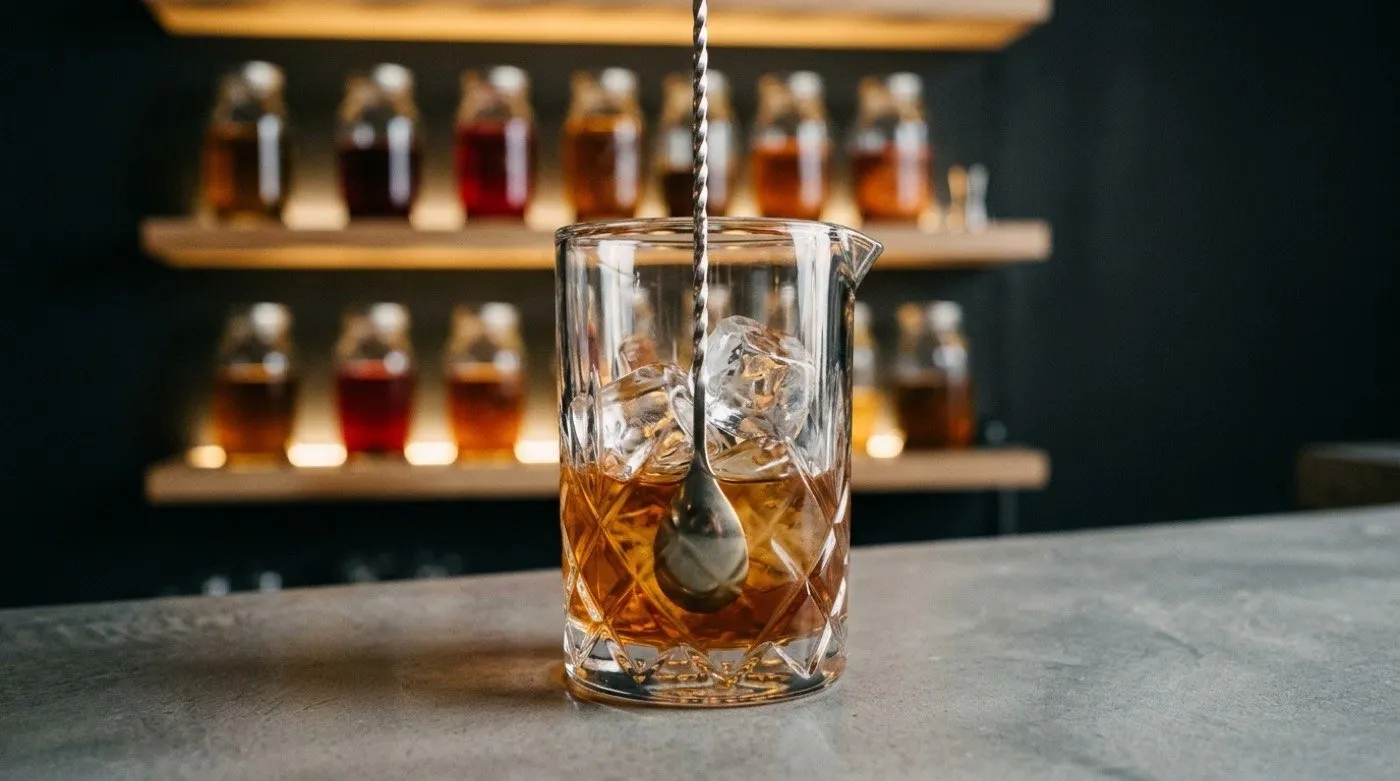
Stirring a cocktail consists of turning ice inside a mixing glass with a bar spoon, using a continuous motion of the wrist. The aim is simply to chill the mixture and add just the right amount of melt water, without the air bubbles or cloudiness that a shaker’s vigorous agitation creates. The result is a drink that is translucent, bright and velvety on the palate — something no shaken cocktail can imitate.
When we stir, the ice glides gently against the walls of the mixing glass. That constant, impact-free contact chills the liquid evenly and releases water little by little. The absence of aeration is deliberate: in cocktails where every ingredient is a noble spirit — gin, vermouth, whisky, bitters — bubbles would only add an unwanted roughness and cloud the visual clarity that defines these classics.
The essential kit for a good stir
At our laboratory bar at STILLROOM we work with three essential pieces that any bartender, professional or amateur, should know:
- Mixing glass: thick glass, wide mouth and a pouring lip. Its capacity — around 500-600ml — lets the ice move freely. We prefer cut-crystal ones because their weight helps maintain thermal stability while stirring.
- Bar spoon: long-handled and helical, ideally 40cm. The spiral in the handle is not just a stylistic flourish: it makes it easier to turn between the fingers and lets liquid descend in layers when building a floated cocktail. The small bowl at the end is useful for measuring and for fishing out a stray piece of ice.
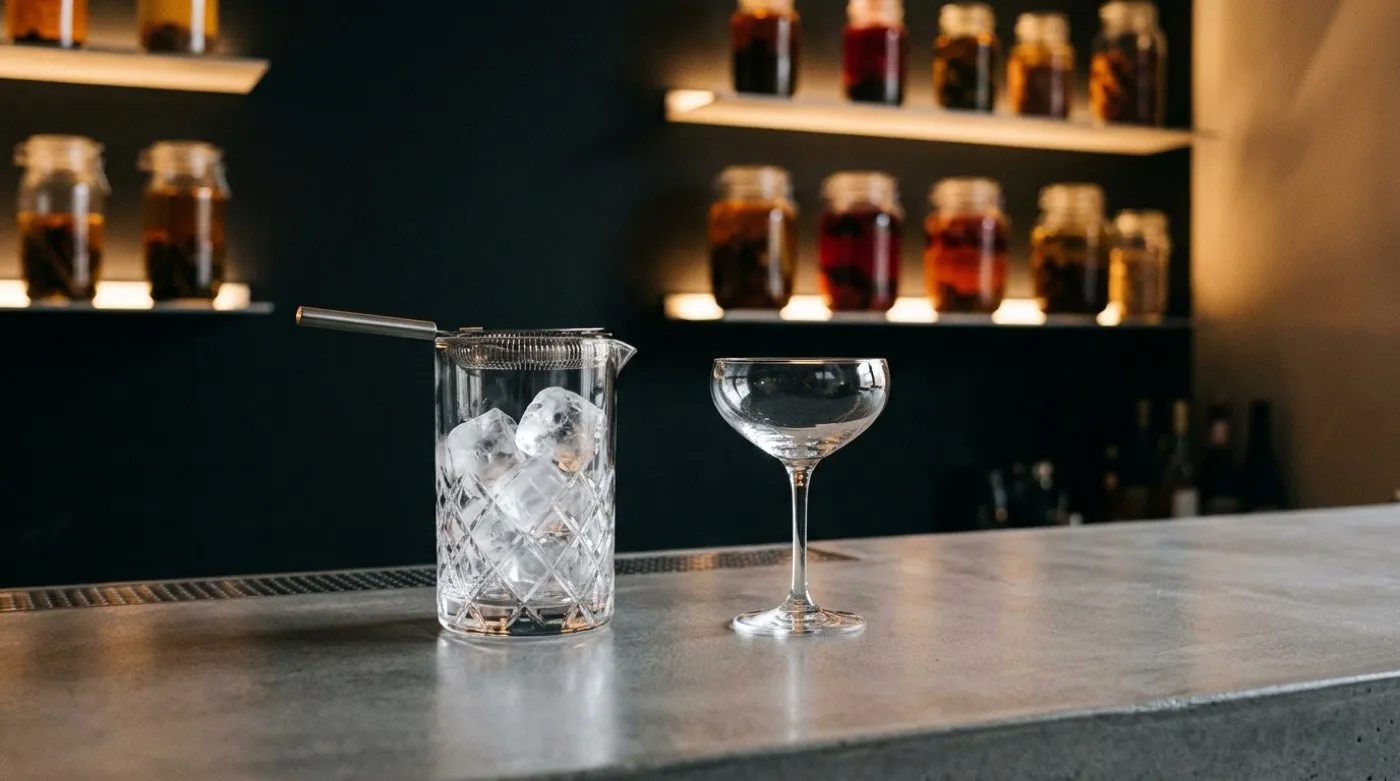
- Julep strainer: a flat, perforated strainer that fits over the mouth of the mixing glass. It holds back the ice and any shards without needing an extra spring strainer. For stirred cocktails, the pour must be clean and quick so as not to lose temperature.
The technique: wrist motion, timing and target dilution
The perfect stir is executed with a smooth, steady turn of the wrist, not the whole arm. The spoon is slipped between the ice and the wall of the glass, concave side facing inward, and glided in circles. The motion should be fluid, without knocks, almost hypnotic. At STILLROOM we time our stirring at between 20 and 40 seconds, depending on the cocktail, the room temperature and the type of ice.
The target dilution sits between 20% and 30% of the total volume. In other words, if we are making a 90ml Martini, by the end of the stir the total liquid will be around 110-115ml thanks to the water that has been incorporated. That water is not the enemy: it is the invisible ingredient that tames the alcohol, wakes up the aromas and lengthens the finish.
How do we know the cocktail is “done”? There are three unmistakable signs:
- The mixing glass feels ice-cold to the touch: if resting your palm against it you feel an intense, even cold, the temperature has dropped enough.
- A thin layer of frost forms on the outside: this shows the mixture has reached a thermal balance close to -2°C to -3°C.
- The sound changes: at first the ice clinks with a sharper pitch; as dilution progresses, the sound becomes duller and silkier.
Classic cocktails that get stirred (and why)
Not every cocktail benefits from stirring. The rule we apply at STILLROOM is simple: if the recipe contains only translucent, spirit-forward ingredients, stir it; if it has juices, dairy, egg or any opaque element, shake it. This logic, which we set out in detail in our article on the shake technique, is the starting point for understanding classic cocktail making.
Here are five canonical examples we always stir, along with the technical reason and the dilution we are aiming for:
| Classic cocktail | Why it’s stirred | Target dilution |
|---|---|---|
| Martini | Gin and dry vermouth are crystal-clear; aeration would break their visual elegance and add roughness. | 25-30% |
| Negroni | Gin, Campari and red vermouth share density and clarity; stirring integrates their bitterness without clouding it. | 20-25% |
| Manhattan | Whisky, sweet vermouth and Angostura bitters need a slow fusion; shaking would oxidise the vermouth and blur the profile. | 22-28% |
| Old Fashioned | Built directly in the glass, but the initial stir with ice is what dissolves the sugar and marries the whisky with the bitters. | 15-20% |
| Sazerac | Cognac or rye whisky, sugar and Peychaud’s; the absence of aeration preserves the dry character and oily texture of the spirit. | 20-25% |
Of the five, the Old Fashioned is the best one for practising the stir at home: we break it down step by step in our Old Fashioned recipe.
Stir vs shake: when to stir and when to shake
The stir-versus-shake dichotomy is one of the questions we hear most often at the bar. To settle it at a glance, we have put together this comparison table that sets both methods against each other on technical criteria:
| Criterion | Stir | Shake |
|---|---|---|
| Texture | Silky, velvety, dense but without a foamy body. | Light, aerated, with small bubbles in suspension. |
| Clarity | Crystal-clear and bright; the cocktail looks clean in the glass. | Cloudy or hazy; the ingredients partially emulsify. |
| Aeration | None or minimal; no oxygen is incorporated. | High; shaking introduces air and forms fine foam. |
| When it’s used | Only translucent, spirit-forward ingredients. | When there are juices, dairy, egg, dense syrups or purées. |
| Examples | Martini, Negroni, Manhattan, Old Fashioned, Sazerac. | Daiquiri, Margarita, Whisky Sour, Pisco Sour, Espresso Martini. |
This rule is not dogma, but it is a guide grounded in the physics of the cocktail. If you would like to dig deeper into the scientific reasoning and the exceptions, we recommend our tour through the advanced cocktail techniques we apply every day.
How we use the stir at STILLROOM
At our house on Calle Moreto 9, the stir is much more than a protocol: it is a precision tool that connects classic cocktail making with our obsession for laboratory technique. Every time we stir a cocktail, we are controlling variables such as the starting temperature of the mixing glass, the quality of the ice — hand-cut, dense and free of cracks — and the exact dilution time for the recipe.
We work with ingredients that have often gone through processes such as milk clarification, controlled fermentations or fat washing. In those cases, stirring becomes even more critical: a vigorous shake could undo days of clarification work or emulsify particles we want to keep settled. Stirring lets us respect the integrity of every component and serve an impeccable drink, worthy of the raw material behind it.
The stir also has an almost meditative quality that we share with whoever is sitting at the bar. The sound of the ice turning, the frost creeping up the glass, the unhurried gesture of straining the liquid into a chilled coupe… all of it is part of an experience that goes beyond flavour. It is signature cocktail making understood as a contemporary ritual.
Three ideas for starting to master the stir
If you have just landed in the world of stirred cocktail making, these three ideas will give you a solid base for practising the technique and training your palate. You do not need a laboratory: a good mixing glass, quality ice and a willingness to observe are enough.
1. A perfectly stirred Martini
The Martini is the entrance exam for stirring. Combine 60ml of London Dry gin with 10ml of dry vermouth in a mixing glass full of ice. Stir for 30 seconds, strain into a chilled glass and express a lemon twist over the surface. The result should be ice-cold, crystal-clear and with a dry finish that begs for another sip. If cloudiness appears or the first sip burns too much, you need more dilution.
2. A silky Negroni
Equal parts — 30ml gin, 30ml Campari, 30ml red vermouth —, plenty of ice and 25 seconds of stirring are enough to turn three bold ingredients into a well-rounded drink. The key is not to cut the time short: an under-stirred Negroni comes out harsh and disjointed. When the dilution is right, Campari’s bitterness integrates and a subtle sweetness appears that needs no added sugar.
3. A balanced Manhattan
The Manhattan demands respect. Mix 50ml of rye whisky, 20ml of sweet vermouth and 2 dashes of Angostura. Stir for 30-35 seconds and strain into a coupe glass. The texture should be oily, almost chewy, with the rye’s spice tamed by the melt water. At STILLROOM we sometimes serve it with a cherry marinated in sour cherry liqueur, but at home a classic maraschino cherry works beautifully.
Frequently asked questions
What does it mean to stir a cocktail?
Stirring, or stir, is the cocktail-making technique that involves turning ice inside a mixing glass with a bar spoon to chill and dilute the mixture without introducing air. It is used exclusively for cocktails made up of translucent, spirit-forward ingredients, such as the Martini, the Negroni or the Manhattan, and the result is a crystal-clear drink with a silky texture.
Why is the Martini stirred and not shaken?
The Martini is stirred because both the gin and the dry vermouth are perfectly translucent and contain no juices, dairy or egg. Shaking it would introduce air bubbles and small ice shards that would cloud the cocktail and give it a rough texture — the exact opposite of the smooth, crystal-clear elegance that defines a good Martini.
How long should you stir a cocktail?
Stirring time varies between 20 and 40 seconds depending on the cocktail, the room temperature and the type of ice. In general, we look for a dilution of between 20% and 30% of the total volume. The most reliable sign that the stir is done is that the mixing glass feels ice-cold to the touch and a thin layer of frost forms on the outside.
What is the difference between stirring and shaking?
Stirring chills and dilutes without aerating, so the cocktail stays crystal-clear with a silky texture; it is used only with translucent ingredients. Shaking chills, dilutes and also aerates, creating a lighter, cloudier texture with fine foam; it is essential when the recipe includes juices, dairy, egg or dense syrups. The choice depends on the clarity and composition of the cocktail.
Do I need a mixing glass, or will an ordinary glass do?
Ideally, use a dedicated mixing glass — thick glass with a pouring lip — because its shape and weight make it easier to turn the ice and hold the temperature. At home, a sturdy kitchen beaker or a robust glass jug can work if the mouth is wide enough. Avoid thin glasses or ones with straight sides, which make it hard for the spoon to move smoothly. Stirring is one of those techniques that separates a correct cocktail from a memorable one. At STILLROOM we approach it with the same precision we bring to a lactic fermentation or a low-temperature distillation, because we know the devil — and the pleasure — is in the detail. If you would like to try our take on the Martini, the Negroni or any other stirred classic, we invite you to explore our cocktail menu and to book a table at Calle Moreto 9, next to the Retiro. And if you are still curious for more technical definitions, drop by our cocktail glossary, where we break down every term with the same care we bring to stirring a Manhattan.