Garibaldi Fermentado at STILLROOM Madrid: the 1860-1960 Italian aperitivo reinvented | Jerónimos
· Updated
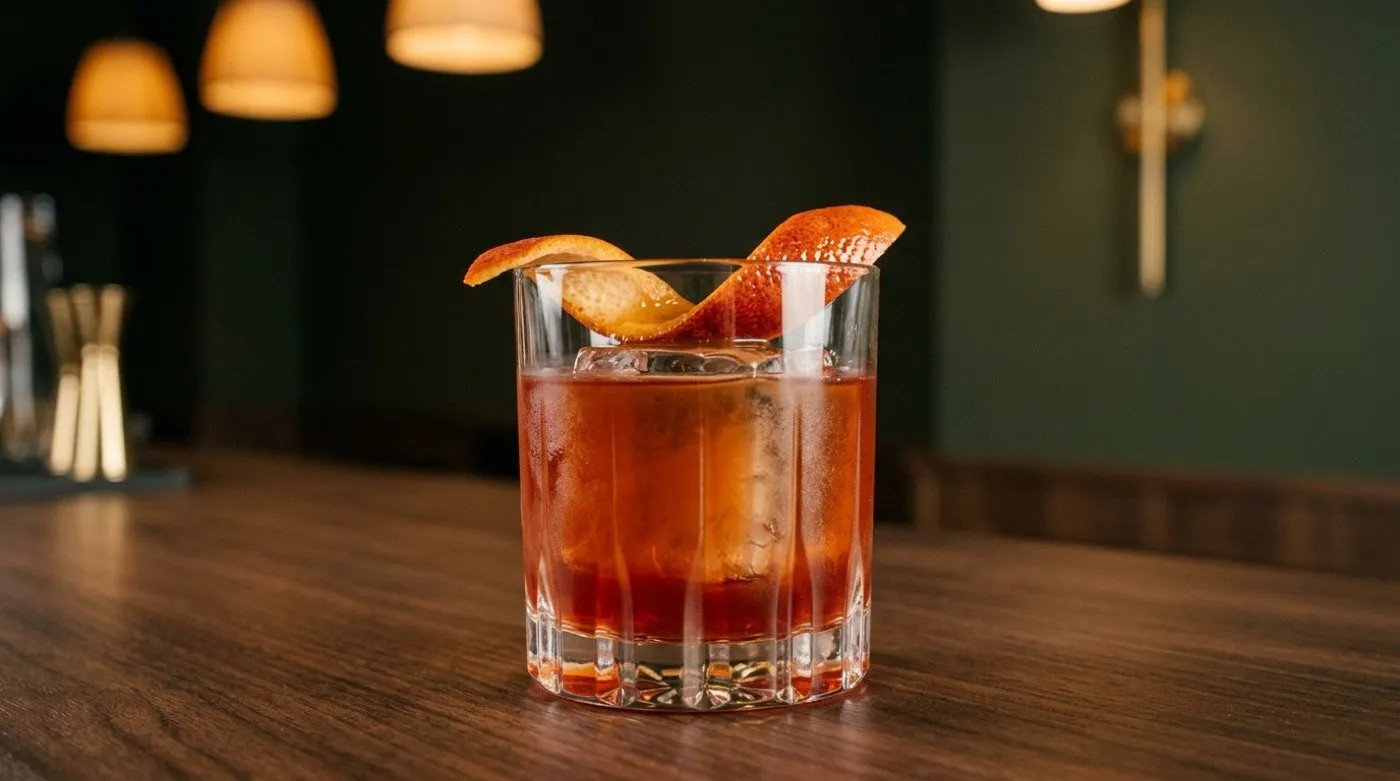
Some cocktails are born from a trend, and some are born from an idea. The Garibaldi belongs to the second category: it was a tribute, a declaration of identity condensed into two ingredients. Half a century on, it’s still here, intact in its minimalism, faithful to an Italy that no longer exists — or that exists only in the collective memory of the bars that served it before Instagram existed. At STILLROOM we serve it fermented, with lacto-fermentation techniques that transform the orange over weeks. It’s not the same cocktail. And that’s precisely where its interest lies.
Before explaining why a cocktail almost a hundred years old deserves a place on the bar of a modern speakeasy next to the Prado Museum, it’s worth understanding where it comes from. Because the Garibaldi isn’t just a mix of bitter and sweet: it’s a geographical narrative disguised as an aperitivo. And understanding that narrative changes the way you drink it.
This piece is an invitation to get to know that cocktail — its history, its original version, ours, and why our version exists — from the inside. You won’t find a recipe to replicate at home here. You’ll find a story that helps you better understand what you’ll be drinking when you come to STILLROOM on Calle Moreto 9.
Garibaldi: the cocktail that paid tribute to Giuseppe Garibaldi (from the 1860s to the 1960s)
Giuseppe Garibaldi was, alongside Cavour and Mazzini, one of the architects of Italian unification. In 1860 he led the Expedition of the Thousand, a military and symbolic milestone that consolidated the union of the southern peninsula with the Kingdom of Sardinia. A year later, the Kingdom of Italy was proclaimed. Garibaldi was a mythical figure for his time: charismatic, romantic, photographable — something exceptional at the time — and defeated only when politics got the better of him. He died in 1882, but his legend survived in Italian culture for generations.
It’s not clear exactly when the cocktail that bears his name was created, but the link is clear and almost literal. Campari comes from the north of Italy, from Milan, where it had been made as an aromatic bitter since 1860. Orange comes from the south, from Sicily and Calabria, where fruit orchards have dominated the coastal landscape since the Middle Ages. North and south in a glass: Garibaldi as a geographical metaphor for the country he unified. The drink as a political map.
For decades, the Garibaldi was an Italian bar secret, a cocktail that connoisseurs ordered and that tourists didn’t know. Its popularisation arrived in the sixties, with the spread of Italian aperitivo culture beyond its borders. The Milano-Torino — Campari from Milan, vermouth from Turin — had already existed as a bar drink since the previous century. The Garibaldi complemented it: the same bitter base, but softened by citrus and turned into something closer to a soft drink than a digestif. In that decade, the Italian bar went global: it opened in European capitals and then all over the world. And the Garibaldi went with it.
Anatomy of the classic Garibaldi: two ingredients, one bar technique
The traditional version of the Garibaldi has just two ingredients: Campari — the red amaro bitter from Campari Group, with no comparable substitute — and freshly squeezed orange juice. No vermouth. No gin. No soda. No crushed ice or orange-slice garnish. Purity is part of its design: a cocktail that proves less can be more when the quality of each component is high.
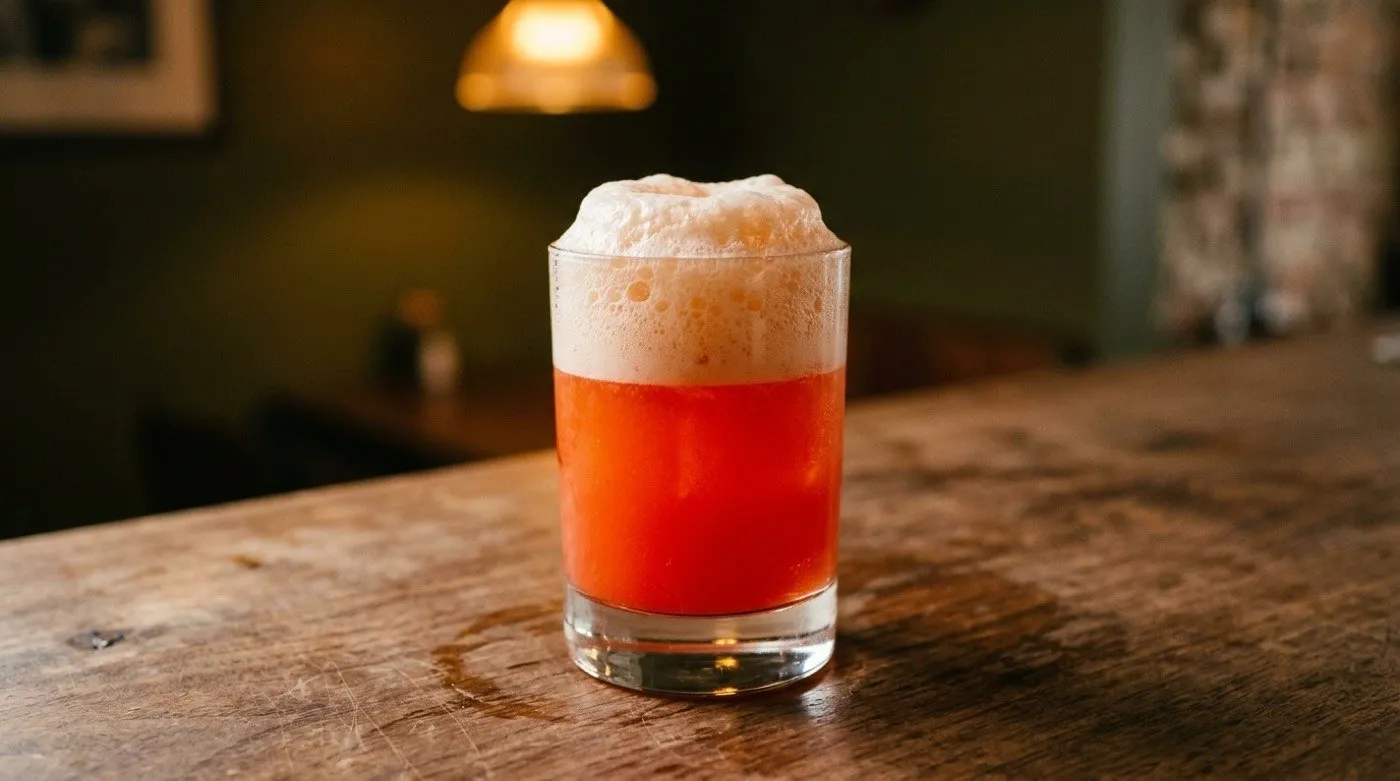
The preparation technique is equally minimalist in appearance and demanding in execution. The “fluffy” method involves whipping the orange juice at high speed together with the Campari for an extended time — usually between thirty seconds and a minute — until the liquid takes on a foamy texture, almost like liquid meringue. Air is incorporated as micro-bubbles that remain suspended in the liquid, creating a stable layer of foam on the surface. That airy body is what sets a well-made Garibaldi apart from one where the ingredients are simply mixed in a glass.
The reason for the long whipping has to do with the chemistry of citrus. Freshly squeezed orange juice contains enzymes and volatile compounds that start breaking down minutes after extraction: vitamin C oxidises, volatile aromatic compounds dissipate, the colour changes. Whipping at high speed aerates the mix and slows down that temporary oxidation. What’s more, the juice’s natural proteins — present in greater quantities in pulpy oranges — act as foaming agents. That’s why freshly squeezed orange makes the difference: it’s not just freshness, it’s chemistry. It’s also why a classic Garibaldi must be drunk right away: its foam doesn’t survive more than a few minutes in the glass.
Why lacto-fermentation reinvents this aperitivo at STILLROOM
At STILLROOM we work with a range of advanced cocktail techniques, and lacto-fermentation is one of the most widely used on our menu. If you want to dig deeper into how we apply this process to our creations, we explain it in detail in our guide to lacto-fermentation in cocktail making. Here we’ll focus on explaining why this technique makes particular sense with the Garibaldi.
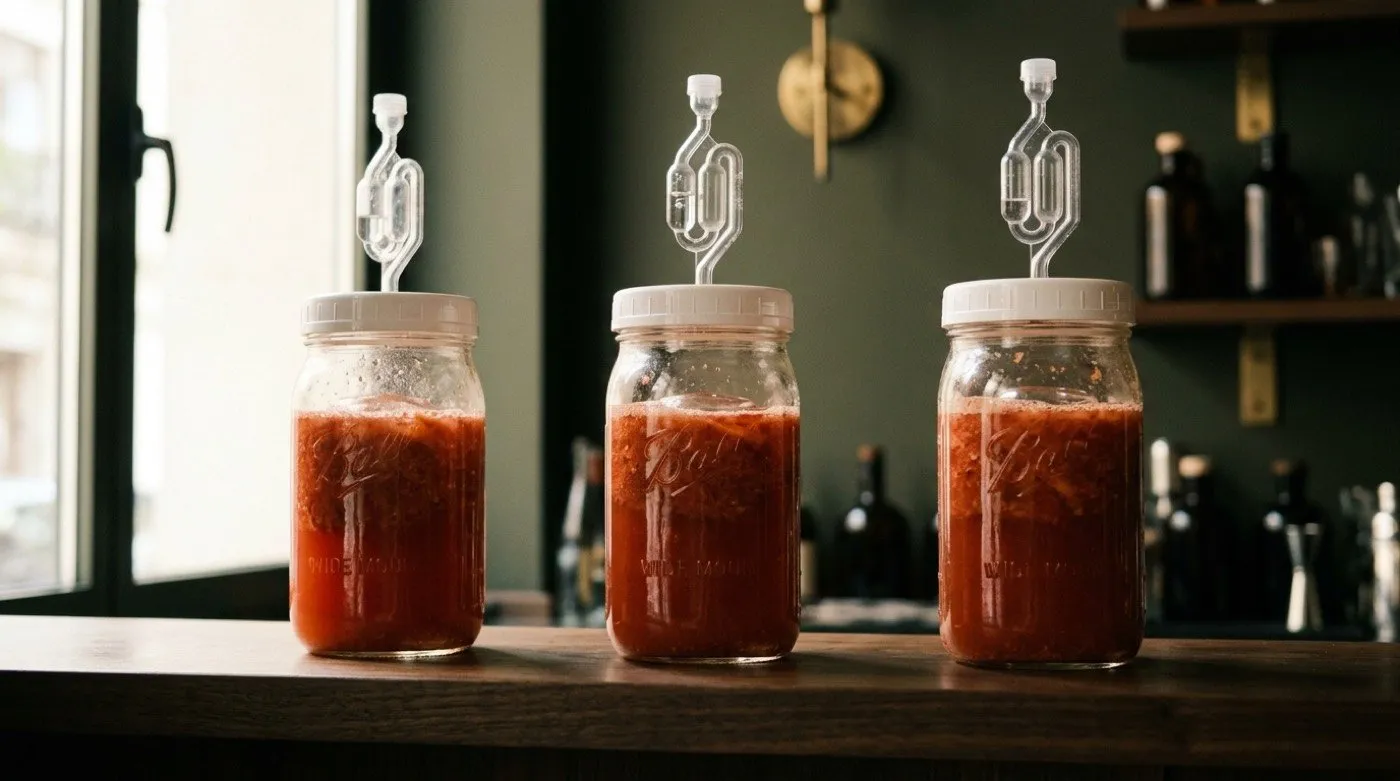
Lacto-fermentation is a biochemical process in which lactic acid bacteria — live cultures naturally present on the surface of many fruits — consume the fruit’s sugars and transform them into lactic acid. Unlike alcoholic fermentation, it doesn’t produce ethanol; it produces a different acid profile, softer and more complex than the original citric acid. In the case of orange, this process takes seven to fourteen days depending on ambient temperature and the initial microbial load. The result is a liquid that has changed in nature: it’s still citrus, but now it’s citrus with depth, with layers that fresh juice doesn’t have.
The Garibaldi, in its classic version, is a one-dimensional cocktail in the best possible sense: fresh, bright, immediate. Lacto-fermentation adds a temporal dimension to it. The fermented orange keeps part of its fresh character — it’s still orange, still citrus — but now it also has mild acidic notes, a touch of complexity that wasn’t there at the start, and a stability that freshly squeezed juice doesn’t have. Campari’s bitterness interacts with that new complexity differently: instead of pure contrast, a more nuanced dialogue emerges between bitter and acidic.
Lacto-fermentation converts part of the fruit’s sugars into mild lactic acids through live bacterial cultures. The result isn’t more acidic: it’s more complex, longer-lasting on the palate and more stable over time.
Classic Garibaldi vs STILLROOM’s Garibaldi Fermentado: four differences you’ll notice
The differences between the two versions aren’t cosmetic. They affect the flavour, the texture, the stability and the drinking experience. We’ve summarised them in this table so you can compare:
| Criterion | Classic Garibaldi | STILLROOM’s Garibaldi Fermentado |
|---|---|---|
| Flavour | Fresh, bright citrus. Two dominant notes: orange and Campari’s bitterness. | Fermented citrus with complexity. Five to seven aromatic layers: fresh citrus, mild lactic notes, deep acidic notes, lingering bitterness. |
| Texture | Light, airy fluffy foam on the surface. Liquid body in the glass. | Medium body with a persistent fine micro-bubble. A more structured, rounder mouthfeel. |
| Keeping quality | Freshly squeezed juice: degrades within hours. Consumed immediately after preparation. | Fermented juice: stable for four to six weeks refrigerated. Prepared in controlled batches. |
| Aromatic complexity | Two main notes perceptible to the average drinker: orange and Campari. | Five to seven layers perceptible in sequence: initial citrus, fermentation, mild lactic notes, lingering Campari bitterness, dry finish. |
Fermentation doesn’t replace the original: it expands it. Some prefer the immediacy of the classic Garibaldi, and some are after something with more history inside the glass. Both things coexist in the world of cocktail making, and both make sense in different contexts.
How we serve the Garibaldi Fermentado at STILLROOM: ritual, glass, soda
Serving the Garibaldi Fermentado at STILLROOM follows a small ritual that’s part of the complete experience. The bartender presents the cocktail, briefly explains its origin and mentions that it contains orange lacto-fermented for over a week. Then they serve it. Before adding ice or stirring, they offer a first taste in a small glass: this way the guest can perceive the difference between the base liquid and what happens once it’s combined with the fermented Campari.
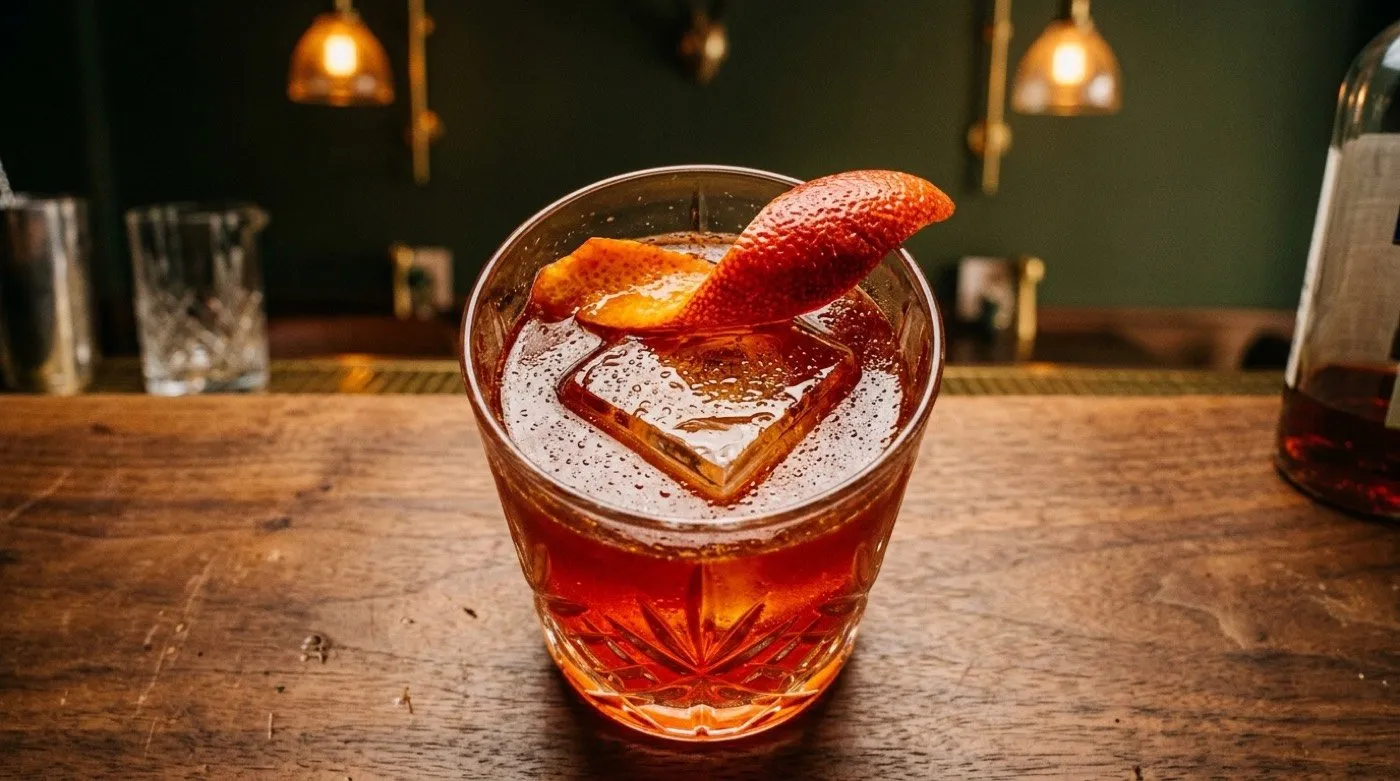
The glass is a heavy rocks glass or a thick low-ball tumbler. The ice is a large clarified cube, slow-melting and dense, that chills without diluting too much. The finishing touch is blood orange zest expressed over the surface of the liquid: essential oils that burst into aroma before the first sip. No soda or sparkling water is added. The Garibaldi Fermentado doesn’t need it: the complexity comes from the fermentation.
At STILLROOM we pair this cocktail with specific dishes from our small plates menu. It’s not marketing: it’s observation. Some combinations work better and we keep repeating them because guests ask for them. We’ll cover those in the next section.
Pairings with STILLROOM’s signature small plates (no recipe book, just experience)
- With the Sous-Vide Octopus: the combination we repeat most. The Garibaldi’s fermented citrus cuts through the richness of the low-temperature-cooked octopus, creating a contrast that enhances both elements. If you want to know more about how we prepare the octopus, we cover it on our Sous-Vide Octopus page.
- With burrata or creamy cheeses: the lactic notes that fermentation has introduced into the orange converse with the creaminess of the cheese. It’s a pairing by kinship: two products that share the same flavour family.
- With bluefin tuna tartare or raw fish: the fermented acidity acts as a second-generation citrus, softer but deeper, a functional equivalent to yuzu or lemon in Japanese cuisine. It balances the fish’s fats without masking it.
- With Iberian pork small plates: presa or secreto cuts of Iberian pork, with their fatty, sweetish profile, find in the Garibaldi Fermentado a bitter, acidic counterpoint that cleanses the palate between bites. The fermented Campari’s bitterness is particularly effective here.
Garibaldi Fermentado: an aperitivo for Los Jerónimos, after the Prado or before dinner
STILLROOM is on Calle Moreto 9, in the Los Jerónimos neighbourhood, three hundred metres from the Prado Museum and less than a ten-minute walk from the Reina Sofía and the Thyssen museums. Our location is no accident: we designed the venue’s concept with an audience in mind who already knows this neighbourhood, comes to Madrid with a cultural agenda, and is then looking for somewhere to sit down, unwind and have something worth drinking. The Garibaldi Fermentado is probably the cocktail that best represents that idea: it’s old and it’s new, it’s Italian and it’s ours, it’s simple in appearance and complex in reality.
It’s mostly ordered by three types of guest: the Italian cocktail enthusiast who wants to see what we do with a classic, the fermentation-technique buff who has read something about lacto-fermentation and wants to try it in context, and the guest who leaves the Prado at the end of the afternoon, walks down Calle Moreto and decides that before booking for dinner they want an aperitivo somewhere that isn’t generic. The best moment depends on the day: on Fridays and Saturdays we open in two sittings, 11:00 to 15:00 and 19:00 to 01:30, and it’s the evening sitting — as the sun sets and the light changes temperature — that’s the natural moment for a Spanish-Italian aperitivo, with the bar open into the small hours for the drink that follows; on Sundays we’re open 11:00 to 23:00 without a break; and from Wednesday to Thursday we serve from 11:00 to 19:00, for anyone who prefers it mid-afternoon. We’re closed Monday and Tuesday.
If you’re in Los Jerónimos, or if you’re coming specifically to check out STILLROOM, you can book a table through our online system. It’s not compulsory — we also welcome walk-ins — but it guarantees you a spot at the bar or in the dining room if you’re coming as a group.
Frequently asked questions
What exactly is the difference between the Garibaldi Fermentado and the classic?
The main difference lies in the base ingredient. The classic uses freshly squeezed orange; ours uses orange that has spent seven to fourteen days in lacto-fermentation. That process transforms the natural sugars into mild lactic acids that add aromatic complexity, change the mouthfeel and extend the liquid’s stability. Campari’s bitterness interacts differently with a fermented citrus than with a fresh one.
Is it very bitter? Who is it aimed at?
The Garibaldi Fermentado keeps Campari’s bitterness as its central axis — it is a bitter cocktail, we won’t deny it — but the fermentation of the citrus softens that bitterness and turns it into something more balanced. It is not a sweet cocktail. If you’re after something sweet, this isn’t your drink. If you’re after an aperitivo with personality, with history and with layers of flavour that keep revealing themselves as you drink, this one is for you.
Can I make it at home?
The version we serve at STILLROOM isn’t easy to replicate faithfully. Lacto-fermentation requires temperature control, specific hygiene conditions and live cultures that not everyone can manage at home without the risk of it going off. What we do here involves a process of seven to fourteen days with daily monitoring. If you want to try the real thing, with the technique and the result we’ve designed, the best option is to come to STILLROOM and book a table.
Is it always on the menu, or is it seasonal?
The Garibaldi Fermentado is a permanent fixture on our cocktail menu. It is not seasonal. Production runs in batches, which means it may occasionally be unavailable if a fermented batch runs out, but the intention is to keep it as a fixed part of our signature cocktail catalogue.
What is the best pairing to start with?
If it’s your first time, we recommend trying the Garibaldi Fermentado on its own, with no accompaniment, to taste it clean. After that, pairing it with the sous-vide octopus or a burrata are the combinations that work best. They’re small plates that don’t overwhelm the palate and let you appreciate the cocktail’s complexity without competing with it.
How exactly is it served?
In a heavy rocks glass or a thick low-ball tumbler, with a large cube of clarified ice and a touch of blood orange zest expressed right at the moment of service. The bartender introduces the cocktail’s origin and offers a taste beforehand, before serving it over ice. It’s an approachable style of service, with no unnecessary theatrics, but with enough explanation that you know what you’re drinking.