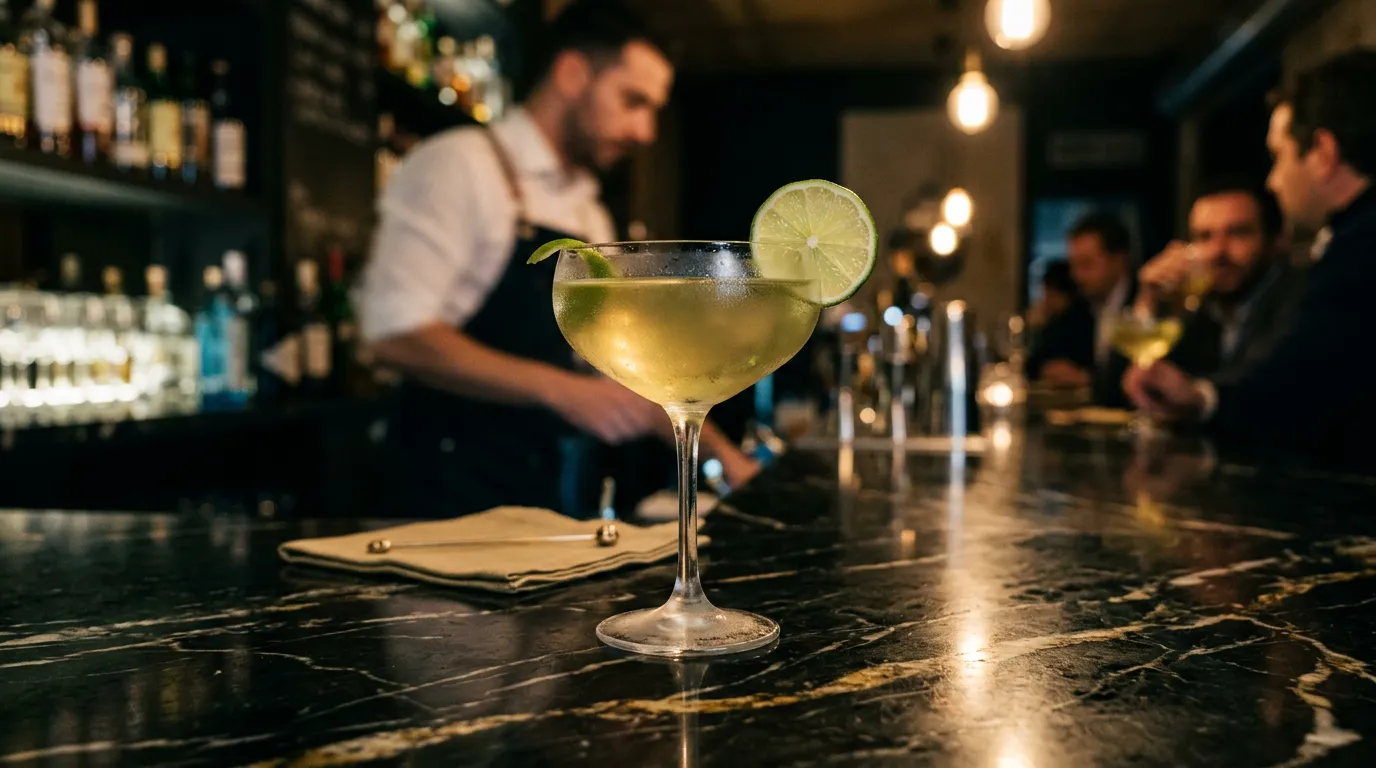
The Daiquiri represents the very essence of classic cocktail making: a Cuban cocktail that proves greatness doesn’t lie in complexity, but in precision. With just three ingredients — white rum, fresh lime juice and sugar syrup — this cocktail encapsulates the philosophy that every component must sit in perfect balance. For any self-respecting bartender, making a flawless Daiquiri is their calling card: the absence of unnecessary elements demands that every technique, every measurement and every second of shaking counts. The Daiquiri forgives no mistakes, and that’s precisely why it measures the true mastery of whoever makes it.
Classic Daiquiri Ingredients
The purity of the Daiquiri lies in the quality and proportion of its three components. Each ingredient performs a specific role that can’t be replaced without altering the cocktail’s character.
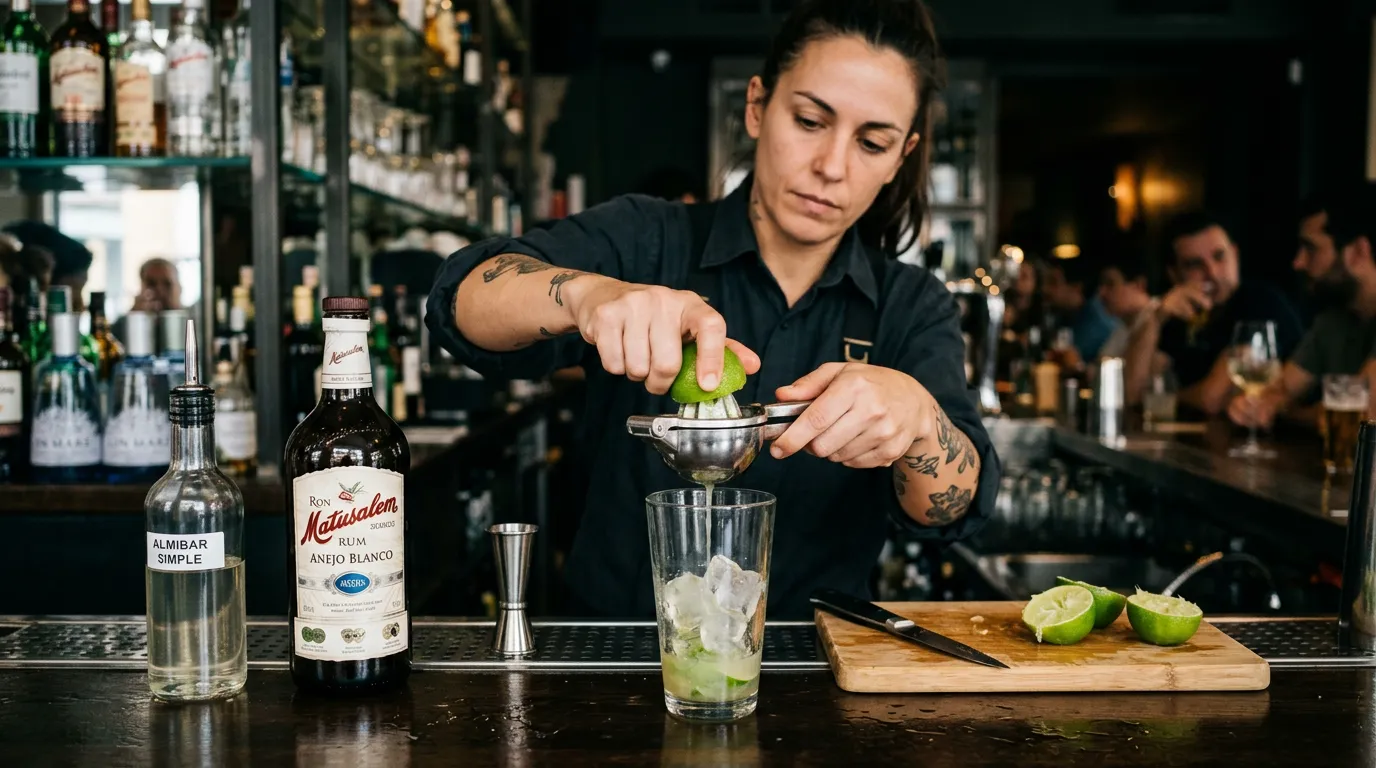
- White rum: 60 ml
- Fresh lime juice: 25 ml
- Sugar syrup: 15 ml
White rum provides the cocktail’s spirituous base. Although a light Cuban rum is traditionally used, any good-quality white rum with tropical notes and a certain dryness will work. The alcohol not only adds volume, but also acts as a flavour extractor when combined with the other ingredients during the shake.
Fresh lime juice is the acidic component that counterbalances the sweetness of the syrup and the richness of the rum. Lime brings freshness, vitality and that crisp quality that makes the cocktail so refreshing. It should never be replaced with bottled concentrate, whose acidic profile is flat and artificial.
Sugar syrup, traditionally made with a ratio of two parts sugar to one part hot water, provides the sweetness needed to balance the lime’s acidity. Syrup integrates better than granulated sugar because it dissolves completely during shaking, avoiding gritty textures in the final drink.
Step-by-Step Preparation
Making the classic Daiquiri requires attention to every detail. A seemingly simple cocktail demands millimetre-perfect precision at every stage of the process.
Step 1: Chill the glass
Before making the cocktail, it’s essential to chill the coupe or martini glass. This is done by filling it with ice and cold water for a few minutes, or simply placing it in the freezer for a while. A cold glass ensures the cocktail keeps its optimum temperature for longer once served.
Step 2: Measure the ingredients
Using a jigger or precision measure, we pour 60 ml white rum, 25 ml fresh lime juice and 15 ml sugar syrup into a cocktail shaker. Precision in the measurements is absolutely essential: even variations of a few millilitres can throw the cocktail off balance.
Step 3: Add ice and shake
We fill the shaker with fresh ice and shake vigorously for around 12 seconds. The shake serves multiple purposes: it slightly dilutes the cocktail as the ice melts, emulsifies the ingredients to achieve a smooth texture and, most importantly, drastically lowers the drink’s temperature. The 12 seconds are essential to reach the ideal point of dilution and chilling.
Step 4: Double strain
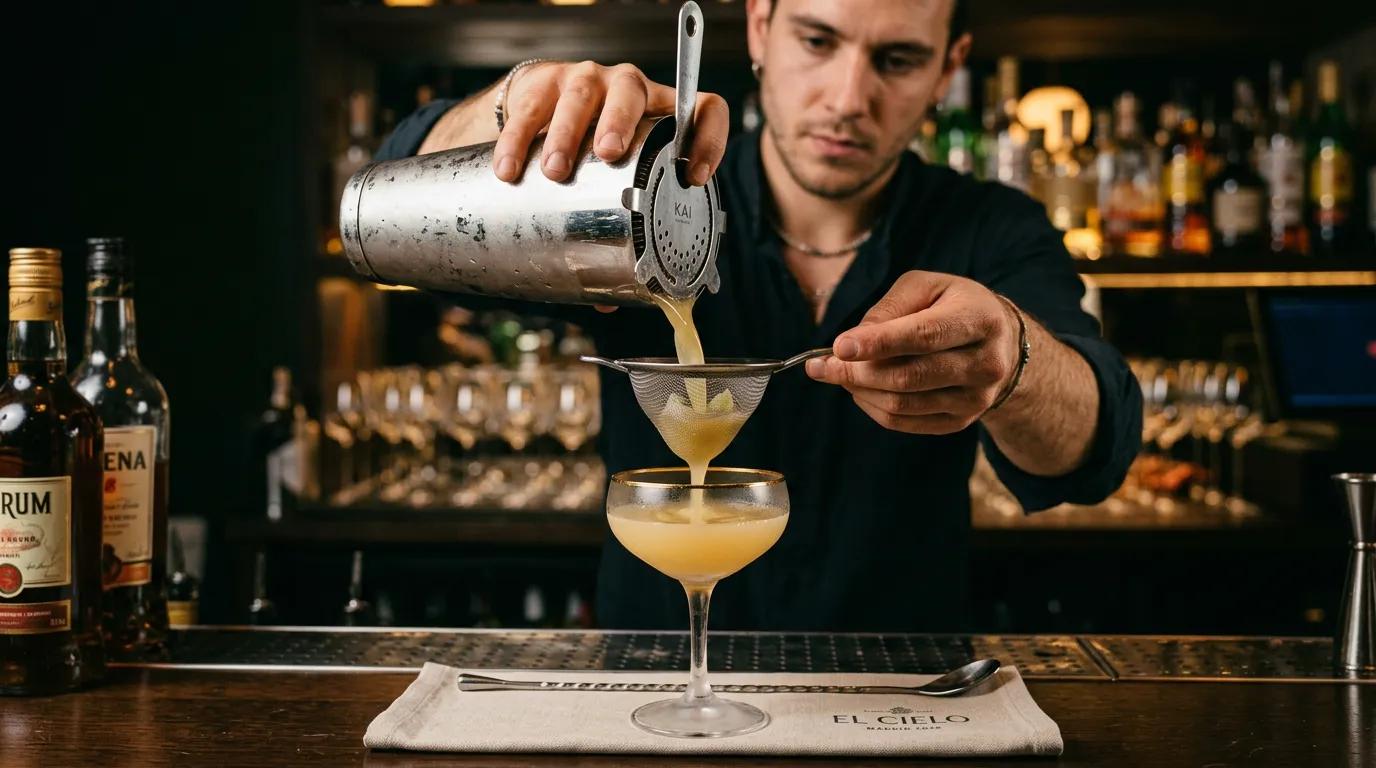
After shaking, we serve the contents of the shaker. The double strain involves first pouring the mix through a cocktail strainer to hold back ice shards and bits of lime pulp, then passing the liquid through an additional fine strainer. This step guarantees a smooth texture, free of particles.
Step 5: Serve
We pour the strained Daiquiri into the pre-chilled coupe glass, without ice. We garnish with a lime wheel, or by lightly expressing the peel of a lime over the surface of the cocktail to release its aromatic oils. Serve immediately.
Common Mistakes
Even the most experienced bartenders can make mistakes when preparing a Daiquiri. Knowing these common pitfalls helps avoid them and always achieve a flawless result.
Using bottled or concentrated lime
The most frequent and serious mistake is replacing fresh lime juice with industrial versions. Bottled juice lacks the acidic complexity of the fresh product and brings metallic notes that ruin the cocktail’s character. What’s more, preservatives significantly alter the flavour profile.
Confusing the classic Daiquiri with the frozen Daiquiri
The classic Daiquiri is served without ice in the glass, while the frozen version blends ice in to create a slushy texture. Ordering a Daiquiri and expecting the frozen version, or vice versa, creates confusion and a completely different flavour experience. It’s important to always specify which version you want.
Overdoing the sugar syrup
The temptation to add more syrup to soften the cocktail is a common mistake. An excessively sweet Daiquiri loses its crisp, refreshing character, turning into a cloying drink that’s difficult to finish. The established proportions are the correct ones; changing them should only be done for a very specific personal preference.
Insufficient shaking
Not shaking for long enough means the ingredients don’t integrate properly, dilution is insufficient and the cocktail reaches the table too warm. A vigorous 12-second shake is essential to achieve the perfect texture and temperature.
Daiquiri Variations
Over the decades, the Daiquiri has inspired numerous variations that respect the cocktail’s original structure while bringing distinct flavour profiles.
Hemingway Daiquiri
This variant owes its name to American writer Ernest Hemingway, who popularised his personalised version at La Floridita in Havana. The Hemingway Daiquiri incorporates, alongside the classic ingredients, maraschino cherry liqueur and pink grapefruit juice. The original version, known as the Daiquiri Special, doubled the amount of rum and added the juice of half a grapefruit. The result is a more complex, fuller-bodied cocktail.
Frozen Daiquiri
The frozen version is made by blending the ingredients with ice until reaching a creamy, slushy texture. It’s especially popular in warm climates and is very refreshing. However, it’s important to remember that the frozen Daiquiri and the classic one are different cocktails that shouldn’t be confused.
Strawberry Daiquiri
This variant incorporates fresh strawberries or strawberry purée into the classic mix. It adds the fruit’s natural sweetness, an attractive pink colour and aromatic nuances that complement the rum’s profile. It’s the perfect choice for anyone looking for a fruitier Daiquiri without losing the essence of the original cocktail.
Variations with aged rum
Some bartenders experiment by replacing the white rum with aged or reposado rum. This variation adds notes of wood, vanilla and caramel that bring complexity to the cocktail, though it substantially changes the light, fresh character of the original Daiquiri.
The Stillroom Signature Version
At Stillroom, Calle Moreto 9, we’ve developed a personal interpretation of the Daiquiri that elevates the classic components through signature cocktail techniques and house-made products.
We start with a white rum that we macerate with Madagascar vanilla for 72 hours. This infusion process adds subtle vanilla notes, creaminess and a hint of sweetness that complements the spirituous base without dominating it. The vanilla is carefully selected for its exceptional aromatic quality.
The citrus component of our version uses the super juice technique, a method that multiplies the yield of lime juice up to eight times by combining fresh juice with citric acid and malic acid. This process not only optimises yield, but also boosts the acidic profile, creating a brighter, more defined citrus than conventional juice.
Finally, we make a house lime and lemon verbena cordial that replaces the traditional sugar syrup. This cordial brings not only sweetness but also the herbaceous, refreshing notes of lemon verbena, creating an extra aromatic dimension that sets our version apart from any conventional Daiquiri.
The result is a signature Daiquiri that respects the purity and balance of the original while bringing complexity, texture and a unique sensory signature that can only be found at Stillroom.
History of the Daiquiri
The story of the Daiquiri goes back to 1898, during the Spanish–American War, when American troops occupied the island of Cuba. At the Daiquirí mines, in the eastern province of Santiago de Cuba, American engineers began mixing with the local workers. According to tradition, an engineer named Jennings Cox asked the bartender at the Daiquirí hotel to make him a drink with the ingredients on hand: rum, lime and sugar.
The cocktail’s popularity grew quickly and soon reached Havana, where bartender Constantino Ribalaigua Vert, known as Constante, perfected the recipe at the famous bar La Floridita. It was here that Ernest Hemingway discovered the Daiquiri and began ordering his personalised version, which included double the rum and additions of maraschino and grapefruit.
Prohibition in the United States between 1920 and 1933 further boosted Havana’s popularity as the world capital of cocktail making, and the Daiquiri became a symbol of Caribbean elegance. Writers, artists and politicians of the era visited La Floridita to enjoy this legendary cocktail.
After the Cuban revolution of 1959, many Cuban bartenders emigrated to the United States and other countries, taking with them the knowledge and techniques of the Daiquiri. Today, the cocktail is made in bars all over the world and has been recognised by the International Bartenders Association as one of the official cocktails in the rum-based mixed drinks category.
The Daiquiri has evolved from those Cuban mines into a timeless classic that appears on the menus of the best bars on the planet. Its apparent simplicity hides a depth of flavour that continues to captivate generations of cocktail lovers.
At Stillroom, in the heart of Los Jerónimos, Madrid, we’ve dedicated time and passion to creating a signature version that honours the Daiquiri’s tradition while exploring new sensory possibilities. We invite you to discover our interpretation: rum macerated with Madagascar vanilla, lime super juice and a house-made lime and lemon verbena cordial. Visit us at Calle Moreto 9 and let yourself be surprised by a Daiquiri that takes Cuban essence to new dimensions of flavour. We look forward to sharing this signature cocktail experience with you, in a unique setting where every detail is designed for your enjoyment.
Frequently asked questions
What is a Daiquiri cocktail?
The Daiquiri is a Cuban cocktail from the sour family, made with white rum, freshly squeezed lime juice and sugar syrup. Its greatness lies in precision: just three ingredients that must hold a millimetre-perfect balance, with nothing to hide behind. At STILLROOM we start from that classic base and elevate it with rum macerated in Madagascar vanilla, lime super juice and a house-made lime and lemon verbena cordial.
How do you make a classic Daiquiri step by step?
You need 60 ml white rum, 25 ml freshly squeezed lime juice and 15 ml sugar syrup. Chill a coupe glass well, measure the ingredients with a jigger and shake them in the cocktail shaker with ice for about twelve seconds. Then apply a double strain to remove any bits of ice or pulp and serve without ice in the chilled glass. The key lies in temperature and dilution: an energetic, controlled shake separates a flawless Daiquiri from a mediocre one.
Is it spelled “daiquiri” or “daikiri”?
The correct spelling is daiquiri, with “qu”: the name comes from the Daiquirí mines, in Cuba’s Santiago province. “Daikiri” is an incorrect spelling, though a very common one, and it’s one of the most repeated searches for the cocktail. At the bar it makes no difference how you spell it: if you order it from us, we know you want white rum, lime and sugar in perfect balance. You can see our signature version on the cocktail menu.
What’s the difference between a classic Daiquiri and a frozen one?
The classic Daiquiri is shaken with ice, filtered through a double strain and served without ice in a chilled coupe glass, with a silky texture and a very low temperature. The frozen version, by contrast, is made in a blender with crushed ice until it reaches a slushy, almost sorbet-like texture. They’re two different experiences: the first seeks precision and balance; the second, freshness and boldness. It’s always worth specifying which of the two you want to order.
What’s the best rum for a Daiquiri?
A light, dry white rum, with tropical nuances, preferably Cuban-style. Rums that are heavily aged or spend a long time in oak impose notes of wood and vanilla that undermine the cocktail’s freshness. A good rule at home: if you wouldn’t drink it neat, it won’t work in the Daiquiri either. We start with a quality white rum and macerate it for seventy-two hours with Madagascar vanilla, to add creaminess without masking the lime.
What is the origin of the Daiquiri?
It was born in Cuba in the late nineteenth century, at the Daiquirí mines, near Santiago. According to tradition, American engineer Jennings Cox mixed rum, lime and sugar to prepare a refreshing drink with whatever he had to hand. Later, in Havana, bartender Constantino Ribalaigua perfected it at La Floridita, and Ernest Hemingway went on to turn it into legend with his own personalised version. Since then it has travelled the world as a symbol of Caribbean elegance.