Sous-Vide Octopus in Madrid: Galician Tentacle at Low Temperature, Radiant Oven and Blowtorch | STILLROOM Jerónimos
· Updated
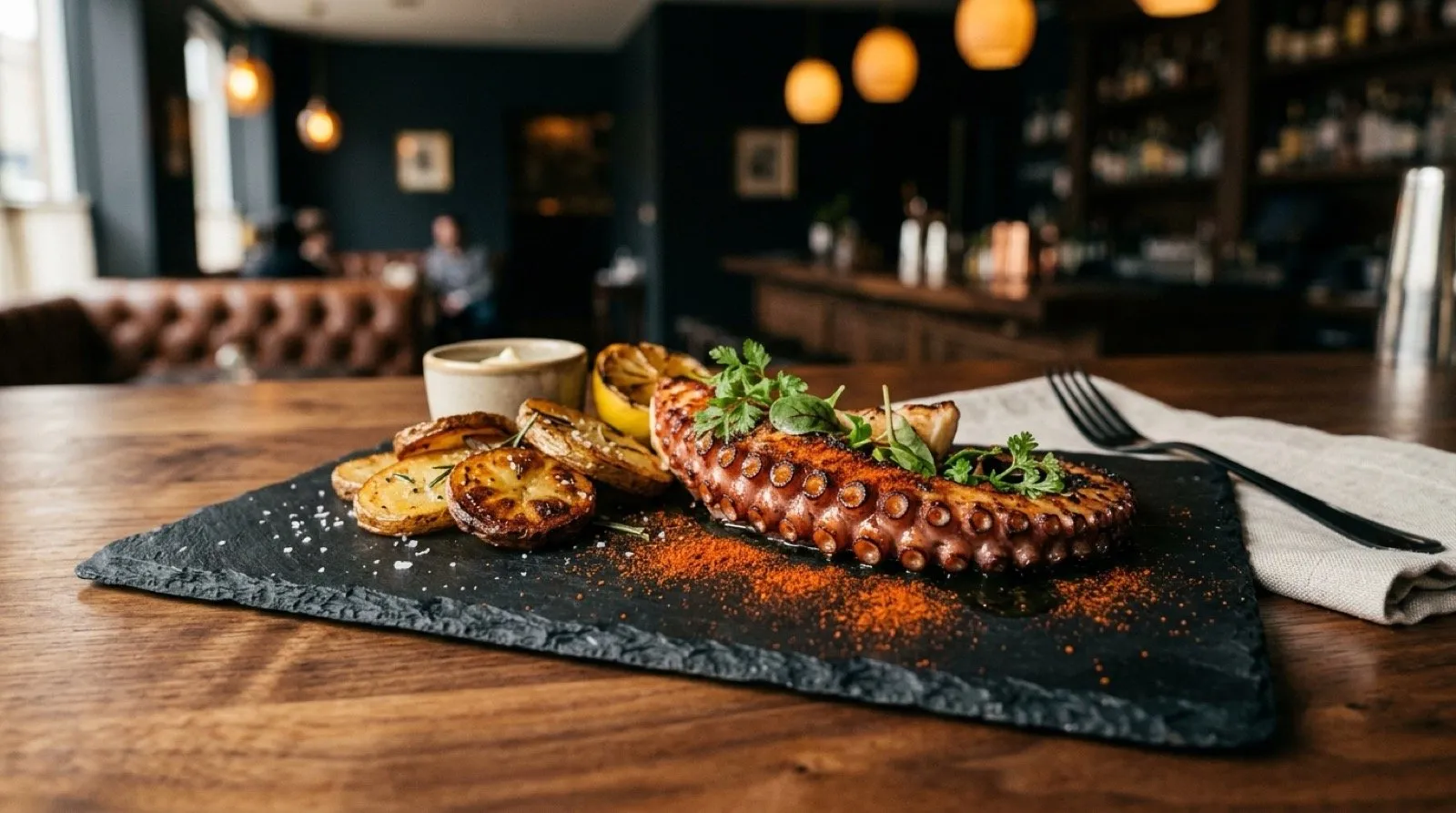
The copper cauldron has been roaring in Madrid’s kitchens for eighty years. The octopus goes into boiling water, comes out, goes back in. Three times. The “asustar” ritual — “scaring” the octopus — repeats itself at every bar, in every home, in every family celebrating with the most Spanish of all dishes, octopus vulgaris. Madrid knows how to cook octopus. Madrid has been doing it the same way for decades. And within that knowledge there is tradition, yes, but also a technical block that nobody dares to break.
Until now.
Why Madrid has cooked octopus the same way for 80 years
Pulpo a la feira is an institution. It was born at Galician fairs, took hold in Madrid’s markets and became the star dish of any menu worth its salt. The technique is simple: salted water, bay leaf, optionally a splash of white wine. Boil for 25 to 30 minutes depending on size. Slice. Add olive oil, paprika, a pinch of flaky salt. Done.
It works. It’s recognisable. The customer orders it, the waiter serves it, everyone’s happy. But there’s a problem nobody mentions: that aggressive cooking destroys part of the octopus’s muscle fibres. Boiling water at 100°C contracts the collagen violently, squeezing part of the flavour out into the cooking liquid and leaving a texture that, let’s admit it, can turn out rubbery in larger or less fresh specimens.
Madrid has lived comfortably with this formula. Traditional restaurants defend it as the only “authentic” way to prepare octopus. Some even publicly criticise any method that strays from boiling water, calling it a “fad” or “conning the customer”. The result is a city where octopus is served the same way everywhere, with minimal variation in presentation but no real innovation in technique.
At STILLROOM we believe tradition deserves respect, but also evolution. So we set out to find an alternative that kept the essence of Galician octopus — its marine flavour, its Atlantic character — but with a texture that unlocked its full potential. The answer lay in a technique that’s been used in fine dining for decades, and that Madrid had yet to adopt for its most iconic dish: low-temperature sous-vide cooking.
Sous-vide applied to octopus: the science of collagen
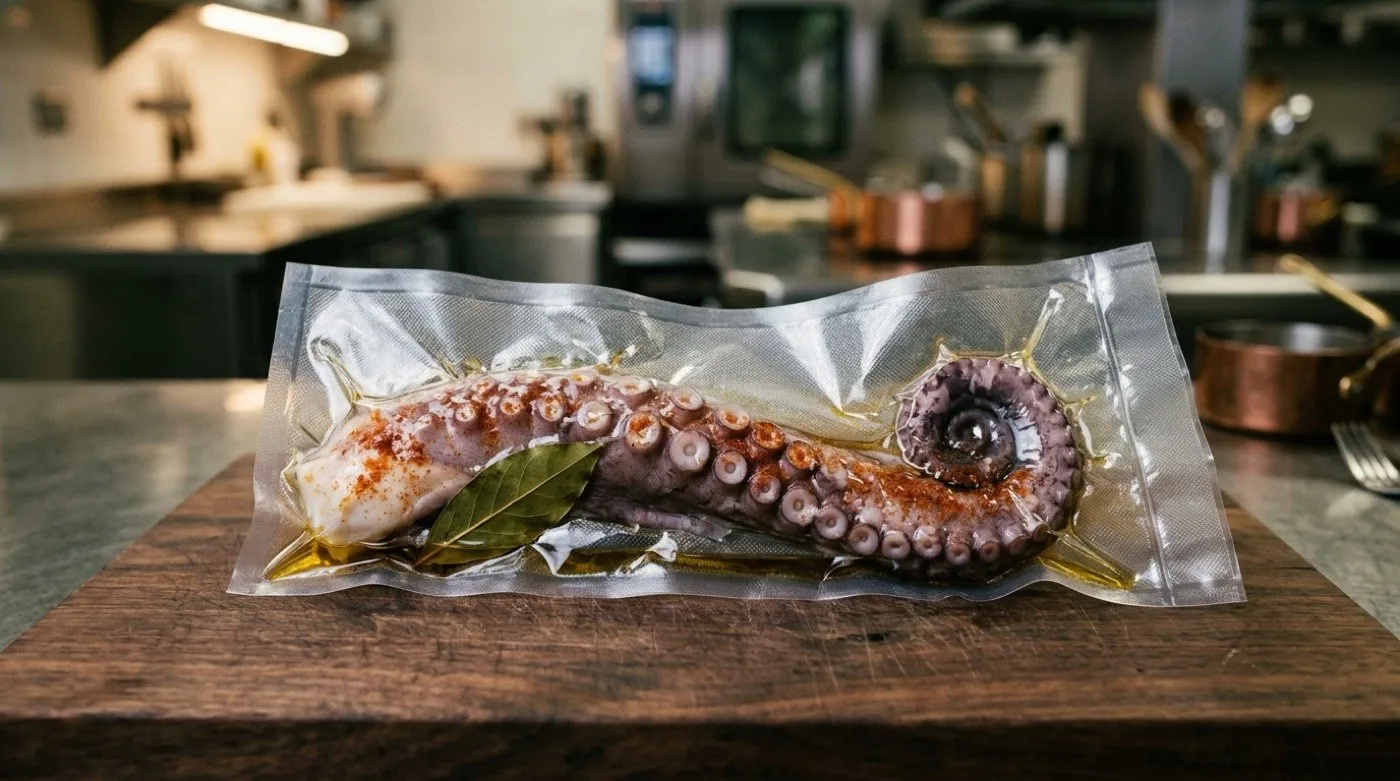
Sous-vide means “under vacuum” in French. It’s a cooking technique that involves sealing food in a vacuum bag and submerging it in a water bath at a controlled, constant temperature. Instead of cooking at 100°C, the octopus is cooked at exactly 77°C for four hours. The difference looks minimal — just 23 degrees less — but the change in the result is dramatic.
The secret lies in how collagen behaves at different temperatures. Collagen is the protein that binds the octopus’s muscle fibres together. Above 80°C, collagen contracts irreversibly, releasing water and causing the flesh to shrink and turn rubbery. Between 60°C and 80°C, however, collagen solubilises gradually, transforming the texture without destroying the fibres. The result is an octopus that holds its shape, with a firm core that still yields to the bite, and that keeps within its cells all the marine flavour that boiling water would otherwise wash out into the broth.
“Between 60°C and 80°C, the octopus’s collagen solubilises gradually and reversibly. Above 80°C the contraction is violent: the fibres expel water, lose structure and the texture turns rubbery. Sous-vide at 77°C is the sweet spot between tenderness and concentrated flavour.” — Thermal principle applied in STILLROOM’s small-plates kitchen
Sous-vide cooking also allows doneness to be controlled with precision. A two-kilo octopus cooked at 77°C for four hours comes out exactly the same in the centre as at the edges. There’s no risk of it being raw inside and overcooked outside. That temperature uniformity is impossible to achieve with a pot of boiling water, where heat travels from the outside in and timing is always approximate.
At STILLROOM we use Ría Galicia octopus weighing over two kilos per piece. Before cooking it, we freeze it for 48 hours at below -20°C. This step is mandatory under health regulations, to eliminate any parasites present in the raw flesh, but it also has a positive side effect: ice crystallisation during freezing breaks down part of the muscle fibres, helping produce a more tender texture once cooked.
Our Sous-Vide Octopus at STILLROOM: from supplier to table
STILLROOM’s Sous-Vide Octopus is a dish that tells the story from the beginning. It starts with a trusted supplier in the Galician rías, an octopus of over two kilos whole, arriving in our kitchen in prime condition. That octopus goes into our blast chiller at 3°C for 48 hours, the time needed to meet regulations and achieve the cell breakdown that improves the final texture.
Once slowly thawed, the octopus is cleaned, dried and placed in a vacuum bag with extra virgin Arbequina olive oil, a bay leaf, La Vera paprika with protected denomination of origin and Maldon sea salt flakes. The bag is sealed and placed in the water bath at exactly 77°C for four hours. The Arbequina olive oil brings fruitiness and a slightly bitter base that complements the seafood’s salinity. The La Vera paprika adds the smoky touch that connects with tradition, and the bay leaf lends aromatic complexity without overpowering the octopus’s flavour.
After the four hours, the octopus comes out of the bath and goes back into the blast chiller at 3°C to stop the cooking immediately. This blast-chilling step is crucial: it cools the product without thermal shock, allowing the fibres to stabilise at their optimal point. The cooked octopus can be kept like this for up to 72 hours, which lets us always have the dish ready without needing to cook to order.
Reference parameters for the dish (not the exact recipe, which stays ours):
- Octopus origin: Ría de Galicia, whole piece over 2 kg
- Prior freezing: 48 h at -20°C (mandatory by regulation + textural improvement)
- Vacuum cooking: approximately 77°C for 4 hours in a sealed bag
- Aromatics in the bag: Arbequina extra virgin olive oil, bay leaf, La Vera PDO paprika, Maldon salt
- Blast chilling: 3°C after cooking to stabilise the fibres
- Regeneration: MyChef rapid radiant oven + blowtorch finish
- Garnish: Kennebec potato gratinated in the same oven
- Finish: raw Arbequina extra virgin olive oil + a dusting of smoked paprika
- Portion: whole tentacle, 320-350 g
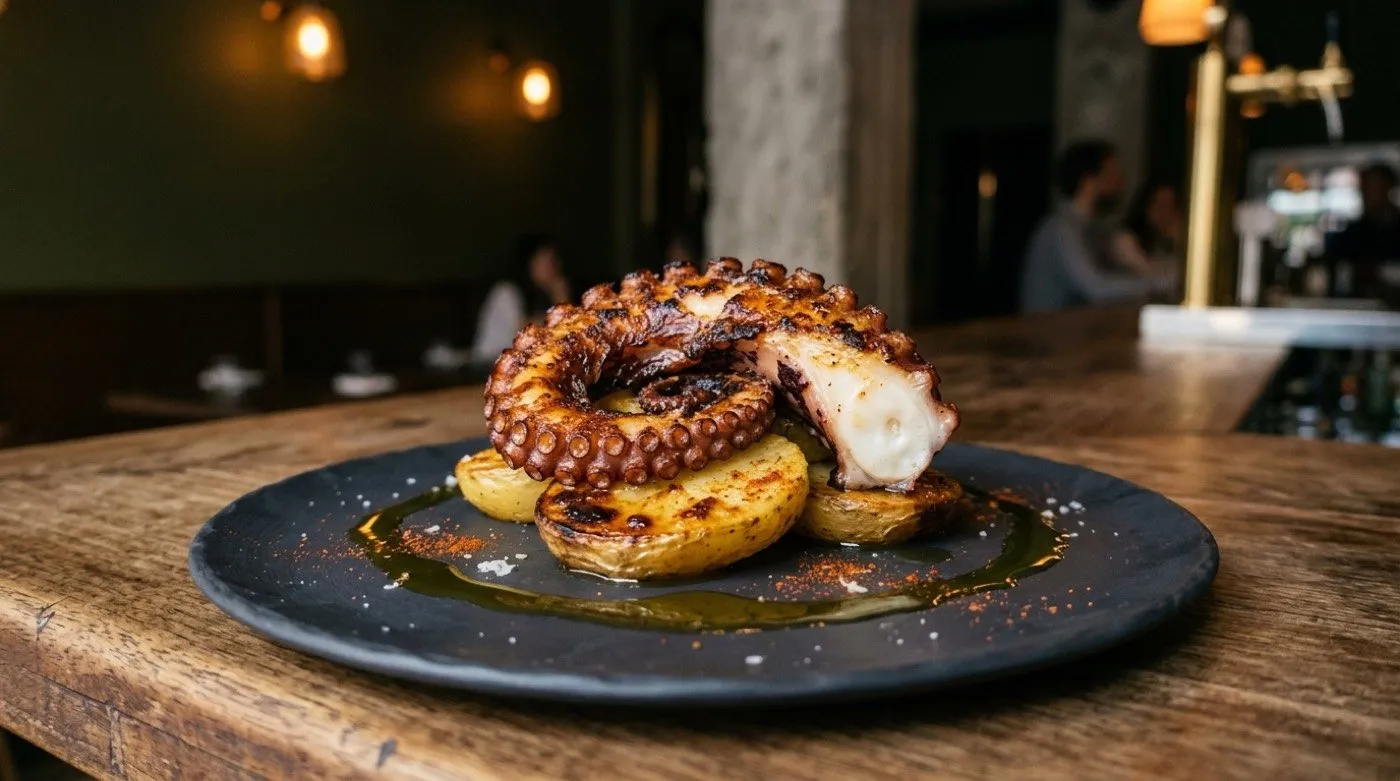
At the moment of service, we cut the octopus into individual tentacles of between 320 and 350 grams. Each tentacle is regenerated for a few seconds in the MyChef rapid radiant oven and gets a final blowtorch touch, just enough to create a golden crust with a Maillard reaction without overcooking the inside. The heat penetrates only a few millimetres, leaving the centre of the tentacle at its exact sous-vide cooking point.
The dish is served with Kennebec potato, an American variety with red skin and white flesh that brings a floury texture, perfect for soaking up the oil and paprika. The potatoes are cut into thick slices and gratinated in the same rapid radiant oven. The whole plate is finished with a drizzle of raw Arbequina extra virgin olive oil and a pinch of smoked paprika. The result is an octopus that looks like the one you already know, but tastes of more: more marine, more tender, more complex.
Regeneration in the rapid radiant oven and blowtorch: the finish that changes everything
Sous-vide cooking solves the problem of the interior texture. But if we simply served the octopus straight from the bag to the plate, we’d be missing a fundamental dimension of flavour: the Maillard reaction. This chemical process, which happens when amino acids and sugars bond at high temperatures, is responsible for the characteristic flavour of browned foods. Toasted bread, roasted coffee, the crust on a steak — they all owe their flavour to the Maillard reaction.
In traditional octopus cooked in boiling water, this reaction never happens. The octopus stays pale, without a crust, its flavour depending entirely on what’s added afterwards: the oil, the paprika, the salt. It’s a decent flavour, but a flat one. At STILLROOM we add a regeneration step in the MyChef rapid radiant oven, finished with a blowtorch touch, to unlock that missing dimension.
The regeneration is brief. A few seconds in the rapid radiant oven, followed by a pass of the blowtorch over the surface of the tentacle. The goal isn’t to cook the octopus — it’s already cooked — but to brown the surface. The combination of both techniques creates a crisp layer barely two millimetres thick that contrasts with the unctuous interior. It’s a textural contrast that traditional octopus doesn’t have, turning every bite into a two-part experience: first the soft, flavourful texture of the inside, then the aromatic intensity of the crust.
The blowtorch brings a very subtle note of controlled smoke on the surface, which integrates with the olive oil. The dish’s smoky depth comes from the La Vera PDO paprika, not from any combustion of our own: that’s the characteristic smokiness of Spanish cuisine that defines the character of the small plate, without turning it into a run-of-the-mill smoked octopus. It’s the same principle of controlled layering that we apply in our advanced cocktail techniques, when we use tools such as fat washing to infuse complex flavours into our drinks.
Pairings with STILLROOM’s signature cocktails
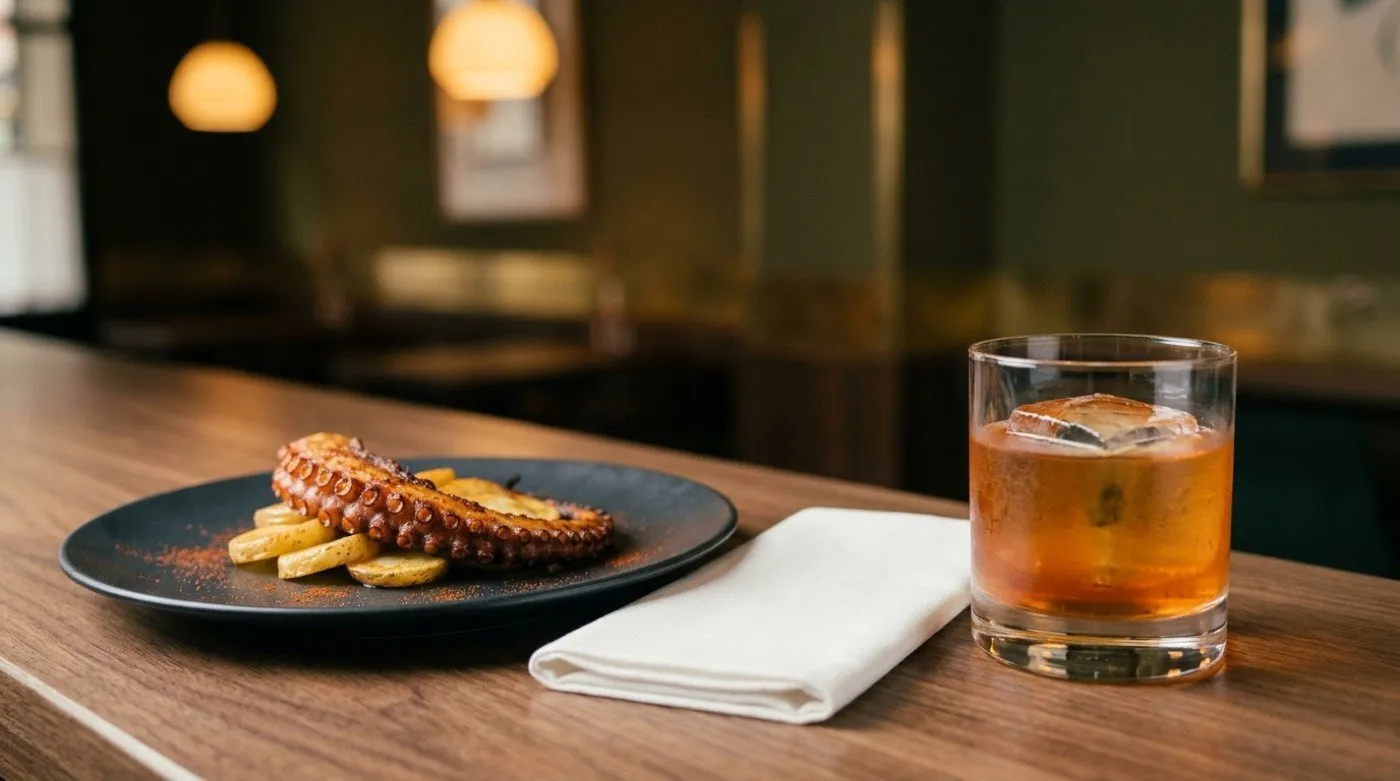
A dish of this complexity deserves a drink to match. At STILLROOM we’ve designed specific pairings that complement the characteristics of the Sous-Vide Octopus: its soft texture, its concentrated marine flavour, its smoky paprika note and the Maillard crust of the final finish.
The first recommended pairing is the Mediterráneo, a reinvented gin and tonic made with gin, infused oregano and artisan tonic. The oregano connects with the dish’s Mediterranean character and brings a herbal note that cuts through the octopus’s richness. The artisan tonic, with its citrus notes, cleanses the palate between bites and readies the next one with freshness.
For those who prefer something more structured, the Garibaldi Fermentado is an exceptional choice. This cocktail, which you can discover in depth in our article on lacto-fermentation in cocktail making, is made with fermented orange, bringing acidic depth and a complex profile that pairs perfectly with the octopus’s maritime notes. You’ll find the Garibaldi Fermentado in detail on our cocktail menu.
If you’re after a bolder contrast, the mezcal Punch offers a different experience. The mezcal, with its natural smokiness and earthy profile, speaks to the smoky note of the La Vera paprika and the Maillard crust on the octopus, creating a sense of harmony between the dish and the drink. It’s a pairing for those who enjoy intense flavours and aren’t afraid of a bit of power.
All of these cocktails are part of our cocktail menu, where every drink is designed to complement our food offering. Our bartending team can recommend the perfect pairing for your taste, whether you’re after something classic or want to explore more innovative combinations.
Sous-vide vs traditional Galician: comparing texture, flavour and shelf life
The question we’re asked most often is: what really sets the Sous-Vide Octopus apart from traditional pulpo a la feira? The answer goes beyond technique and touches on texture, flavour and even shelf life — points that deserve a detailed comparison.
| Aspect | Traditional octopus (boiling water) | STILLROOM Sous-Vide Octopus |
|---|---|---|
| Cooking temperature | 100°C (boiling water) | ≈ 77°C (controlled immersion bath) |
| Time | 25-30 minutes | 4 hours |
| Collagen behaviour | Violent contraction, fibres expel water | Gradual solubilisation, fibres intact |
| Resulting texture | Variable, can turn rubbery in larger pieces | Uniform edge to edge, firm but yields to the bite |
| Flavour | Some flavour migrates into the cooking liquid | Concentrated marine flavour stays in the dish |
| Surface finish | No crust, flavour depends on final seasoning | Maillard crust (rapid radiant oven + blowtorch) |
| Shelf life after cooking | Immediate consumption, loses quality on cooling | Up to 72 h, sealed and blast-chilled |
| Madrid today | The norm in traditional octopus houses since the 1960s | Available at STILLROOM (Calle Moreto 9, Los Jerónimos) |
In terms of texture, traditional octopus cooked in boiling water has a variable consistency. Smaller specimens tend to come out tender, but larger ones can turn rubbery, especially at the centre of the tentacle, where heat takes longer to penetrate. The “asustar” technique — dunking the octopus in and out of the boiling water — helps contract the flesh, but doesn’t solve the problem of uneven cooking. The Sous-Vide Octopus, by contrast, guarantees a uniform texture edge to edge. The inside of the tentacle is cooked to the same point as the outside, and the controlled temperature of 77°C keeps the fibres at their optimal point of tenderness: firm but not rubbery, soft but with body.
When it comes to flavour, traditional octopus loses part of its intensity into the cooking water. Although the resulting broth is tasty, that richness never makes it back to the plate. The octopus we eat ends up somewhat diluted, relying on the seasonings added afterwards to deliver flavour. The Sous-Vide Octopus, cooked at low temperature and vacuum-sealed with olive oil, bay leaf, paprika and salt, keeps all the seafood’s natural juices inside the bag. The result is an octopus with more concentrated flavour: more marine, more intense. The Arbequina extra virgin olive oil added during cooking infuses the flesh with extra fruitiness that integrates with the octopus’s natural flavour.
As for shelf life, traditional octopus needs to be eaten straight away. Once cooked and cooled, it starts losing texture and flavour. The Sous-Vide Octopus, by contrast, stays in optimal condition for up to 72 hours after cooking, thanks to vacuum sealing and blast-chilling. This allows for more precise kitchen planning and guarantees that the dish reaching your table is always at its exact point — never reheated, never past its best.
Regeneration in the rapid radiant oven, finished with a blowtorch touch at the moment of service, adds the crisp texture element that traditional octopus doesn’t have. It’s the only way to achieve that contrast between the juicy interior and the golden crust without resorting to frying or finishes that would add unnecessary fat.
If you’d like to try the Sous-Vide Octopus, you can book a table on our website. We’re on Calle Moreto 9, in the heart of the Jerónimos neighbourhood, a few steps from the Museo del Prado. We open Wednesday and Thursday from 11:00 to 19:00, Friday and Saturday from 11:00 to 15:00 and 19:00 to 01:30, and Sunday from 11:00 to 23:00 without a break; we’re closed on Monday and Tuesday. We look forward to showing you that octopus can be different.
Frequently asked questions
What makes sous-vide octopus different from the traditional Galician method?
The main difference lies in the cooking technique. Traditional octopus is cooked in boiling water at 100°C for 25-30 minutes, which contracts the muscle fibres aggressively and can result in a rubbery texture. STILLROOM’s Sous-Vide Octopus is cooked at 77°C for four hours in a vacuum bag with Arbequina olive oil, La Vera paprika, bay leaf and Maldon salt. This lower temperature respects the octopus’s fibres, preserving its structure and concentrating the marine flavour. The final regeneration in a MyChef rapid radiant oven, finished with a blowtorch, adds a golden crust with a Maillard reaction that brings an aromatic complexity the traditional method simply doesn’t have.
Can I make sous-vide octopus at home without professional equipment?
Roughly speaking, yes, though with obvious limitations. Prolonged low-temperature cooking needs precise immersion equipment — an immersion circulator or, failing that, a large pot and a good thermometer — plus vacuum bags. The final finish needs a very localised, intense heat source to achieve the surface browning without overcooking the interior. The difference with STILLROOM’s version, where we combine professional sous-vide, a rapid radiant oven and a blowtorch with a protocol refined over months, is noticeable in texture, uniformity and aroma. If you want to try the full result, the best option is to book a table at our venue on Calle Moreto 9.
Which cocktail pairs best with the octopus on the STILLROOM menu?
Our main recommendation is the Mediterráneo, a gin with infused oregano and artisan tonic that brings herbal freshness and cleanses the palate between bites. For those after more complexity, the Garibaldi Fermentado — a cocktail made with lacto-fermented orange — offers a deep, acidic profile that complements the octopus’s maritime notes. If you prefer a bolder contrast, the mezcal Punch connects with the smoky note of the La Vera paprika and the Maillard crust on the finished octopus. All of these cocktails are available on our cocktail menu, and our team can put together the perfect pairing for your taste.
What comes with our Sous-Vide Octopus?
It includes a whole octopus tentacle weighing between 320 and 350 grams, cooked sous-vide at 77°C for four hours and finished with a quick pass through the MyChef radiant oven plus a blowtorch touch at the moment of service. The dish is served with Kennebec potato gratinated in the same oven, a drizzle of raw Arbequina extra virgin olive oil and smoked La Vera PDO paprika. It’s a generous portion that can be shared between two people as part of a broader tasting experience, or enjoyed solo as a main dish.
Where does the octopus come from, and why is it frozen for 48 hours?
The octopus comes from the Galician rías, specifically from suppliers specialising in top-quality octopus vulgaris. Each piece is over two kilos, which guarantees a generous size on the final plate. Freezing for 48 hours at below -20°C is a mandatory step under health regulations, to eliminate any parasites present in the raw flesh. This process has an added benefit: ice crystallisation during freezing breaks down part of the muscle fibres, resulting in a more tender texture once cooked. After slow thawing, the octopus is ready for sous-vide cooking.